Aggregation
Some prices should not move with the market
Not every instrument wants a live venue quote behind it. A stablecoin at parity, an administered rate or an internal transfer price needs to publish a fixed number reliably, and keep publishing it when the venues behind everything else go quiet.
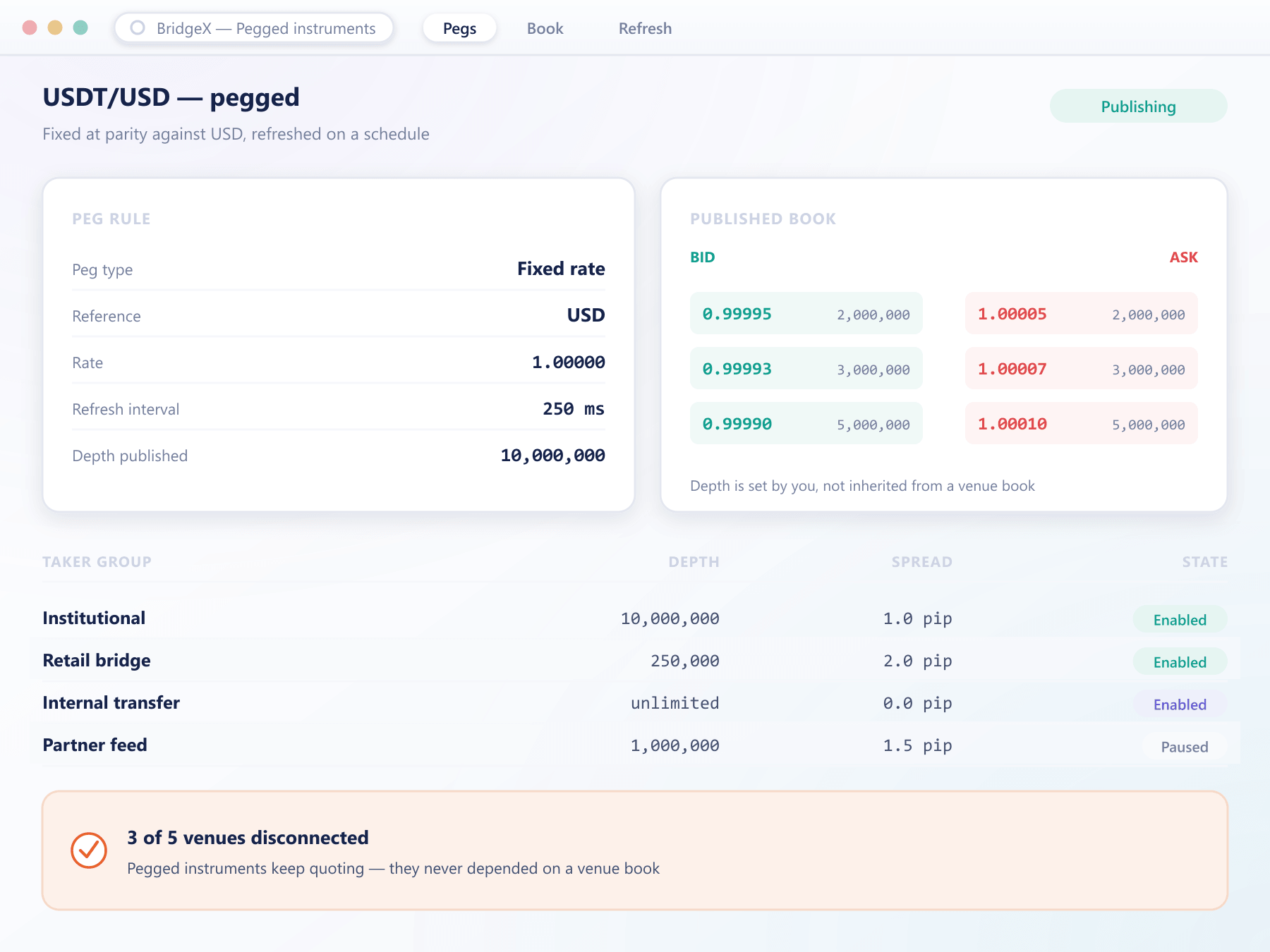
What pegging gives you
A quote you control rather than one you receive
A pegged instrument is priced against a rule you define instead of an order book, while still behaving like a normal instrument to every taker.
Fixed against another instrument
Price one instrument at a set rate relative to another the hub already carries, so a peg moves only when you decide it should.
Published continuously
The book refreshes on a schedule rather than waiting for a venue tick, so a pegged instrument never goes stale for lack of market activity.
Depth you define
Because there is no venue book to inherit, the size available at the pegged price is set by you per taker group.
Changed without a restart
Adjusting a peg is a configuration change that takes effect on the next refresh, not a redeployment of the instrument.
Isolated from venue failure
A pegged instrument keeps quoting when the venues behind your live instruments disconnect, because it never depended on them.
How it runs
From rule to published book
Define the peg
Choose the reference instrument and the fixed relationship, or set an absolute rate where there is no reference.
Set the book
Decide the depth and the size bands published at that price, per taker group if they should differ.
It publishes on schedule
The hub refreshes the book at the interval you set so downstream systems see a live, current quote.
Monitored like any instrument
Quote age, taker subscriptions and fills are tracked the same way, so a peg is not a blind spot in monitoring.
Pegging questions
When to peg and when not to
4 short answers to what teams ask before a demo.
Instruments where a market price is the wrong answer: a stablecoin you treat as parity, an administered rate, or an internal transfer price between books. Anything with a real two-sided market should not be pegged.
Yes, and more than a routed one. You are quoting a price no venue is obliged to honour, so the exposure sits with you. Depth limits per taker group exist for exactly that reason.
Yes. It can be set at a fixed relationship to a reference instrument the hub prices, so it tracks that reference while staying independent of its own venue availability.
The peg holds its last computed rate and continues publishing, because the alternative is dropping a quote that your clients treat as always available. Monitoring flags it so the decision to intervene is yours.
Still have a question?
A specialist will answer it directly, with your set-up in mind.
Ask a specialistTell us which instruments should not float
Bring the rates you administer and we will configure them as pegs on a live hub so you can see the published book.