For Liquidity Providers
Publishing a price should not mean accepting every order
A stream needs protection: how fast a taker may hit it, how long a quote stays valid, and what happens when one counterparty’s behaviour stops resembling the relationship you agreed.
Controls — one taker
Per relationshipRequest rate
- Capped per interval
Quote validity
- Short window
Rejection threshold
- Narrow, then suspend
Scope
- Per instrument
The same stream, published to another taker on entirely different settings.
See it live
Keys, scoped and rate-limited per taker
Each taker’s API access is a key with its own rate limit, visible alongside every other credential you have issued.
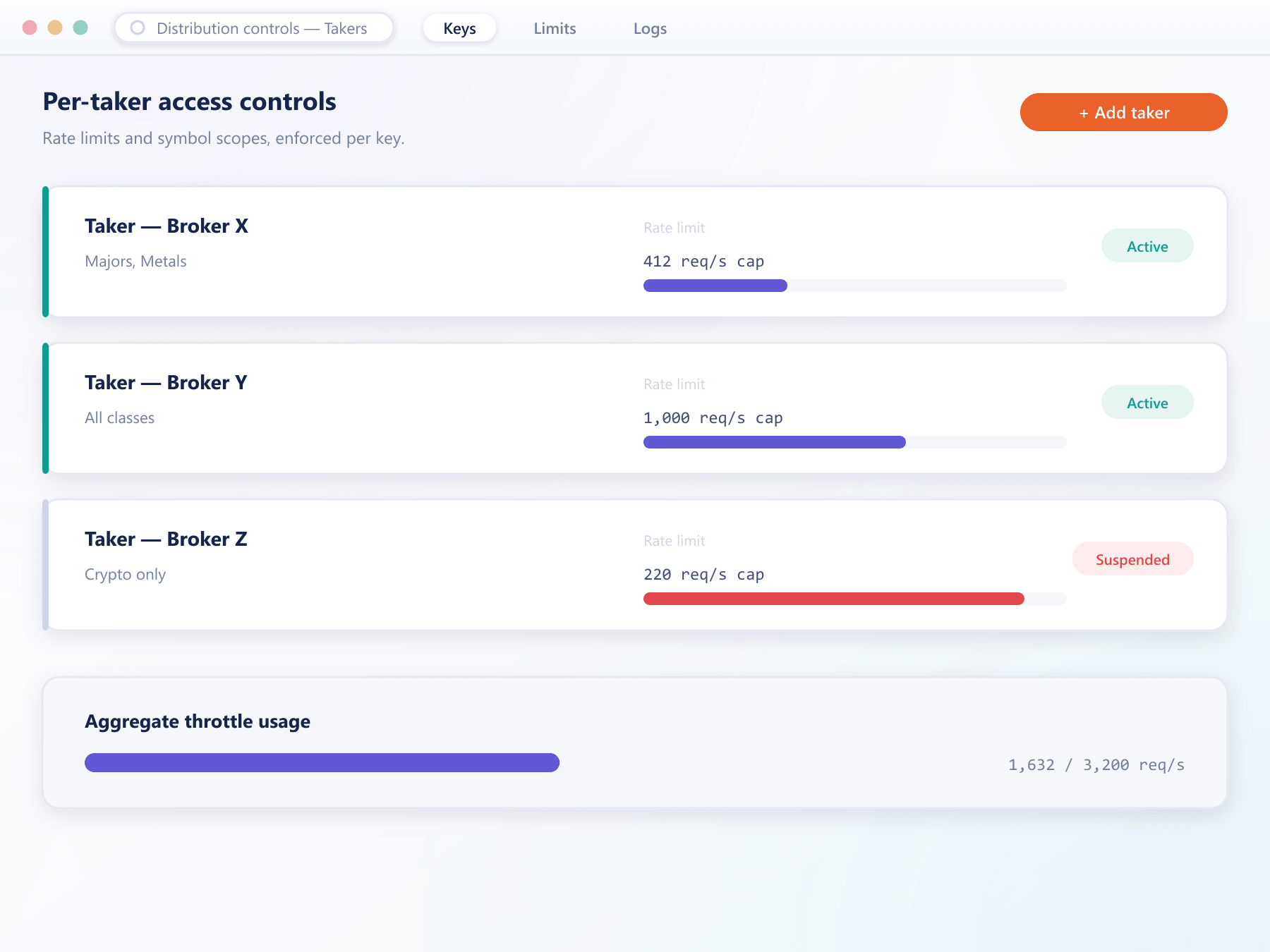
The protections available per taker
The right setting for a bank and for an aggressive prop desk are not the same
Request rate limits
A cap on order submissions per interval per taker, which contains a malfunctioning or overly aggressive client without affecting anyone else.
Quote validity window
How long a published quote remains executable. Orders arriving against an expired quote are rejected with that reason stated.
Rejection thresholds
Where a taker's rejection rate or behaviour crosses a configured threshold, their stream can be automatically narrowed or suspended.
Instrument-level controls
Limits can differ per instrument within a relationship, so a thin symbol carries tighter protection than a liquid one.
Recorded actions
Every automatic narrowing, suspension and restoration is written to the event log with the trigger that caused it.
Protecting a stream in practice
The controls run continuously and act before a person would notice a pattern
- Publish
The stream goes out on their terms
The taker receives their entitled instruments at their agreed markup, with validity and rate limits attached to the relationship.
- Guard
Every request checked
Rate, quote age and instrument scope are validated on each order before it reaches matching, with a specific rejection reason returned.
- React
Behaviour outside the agreement
Sustained threshold breaches narrow the stream or suspend it, which protects the book without requiring an immediate human decision.
- Review
The pattern is visible afterwards
The event log shows what triggered each action, which is what turns a difficult conversation with a counterparty into a factual one.
What the controls preserve
The point is to keep publishing a good price, which means not being picked off while doing it.
A stream you can afford
Validity windows and rate limits keep the cost of publishing predictable.
Contained bad actors
One aggressive counterparty is throttled without narrowing the price for everyone.
Automatic response
Thresholds act at machine speed rather than waiting for someone to spot a pattern.
Evidenced conversations
A recorded trigger makes a commercial discussion about behaviour straightforward.
FAQ
Distribution controls: common questions
5 short answers to what teams ask before a demo.
Yes, and they generally should. Rate limits, quote validity and thresholds are properties of the relationship, so a bank and an aggressive prop desk can be treated quite differently.
How long a published quote remains executable. An order arriving against a quote older than that window is rejected with the reason stated, which protects you from being traded on a price the market has already left.
Depending on configuration, their stream is narrowed or suspended automatically. The trigger, the action and the restoration are all written to the event log.
No. Limits are applied per relationship, so containing one counterparty's behaviour has no effect on what anyone else receives.
Yes, after a configured period of the behaviour returning to normal. Restoration is recorded in the same way as the suspension.
Still have a question?
A specialist will answer it directly, with your set-up in mind.
Ask a specialistReview your stream protection
Bring a counterparty relationship that has been difficult and we will configure controls that address it.