Execution
Retaining flow is a decision, and it needs a limit
Warehousing is the most profitable execution model and the one that ends desks. The difference is entirely in whether the exposure limits are real and whether the unwind triggers actually fire.
Net exposure — EUR/USD
Within limitsCurrent
52% of capWarning at
72% of capUnwind at
92% of capIllustrative thresholds. Caps and triggers are configured per instrument.
See it live
The book’s health, in one view
A margin-health gauge alongside the equity behind each retained position, so the distance to a cap is never a figure someone has to calculate.
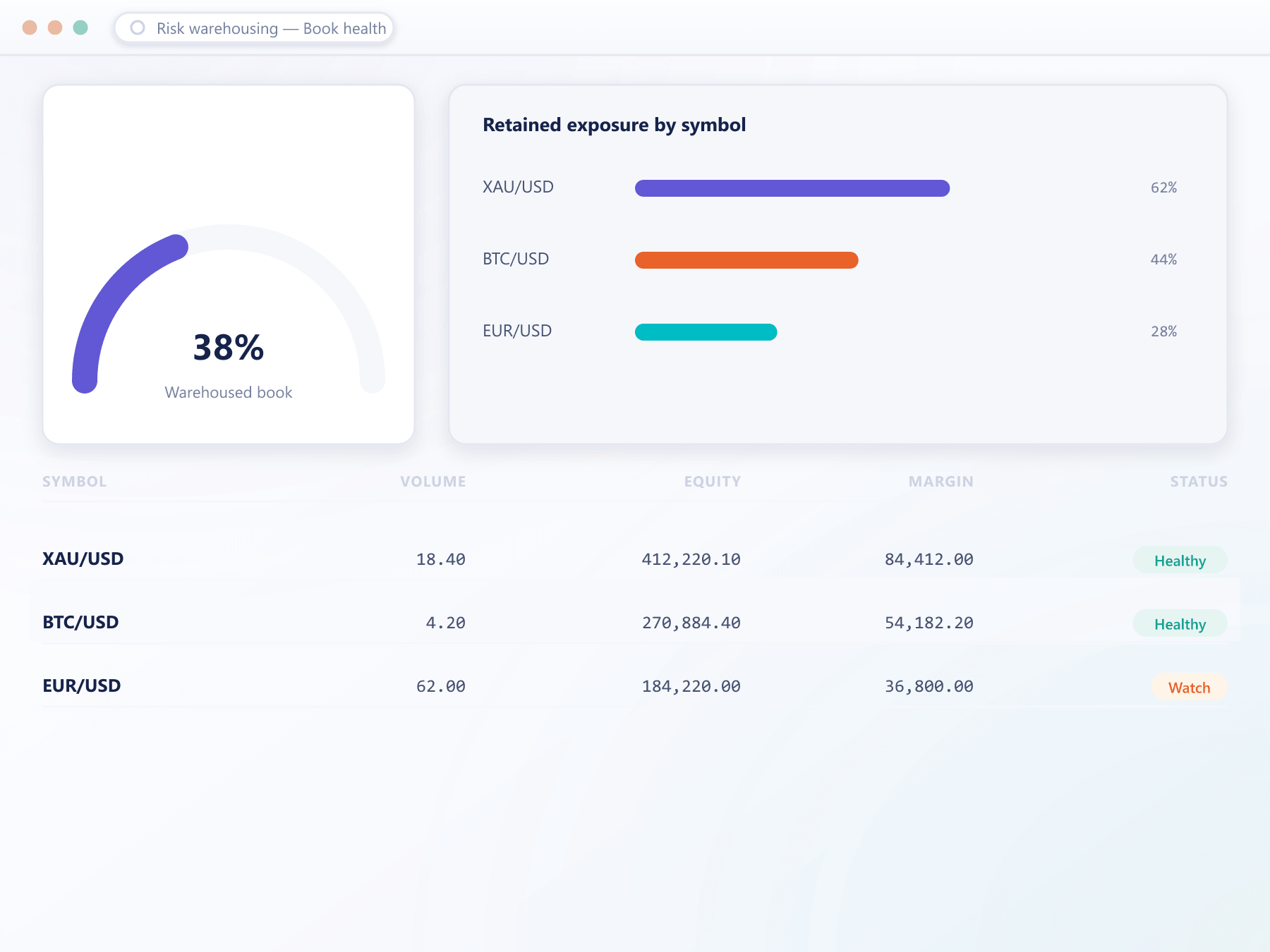
What makes warehousing survivable
Every one of these exists to stop a profitable strategy from becoming an incident report
Live net exposure
Net and gross exposure per instrument and asset class update on every fill, with the counterparties contributing most identified.
Enforced in the engineHard caps
Per-instrument and aggregate exposure caps are enforced in the engine. Flow that would breach a cap is routed out instead of retained.
Enforced in the engineAutomatic unwind
Crossing a configured threshold triggers hedging of the excess without waiting for a person to notice and act.
Enforced in the engineTime-based limits
A position can be capped by age as well as size, so exposure taken intraday does not quietly become an overnight position.
Enforced in the engineAttributed result
Warehousing profit and loss is reported separately from markup and spread, so the return on risk is visible rather than blended away.
Enforced in the engineFrom retained fill to unwound position
The controls run continuously, not on a scheduled sweep
- 01Retain
The fill stays on your book
The client is filled and no external order is placed. The resulting exposure is added to your net position for that instrument immediately.
- 02Measure
Exposure recalculated per fill
Net and gross exposure, and the distance to each configured cap, are recomputed on every fill and every price update.
- 03Warn
Alerts before the cap
Approaching a cap raises an alert into your operational channels while there is still room to act deliberately.
- 04Unwind
The excess is hedged automatically
At the trigger threshold, the amount above it is hedged through the normal routing path, and the hedge is linked to the exposure that caused it.
What controlled warehousing produces
The revenue is real. So is the risk, which is why the controls matter more than the strategy.
No execution cost
Retained flow costs nothing to execute, which is the whole commercial argument.
Risk you agreed to
Caps enforced in the engine mean exposure cannot exceed what your risk committee approved.
No overnight surprises
Time-based limits stop intraday risk from becoming a position nobody decided to hold.
Measurable return
Separate attribution answers whether warehousing is actually paying for its risk.
FAQ
Risk warehousing: common questions
5 short answers to what teams ask before a demo.
On every fill and every price update for the instrument. There is no scheduled sweep, which is what keeps a fast move from breaching a cap before anything reacts.
It is routed out rather than retained. The cap is enforced at the point of decision, so warehousing simply stops for that instrument until exposure falls back.
Automatic at the configured trigger. The excess above the threshold is hedged through the normal routing path without waiting for someone to notice, and an alert is raised at the same time.
Yes. Positions can be capped by age as well as by size, which prevents exposure taken during the session from silently becoming an overnight holding.
Warehousing result is reported as its own line, separate from markup and spread. That makes it possible to compare the return against the risk taken rather than assuming it is positive.
Still have a question?
A specialist will answer it directly, with your set-up in mind.
Ask a specialistSet your exposure limits with us
Bring your risk appetite and we will configure caps, warnings and unwind triggers on a live environment.