Developers
A test environment that fails the way production does
A sandbox that only ever succeeds teaches an integration nothing. This one simulates declines, timeouts, rejected documents and partial payments, because those are the paths that break in production.
Failures you can trigger on demand
What the sandbox actually gives you
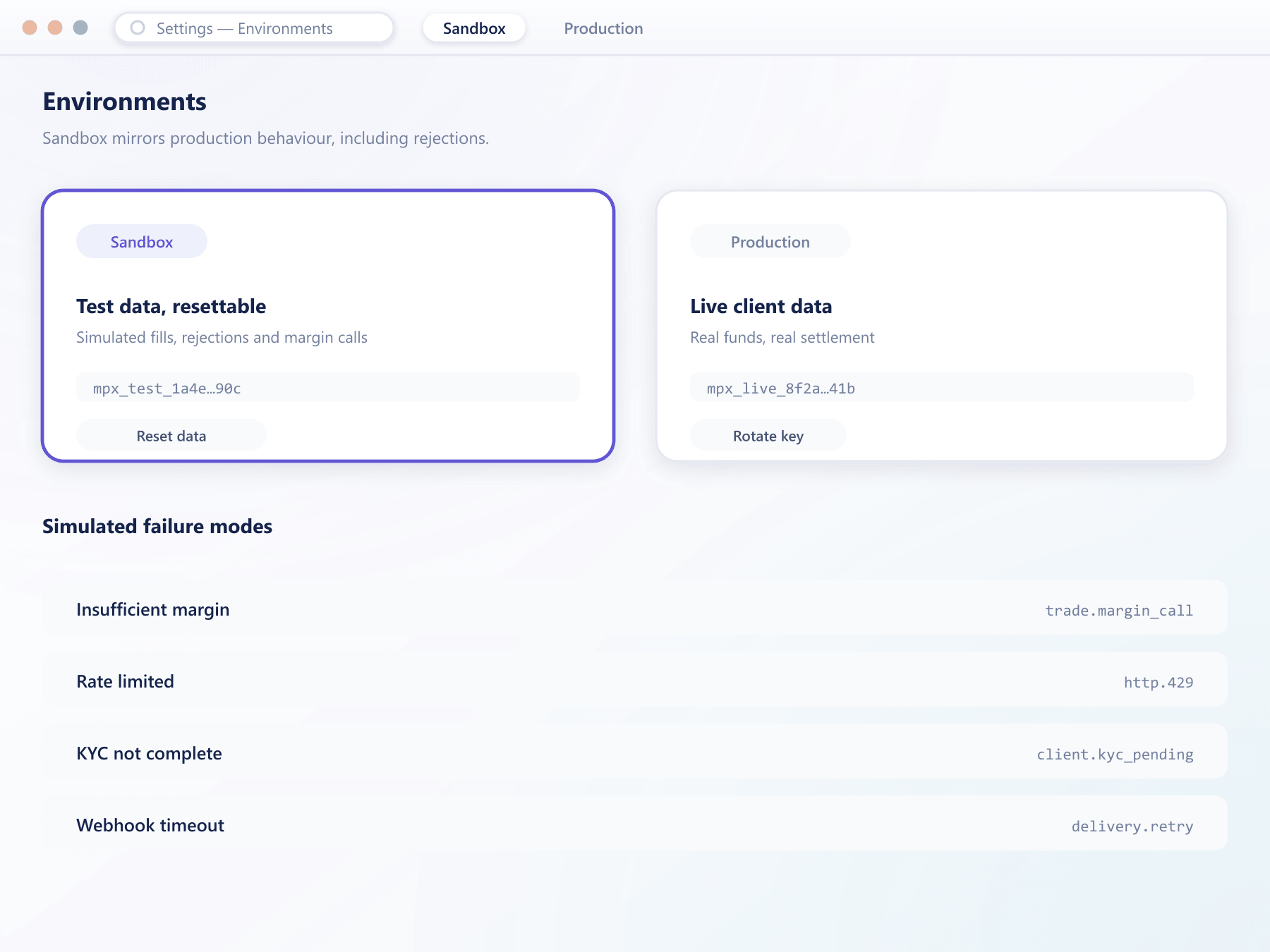
The failure simulation is the part that matters
Separate state
The sandbox shares no data with production. Test clients, balances and transactions cannot leak into your live book.
Simulated provider responses
Payment declines, timeouts, verification rejections and partial settlements can all be triggered deliberately.
Seeded test data
Clients at each verification tier, funded accounts and historical transactions are available without constructing them by hand.
Configuration promotion
Client groups, limits and templates validated in the sandbox are promoted to production rather than being re-entered.
Same API surface
Endpoints, request shapes, responses and error semantics are identical, so nothing surprises you at go-live.
See it live
A key scoped to sandbox, not production
Test credentials carry their own scopes and rate limits, so integration work never touches a real client or a real balance.
From development to production
The promotion step is what stops configuration drifting between environments
- 1Build
Against seeded data
Development works against test clients that already exist at each verification tier, so no time goes into constructing fixtures.
- 2Break
Trigger the failure paths
Provider declines, timeouts and rejections are triggered on demand, which is the only way to test the paths that matter.
- 3Validate
Configuration proven here first
Client groups, limits, templates and rules are set up and exercised in the sandbox before they are used anywhere real.
- 4Promote
Moved, not re-keyed
Validated configuration is promoted to production as a unit, which removes the transcription errors that manual re-entry produces.
What proper environments prevent
Almost every go-live incident is something that was never tested because it was hard to trigger.
Fewer go-live surprises
Failure paths exercised in advance stop being discovered by clients.
No configuration drift
Promotion rather than re-entry keeps environments genuinely aligned.
Safe experimentation
New rules and templates can be tried without any risk to the live book.
Faster integration
Seeded data removes the setup work that usually precedes any real testing.
FAQ
Environments: common questions
5 short answers to what teams ask before a demo.
Yes. They share no data. Test clients, balances and transactions exist only in the sandbox and cannot appear in your live book under any circumstance.
Yes. Declines, timeouts, partial settlements and provider errors can be triggered deliberately, which is the only reliable way to test the handling that matters most.
By promotion. Client groups, limits, templates and rules validated in the sandbox are moved as a unit rather than re-entered by hand, which removes transcription errors.
Yes. Endpoints, request shapes, responses and error semantics match production exactly, so moving over changes only the credentials and the base URL.
Yes, and we encourage it. Working the queues against seeded data is the most effective training available before go-live.
Still have a question?
A specialist will answer it directly, with your set-up in mind.
Ask a specialistGet sandbox access
We can provision a sandbox for your team to work against before any commercial commitment.