Compliance
Screening that happens before money moves
Clients are screened at onboarding and rescreened on a schedule. Transfers are screened before they complete. Everything above your threshold enters a review queue with the provider’s reasoning attached.
Open case
Held- Subject
- Withdrawal · Client 4021
- Provider score
- Above threshold
- Reasoning
- Name match, medium confidence
- Transfer state
- Held, not executed
Nothing completes while the case is open
Where screening applies
Screening only once, at onboarding, is the most common gap in a compliance programme
Onboarding checks
Sanctions, PEP and adverse media screening run as part of verification rather than as a review afterwards.
Ongoing rescreening
Existing clients are rescreened on a schedule, because a list changing is precisely the event a one-time check misses.
Transfer screening
Deposits and withdrawals are screened before completion, with the transfer held rather than reversed afterwards.
Configurable thresholds
The score at which a case is held for review is set per client group and per transfer type, so the policy can be proportionate.
Recorded decisions
Every release or rejection carries the operator, the reason and the provider's reasoning, which is exactly what a review examines.
See it live
A hold, not a headline
While a flagged transfer waits for review, the client sees only a pending status — the screening detail stays with your operators.
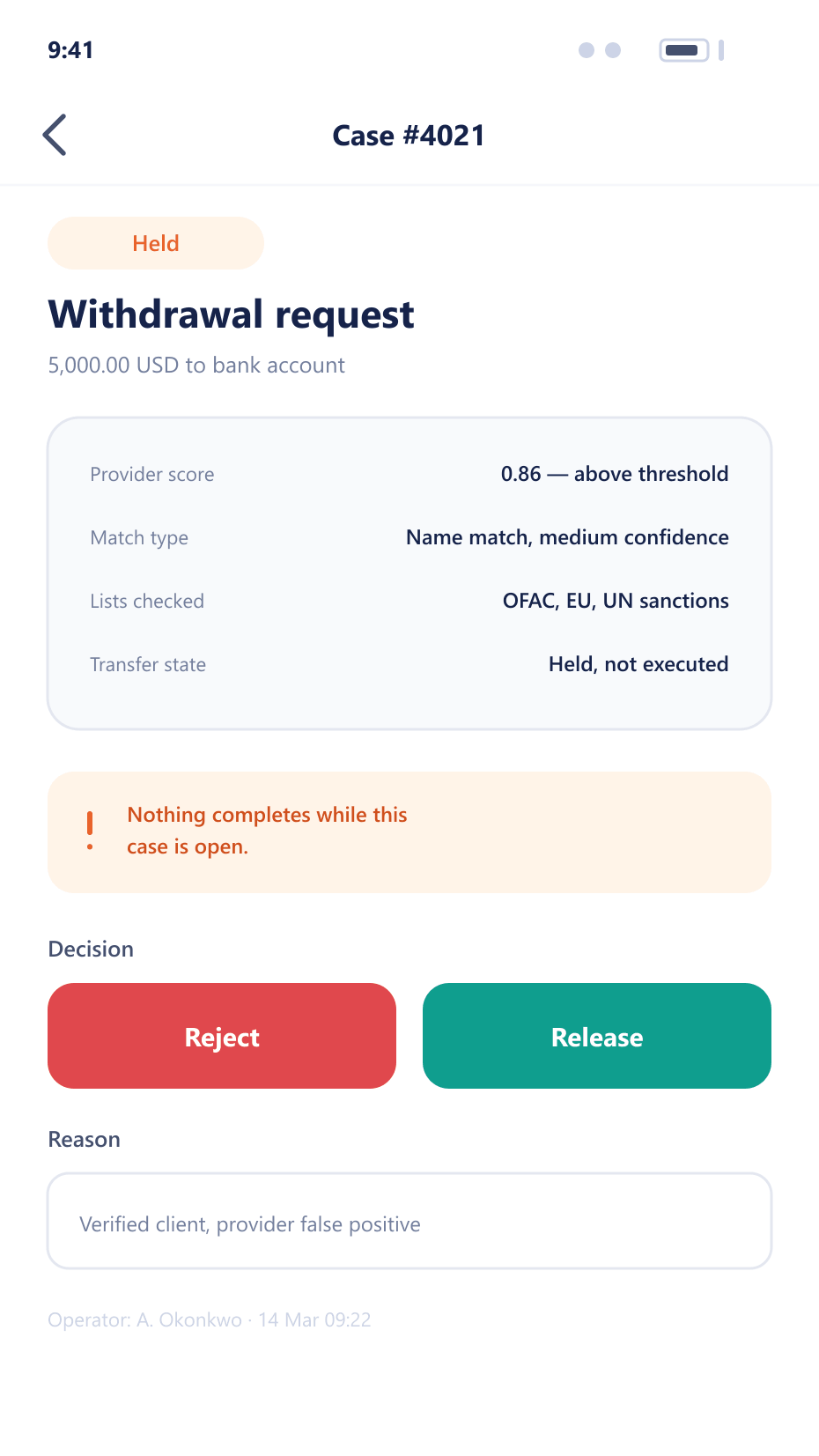
A case through screening
The important property is that nothing completes while a case is open
- Submit
Sent before completion
The client or transfer details are submitted to your screening provider before onboarding finishes or the transfer executes.
- Score
Result and reasoning stored
The provider returns a score with its reasoning, and both are stored against the client or transfer permanently.
- Hold
Above threshold, nothing proceeds
A case above the threshold is held and queued. The client or the transfer stays in a pending state rather than completing and being unwound.
- Decide
With a recorded reason
An operator releases or rejects, and the decision, the reason and their identity are written to the case and the audit log.
Why in-path screening is different
Screening after the fact tells you about a problem you already have.
Prevented, not reported
A transfer held before completion is a decision you still control.
Ongoing coverage
Rescheduled screening catches clients whose status changes after onboarding.
Proportionate policy
Thresholds per group avoid holding routine activity while still catching what matters.
Defensible file
Provider reasoning plus a recorded human decision is what a regulator asks to see.
FAQ
AML screening: common questions
5 short answers to what teams ask before a demo.
Yours. The integration is generic, so the provider, the lists covered and the commercial terms remain your decision and can be changed without rebuilding the flow.
Yes, on a schedule you configure. A one-time check at onboarding misses exactly the case that matters most — a client whose status changes afterwards.
Yes. Deposits and withdrawals are screened before completion, so a flagged transfer is held rather than executed and then unwound.
It is held and enters a review queue with the provider's score and reasoning alongside the client context. Nothing completes until an operator decides.
The provider score and reasoning, the operator who decided, the reason they gave and the timestamp. That record is the whole point of the process.
Still have a question?
A specialist will answer it directly, with your set-up in mind.
Ask a specialistReview your screening policy
Bring your provider and thresholds and we will configure the screening path during the call.