Back Office
The most consequential queue in the business
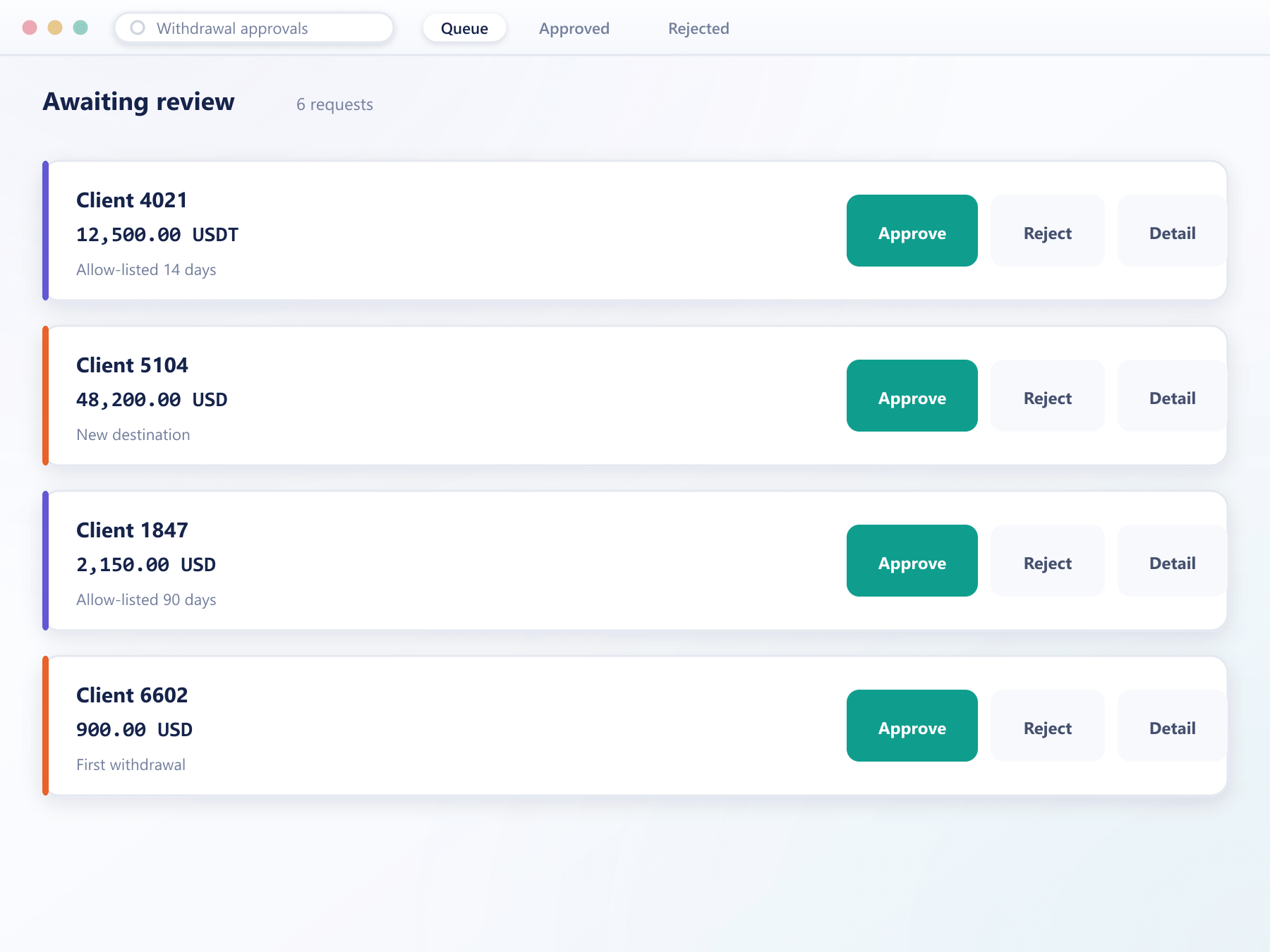
Approve too slowly and clients leave. Approve too readily and you fund a compromised account. The queue is built so an operator has everything needed to decide quickly and correctly.
Risk indicators
2 triggeredIllustrative. The operator sees which patterns fired, not just a score.
What the queue puts in front of an operator
Each of these exists because its absence has cost somebody money
Automatic below threshold
Small, low-risk withdrawals to allow-listed destinations execute without review, so the queue holds only what needs judgement.
Risk indicators
New destination, recent password change, unusual amount, rapid deposit-then-withdraw and mismatched location are surfaced explicitly.
Client context
Balance history, trading activity, previous withdrawals and verification state sit beside the request.
Second approver
Above a configurable amount, a second operator with the appropriate role must approve before execution.
Soft limits
A request above a soft limit is not refused. It goes to a two-level review, first-line and then senior, so a genuine large withdrawal is paid rather than split into pieces.
Recorded reasons
Every approval and rejection carries a reason, which is what makes later review and regulatory response possible.
See it live
The request the client is watching
While an operator reviews the risk indicators behind the scenes, the client sees a straightforward withdrawal screen — the scrutiny happens without slowing them down.
A request through the queue
Most requests never reach a human, which is what keeps the ones that do reviewable
- All requestsScreen
Checks before the queue
Allow-list, limits, cooling period and screening run first. A request failing any of them is refused with the reason before an operator sees it.
- Most exit hereSort
Automatic or manual
Requests below the threshold with no risk indicators execute automatically. Everything else enters the queue with its indicators attached.
- The remainderReview
Decided with context
The operator sees the indicators, the client's history and any previous decisions, then approves, rejects or escalates with a reason.
- On approvalExecute
Debited on completion
On approval the payment is executed and the balance debited. The client is notified at each stage without asking.
Balancing speed against loss
Both failure modes are expensive, in different currencies.
Faster payouts
Automatic approval below threshold means most clients are paid without waiting for a person.
Fraud caught
Explicit risk indicators surface the patterns that matter rather than relying on an operator noticing.
Consistent decisions
The same context and the same thresholds mean two operators reach the same conclusion.
Defensible records
A reason on every decision is exactly what a regulator or a complaint investigation asks for.
FAQ
Withdrawal approvals: common questions
6 short answers to what teams ask before a demo.
Yes. A threshold per client group determines which requests execute without review, provided no risk indicator is present and the destination is allow-listed.
A newly added destination, a recent password or two-factor change, an unusual amount relative to the client's history, deposit followed rapidly by withdrawal, and a location inconsistent with previous activity.
Yes, above a configurable amount. The proposal and the approval are recorded separately with both operator identities.
A hard limit refuses the request outright. A soft limit lets the client submit it and routes it through two levels of review instead, with the first reviewer able to approve within their authority or pass it to a senior operator. Each level and its decision is recorded.
On execution, not on request. The amount is reserved when the request is created, which prevents it being traded while pending.
Yes, for approvals as well as rejections. Without reasons, an audit of past decisions tells you what happened but never why.
Still have a question?
A specialist will answer it directly, with your set-up in mind.
Ask a specialistWork the approval queue with us
We will run genuine and suspicious requests through the queue so you can see what an operator actually sees.