Compliance
A risk rating that does something
Most risk ratings sit on a record and are looked at during an audit. This one drives review frequency, withdrawal thresholds and whether an approval needs a second operator — automatically.
Score composition
Band: elevatedIllustrative weights. The model is yours to configure.
What feeds the score and what it changes
A score is only useful if something downstream reads it
Multiple inputs
Jurisdiction, verification tier, screening outcome, funding pattern and account behaviour each contribute with a weighting you set.
Recalculated on events
The score updates when something relevant happens rather than on a periodic review, so it reflects the client as they are now.
Drives review frequency
Higher-risk clients are rescreened and reviewed more often, automatically, without a person maintaining a list.
Drives thresholds
Automatic withdrawal approval limits and second-approver requirements are resolved from the score rather than set per client.
Explainable
The contribution of each input is visible, so a rating can be justified rather than merely asserted.
See it live
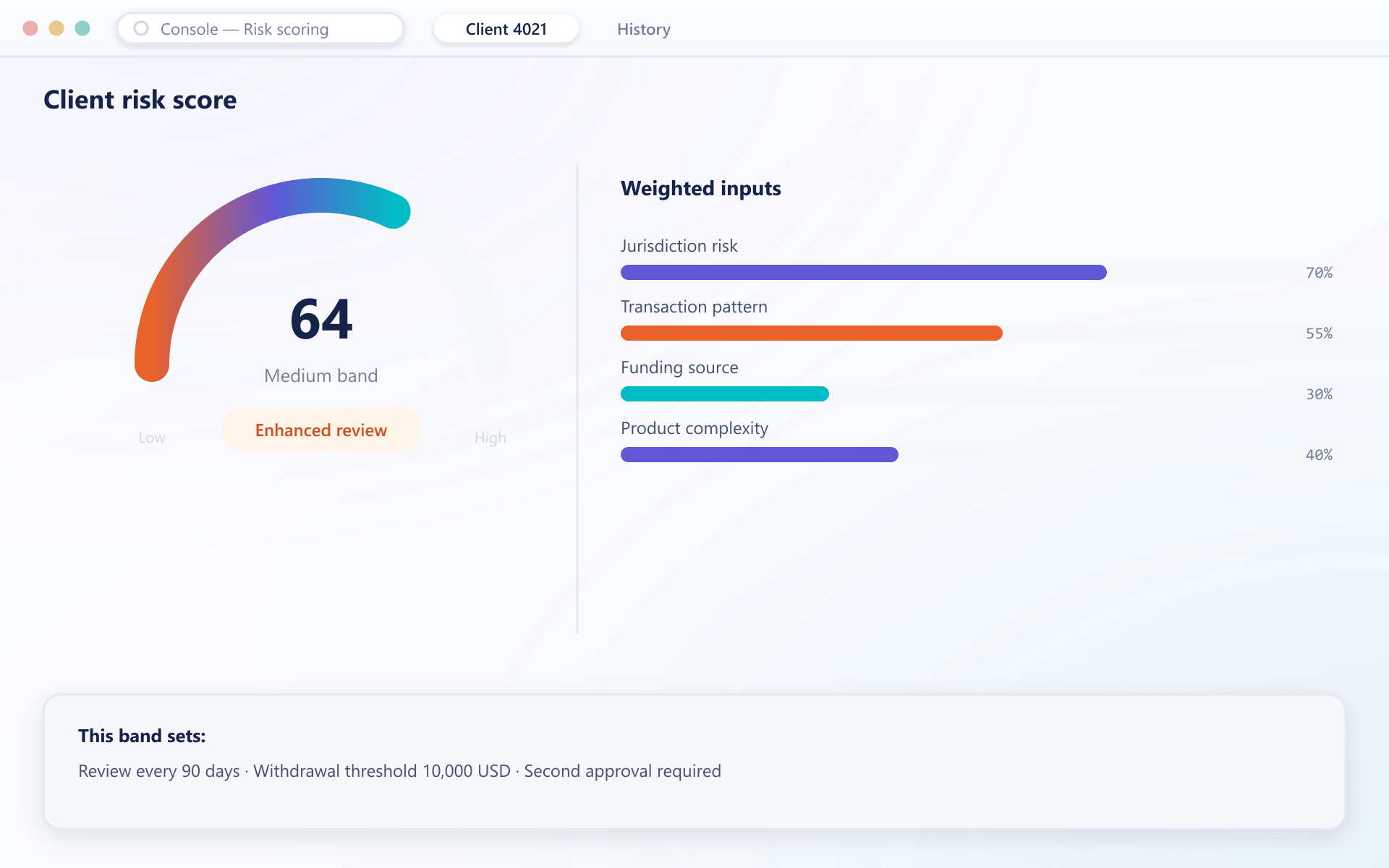
A score you can actually see move
Each input’s weight and the band it produces are visible together, so a rating can be explained rather than just asserted.
From inputs to enforced controls
The last step is the one that distinguishes this from a label on a record
- 1Gather
Inputs from across the platform
Jurisdiction, verification tier, screening result, deposit and withdrawal patterns and trading behaviour are all read from existing records.
- 2Weight
Your model, not ours
Each input carries a weighting you configure, so the model reflects your own risk appetite and your regulator's expectations.
- 3Score
Recalculated on change
A relevant event triggers recalculation immediately rather than waiting for a scheduled review cycle.
- 4Enforce
Controls follow the band
The resulting band determines review frequency, automatic approval thresholds and whether sensitive actions need a second operator.
What an active score achieves
A risk-based approach is a regulatory expectation, and this is what implementing it actually looks like.
Effort where it matters
Review capacity concentrates on higher-risk clients instead of being spread evenly.
Faster for most clients
Low-risk clients get higher automatic thresholds, which means quicker withdrawals.
Consistent treatment
Controls follow the score, so two similar clients are handled the same way.
Demonstrable approach
An explainable model with enforced consequences is what a risk-based review expects to find.
FAQ
Risk scoring: common questions
5 short answers to what teams ask before a demo.
Jurisdiction, verification tier, screening outcome, funding patterns and trading behaviour, each with a weighting you configure. The model is yours rather than a fixed formula.
When a relevant event occurs — a new deposit pattern, a screening result, a jurisdiction change — rather than on a periodic cycle, so the score reflects the client as they currently are.
Rescreening and review frequency, automatic withdrawal approval thresholds, and whether sensitive actions require a second approver. It is enforced rather than advisory.
Yes. The contribution of each input is shown, so a rating can be justified to a client, an auditor or a regulator rather than asserted.
Yes, with a recorded reason and, where you require it, a second approver. Overrides are visible on the client record and in the audit log.
Still have a question?
A specialist will answer it directly, with your set-up in mind.
Ask a specialistBuild your risk model with us
Bring your risk framework and we will configure the inputs, weightings and resulting controls.