BrokerOS · Section
Back Office
The half of a brokerage nobody markets and everybody depends on. These are the tools your operations, finance and risk teams live in — built around throughput rather than around a feature list.
See it live
Seven systems, one back office
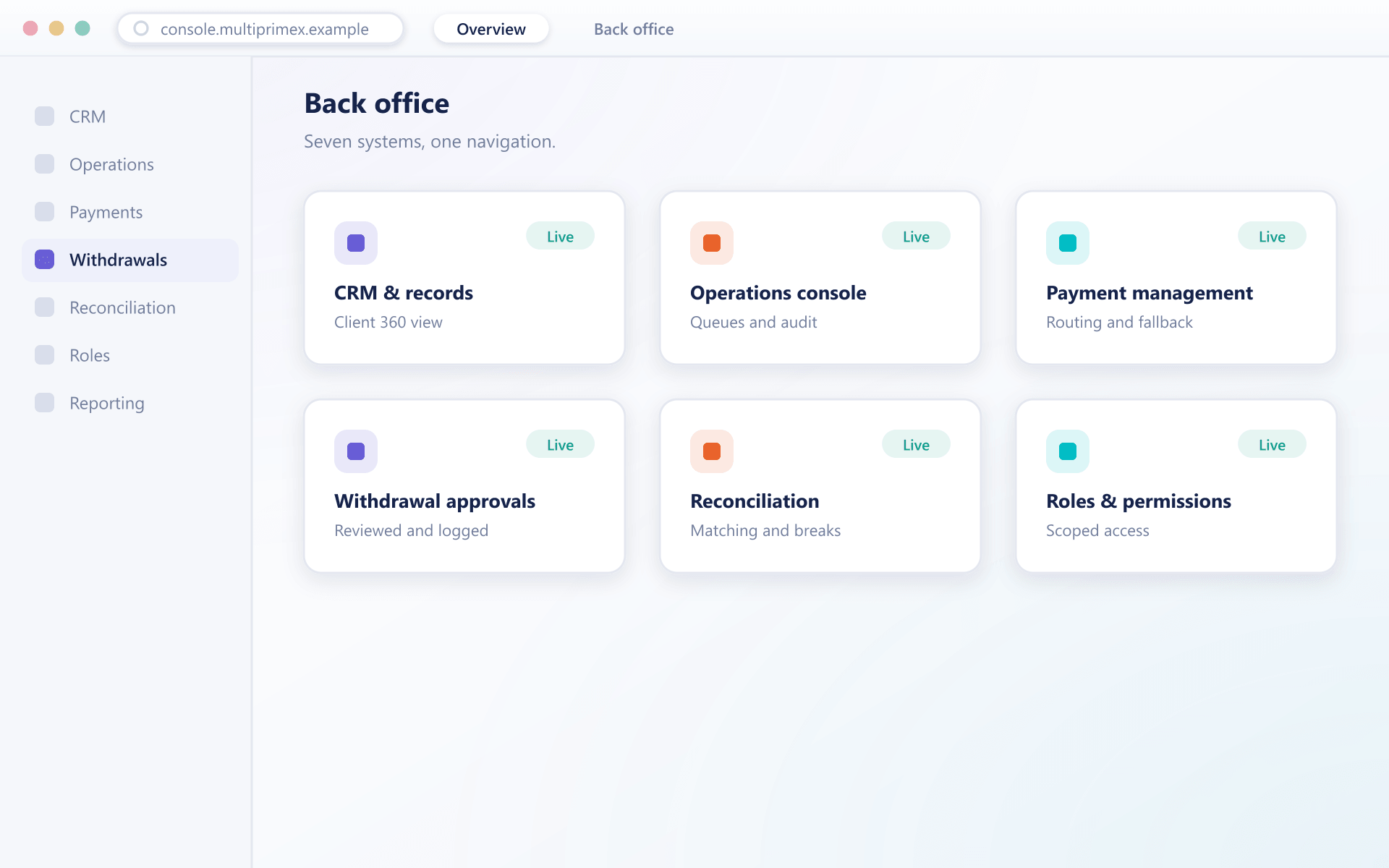
Client records, the operations console, payments, approvals, reconciliation, access control and reporting sit behind a single navigation rather than seven logins.
Who you serve
Everything known about a client, and the surface your team works in.
Money moving
Payments in, approvals out, and the matching that proves both.
Control and evidence
Who is allowed to act, and what the numbers actually say.
What it covers
The tools your desk opens every morning
Client records, money movement, approvals and reporting in one console, with every action attributed and retained.
One record per client
Contact details, verification state, accounts, balances and past requests on a single record, with saved segments your team can work as a list.
A single worklist
Verification reviews, flagged transactions and failed jobs collect in one queue instead of scattered notifications, each showing who touched it last.
Payment routing without a release
Methods are enabled per currency, country and client group, with limits and fees per route. Adding a corridor is configuration, not engineering.
Approvals driven by rules
Thresholds decide what clears automatically and what needs a second pair of eyes, and anything held shows the rule that held it.
Reconciliation that surfaces breaks
Provider statements are matched line by line, and anything that does not agree is listed with the difference rather than quietly absorbed.
Access shaped to the job
Roles grant only what a function needs, down to individual screens and fields, with second-approver rules on sensitive operations.
Back office questions
How your team actually works in it
5 short answers to what teams ask before a demo.
Pricing is by capability rather than seats, so you are not choosing between giving someone access and paying more. Add the people who need it and constrain them with roles.
Yes. Approval thresholds are set per amount, method and client group, and anything above a limit routes to a second approver before it can be released.
Who changed what, when and from where is retained for every material action, including configuration changes and manual overrides, and it is exportable for audit.
Yes, both as scheduled exports and through the API. Balances, flows, commissions and verification outcomes are all reportable over any period.
We absorb it. Provider maintenance sits on our side of the line, which is the main practical difference between adopting this and building it in-house.
Still have a question?
A specialist will answer it directly, with your set-up in mind.
Ask a specialistBring your operations team to the walkthrough
We will work a real queue, reconcile a real statement and build a real report rather than showing prepared screens.