Infrastructure
A statement you can reconcile, not just read
Most disputes with a liquidity provider are not about execution. They are about two sets of records that will not line up, and nobody being able to say which trade is which.
See it live
What arrives, and on what cycle
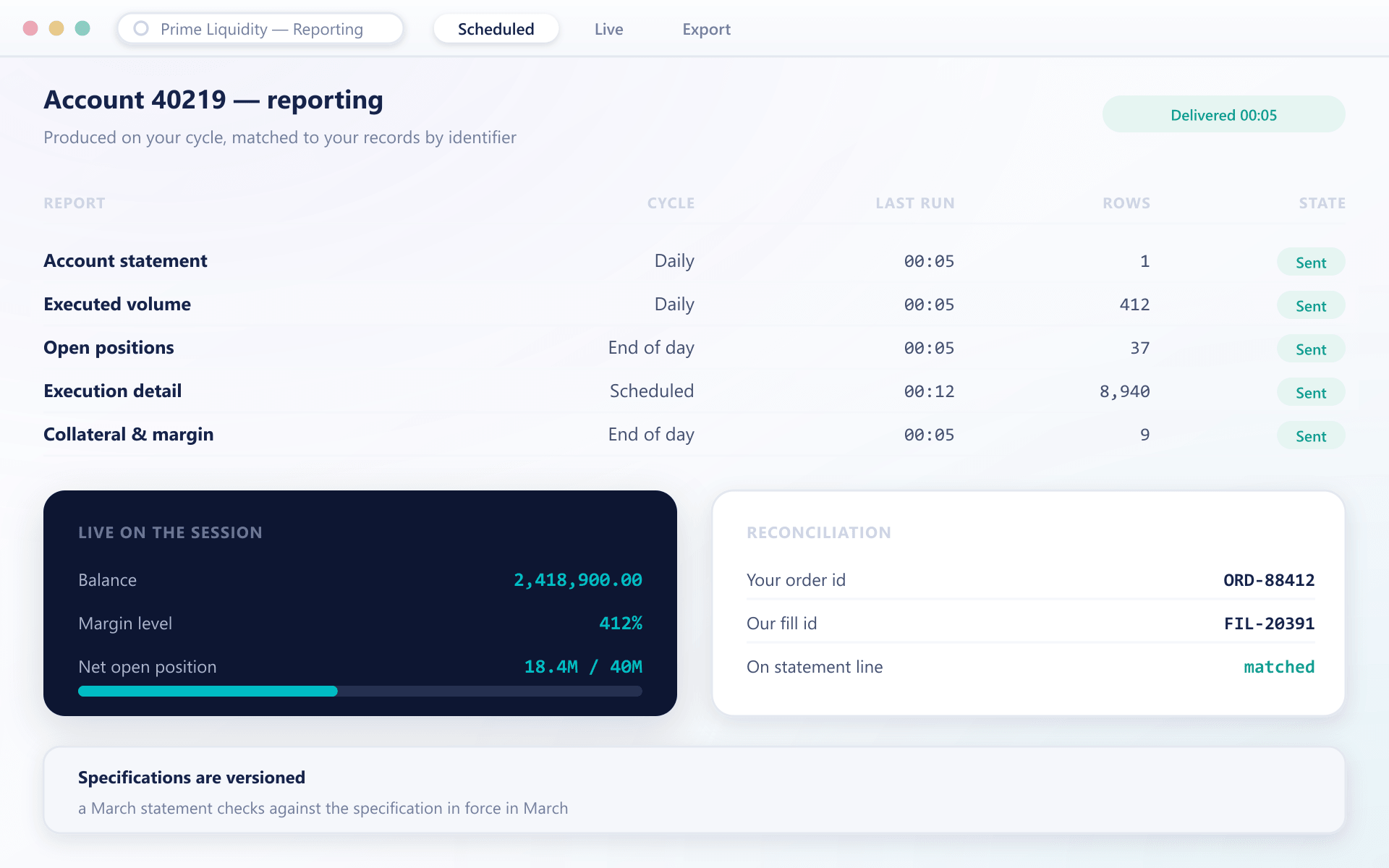
Statements, volume and position reporting on a schedule you set, with the live balance and exposure readable on the trading session itself.
What is produced
Five reports, and what each one actually carries
Daily and monthly
Opening and closing balance, realised profit and loss, fees, funding and adjustments
Daily and monthly
Notional traded by instrument, asset class and quote currency
End of day
Position, average price, unrealised profit and loss, and the margin it consumes
On request or scheduled
Fill-level records with timestamp, venue and the order identifier that produced them
End of day
Posted collateral, credit after haircut, requirement and free equity
How it reaches you
Four routes, and none of them is a portal to remember
Scheduled delivery
Reports are produced and sent on the cycle you set, to the recipients you nominate. Nobody has to remember to log in and export something on the first of the month.
Live over the session
Balance, margin level and current exposure are readable on the same connection that carries your orders, so your own risk screen does not depend on a separate poll.
Both formats, one run
A spreadsheet for reconciliation and a document for circulation come from the same figures, so the two can never disagree with each other.
Into your own systems
The same records can be pulled programmatically and written into your reporting database, so your analysts read your own store rather than asking us for an extract.
The part that prevents disputes
Three things that make reconciliation arithmetic
Identifiers carry through
The order identifier you sent appears on the fill, on the statement and in the execution detail. Reconciliation becomes a join rather than a negotiation about which trade is which.
Adjustments are separate lines
A correction, a fee rebate or a funding charge each appears as its own entry rather than being netted into a balance movement with no explanation attached.
Specifications are versioned
Contract size, tick, margin rate and session for every instrument are published as a reference set with a date on it, so a statement from March can be checked against the specification that was in force in March.
FAQ
Reporting: common questions
6 short answers to what teams ask before a demo.
Yes. Balance, margin level and current exposure are available on the same session that carries your orders, so your risk screen updates continuously rather than between report runs.
Statements and volume reports are retained for the period agreed in your contract, and execution detail for at least as long. Where you need longer, the practical answer is to pull it into your own store as it is produced.
They should, because the order identifier you sent travels through to the fill and onto the statement. Where a difference appears it is almost always timing — a trade booked either side of a cut-off — and the identifiers make that visible rather than mysterious.
Yes, as a dated reference set covering contract size, tick, margin rate and session per instrument. It is versioned deliberately, because reconciling an old statement against today's specification is how people arrive at the wrong answer.
Whichever recipients you configure, and they can differ per report. A daily statement often goes to the desk while the monthly one goes to finance and to your auditor.
No. Report generation reads from a separate copy of the data, so a month-end run does not compete with execution for resources.
Still have a question?
A specialist will answer it directly, with your set-up in mind.
Ask a specialistSend us a month you could not reconcile
Bring the statement that would not tie out against your platform and we will show which identifiers would have made it a five-minute job.