Features
Your best provider is rarely on the convenient server
They are wherever they have been trading, with a record built there. Asking them to move so your architecture is tidier is a request they are entitled to refuse.
See it live
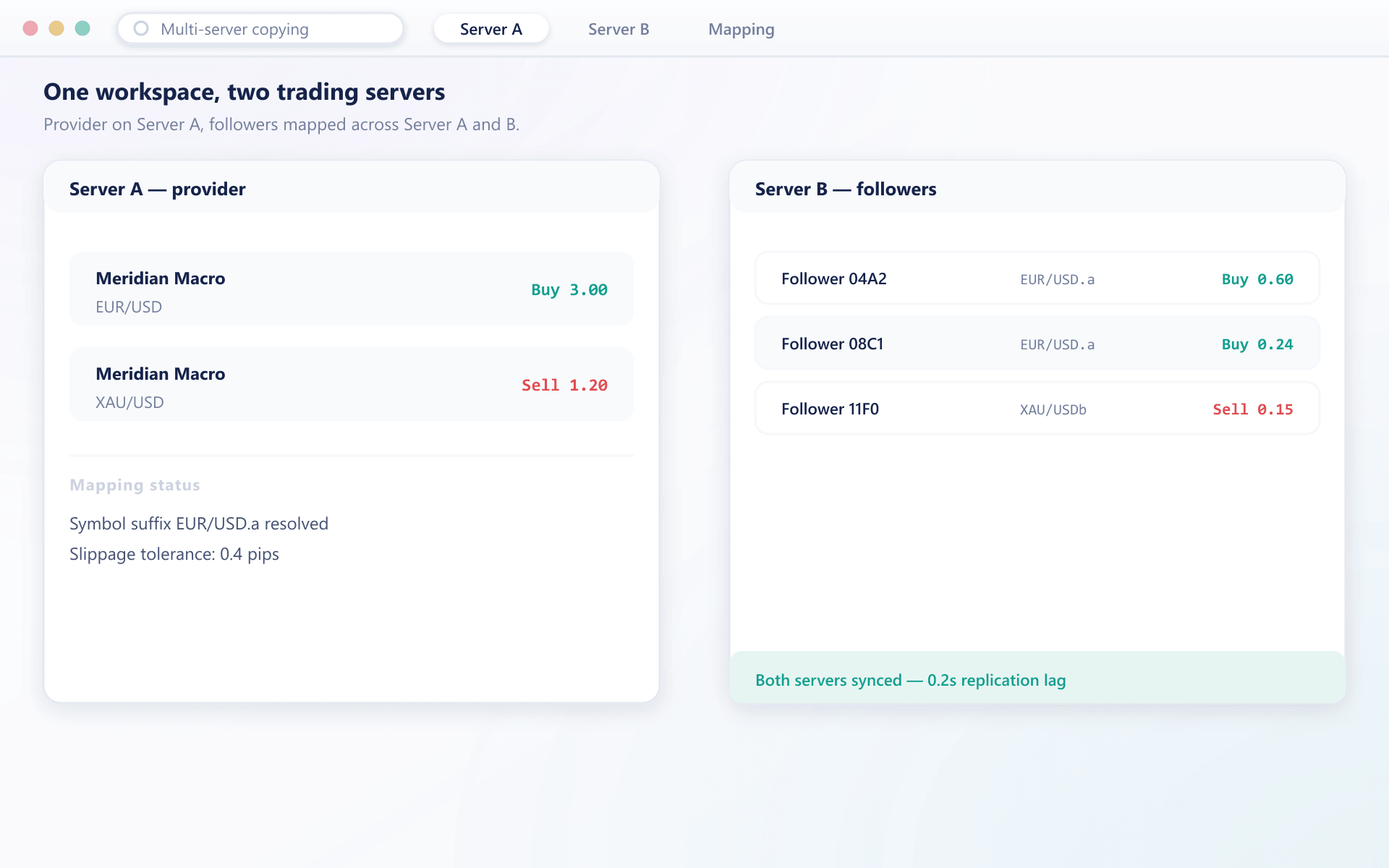
One workspace, positions from both servers
Provider and follower accounts sit side by side regardless of which platform each one is actually running on, with mapping and slippage visible in the same tiles.
Four obstacles
And the honest handling of each
The symbol is named differently
The same instrument carries different names, contract sizes and precision on two platforms. Mapping absorbs that, and getting it wrong is how a position ends up a different size than intended.
The clocks do not agree
There is a real interval between the provider's fill and the follower's. A tolerance decides whether an order that has moved too far is still copied or skipped, and that should be your decision.
The instruments do not fully overlap
A provider may trade something followers on another platform cannot access. Skipping it is honest; substituting something similar is not, and we do not do it.
Slippage is real and should be reported
Copy slippage across servers is larger than within one. Measuring and showing it is better than a claim of instant copying that nobody in the market believes anyway.
Three reasons it comes up
None of them is a preference for complexity
Providers are where they are
A trader with a strong record and a following is not going to move platforms because it suits your architecture. Meeting them where they are is the whole point.
Migrations take time
Moving a client base between platforms is a long project. Copying across both during the transition means the programme keeps running rather than pausing for a quarter.
Segments differ
Professional and retail clients frequently sit on different environments for good reasons. One strategy should still be able to serve both.
FAQ
Multi-server copying: common questions
6 short answers to what teams ask before a demo.
Yes, and it is common. A trader with a following is not going to move platforms to suit your architecture, so the engine meets them where they are rather than the other way round.
More than copying within one environment, and it is measured and reported rather than glossed over. Anyone claiming genuinely instant cross-platform copying is describing something that is not possible.
The trade is skipped and the exclusion is recorded. We do not substitute a similar instrument, because a client who thinks they are copying a strategy and is silently receiving something else has a legitimate complaint.
As a maximum acceptable price deviation, a time window, or both. Beyond it the copy is skipped rather than executed at a materially different price, and the skip is visible to the follower.
Yes, through the symbol mapping. Two platforms quoting the same instrument with different contract specifications is exactly the case that produces a position several times the intended size when mapping is wrong.
Very. Copying across both environments means the programme keeps running while the client base moves, rather than being suspended for the duration of the project.
Still have a question?
A specialist will answer it directly, with your set-up in mind.
Ask a specialistSend us both symbol lists
We will map them and flag the instruments where contract specifications differ — which is the case that produces a position several times the intended size.