Features
Holding periods that protect a pool without trapping anyone
A PAMM pool that anyone can leave on any day forces its manager to keep cash idle and sell at bad moments. A pool nobody can leave is a complaint waiting to happen. Lock-up terms sit between the two: a holding period the investor agrees to up front, and a fee for leaving early that falls as the period runs.
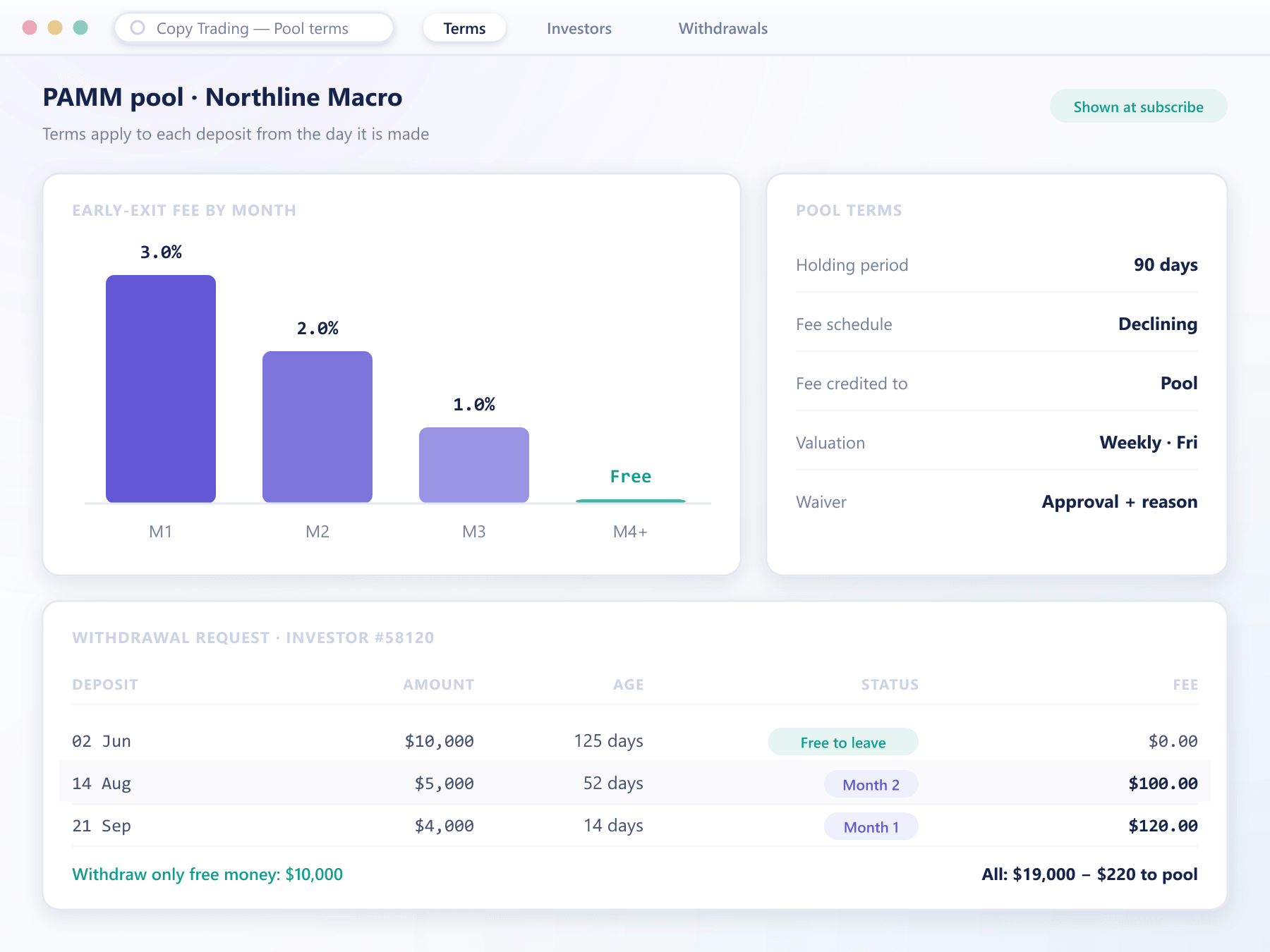
What you can set
Terms per pool, visible before anyone commits
Every term below is configured on the pool and shown to the investor on the subscription screen, so nobody meets it for the first time on the way out.
A holding period per pool
Set how long a deposit is expected to stay, counted from each deposit rather than from the first one, so topping up does not reset an investor's earlier money.
A fee that declines
The early-exit fee can step down across the period, for example higher in the first month and lower near the end, so leaving late costs less than leaving at once.
Who receives the fee
Credit it to the pool, so the investors who stay are compensated for the forced sale, or to the manager, or split between them. The choice is shown on the pool's terms.
Disclosed before subscribing
The holding period, the fee schedule and the date an investor's money becomes free to leave are on the subscription screen and in the confirmation that follows.
Exceptions with approval
Hardship or a complaint can justify waiving the fee. A waiver needs an operator's approval and a reason, and both are recorded against the withdrawal.
Itemised on the statement
Any early-exit fee appears as its own line with the deposit it applied to and the rate used, so an investor can see exactly why the amount received differs.
An early withdrawal
What happens when an investor leaves early
Request
The investor asks to withdraw. The screen shows which deposits are still inside their holding period and the fee each would carry.
Confirm
They confirm with the fee in front of them, or choose to withdraw only the money that is already free.
Redeem
At the next valuation point their share is redeemed and the fee is credited to the pool, the manager or both, as the terms say.
Record
The statement shows the redemption, the fee and the deposit it applied to. Partner and manager reports pick up the fee on the same cycle.
Lock-up questions
Using holding periods well
4 short answers to what teams ask before a demo.
No. Pools trading liquid instruments over short horizons rarely need one. Lock-ups make sense where the strategy holds positions for weeks or trades instruments that are costly to unwind quickly.
It does not have to. Most brokers allow early withdrawal with a fee rather than refusing it outright, which keeps the protection for the pool without leaving an investor unable to reach their money.
Because the investors who stay are the ones who bear the cost when the manager sells to fund an early exit. Crediting the fee to the pool compensates them, and it is the easier arrangement to defend.
New terms apply to new deposits. Money already in the pool keeps the terms that were shown when it was deposited, so nobody's exit cost changes after the fact.
Still have a question?
A specialist will answer it directly, with your set-up in mind.
Ask a specialistSet up a pool with a holding period
We will configure a test pool with a declining early-exit fee so your team can walk through a withdrawal from the investor's side and the console's.