Funding
The payout is the promise being tested
Everything before it is marketing. Traders judge a programme almost entirely on whether the first payout arrived, when it was supposed to, for the amount they expected.
Whether enough time has passed since funding or the last payout
Profit above the high-water mark, not the raw account balance
The trader share and your share, computed from the ledger
Whether the profit came from a single day, where your rules require spread
Whether unrealised exposure should reduce the payable amount
That no breach is under review at the time of the request
See it live
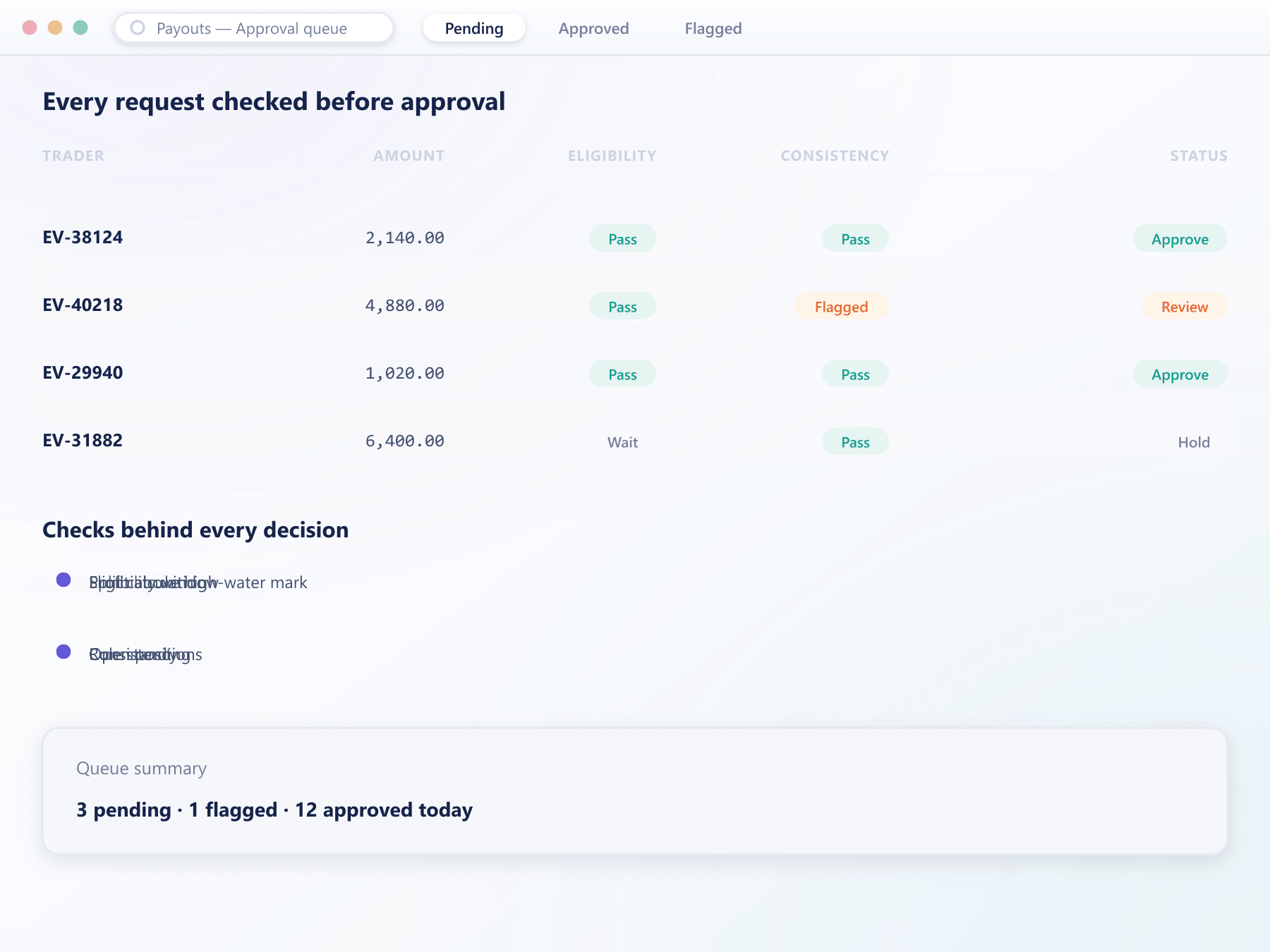
The payout, as the trader sees it arrive
Amount, destination and status update the moment the checks clear — the same screen a trader watches while a request moves through the programme.
Three things about payouts
All of them are reputational before they are operational
This is the moment you are judged on
Traders discuss payouts publicly and in detail. A programme that pays accurately and on time acquires a reputation that costs nothing; one that does not acquires the opposite kind just as quickly.
Speed matters as much as accuracy
A correct payout that takes three weeks is remembered as a slow payout. If the checks are automatic, the only thing left is the transfer itself.
Every decision needs a record
Approved, reduced or refused — with the figures and the reason. A refusal you cannot explain in writing is one you will be explaining publicly instead.
FAQ
Payout controls: common questions
6 short answers to what teams ask before a demo.
From the high-water mark, so a trader who recovers a loss is not paid twice for the same profit. Paying from the raw balance is a mistake that only becomes visible after somebody has drawn down and recovered.
A test of whether the profit came from a single outsized day rather than sustained trading. Whether you require consistency is your commercial choice; if you do, it has to be stated up front because it is the most commonly disputed rule in the industry.
They can, by policy. Paying out the full realised profit while significant unrealised exposure is open can leave the account undercapitalised, so the treatment is configurable rather than assumed.
The checks run automatically, so the decision is immediate. What remains is the transfer, which runs through your payment infrastructure rather than through this product.
The trader is told which check failed and what the figures were. A refusal without a specific reason is the single most damaging thing a prop programme can do, and it always ends up in public.
Through your payment rails. Approved payouts become a payout run in PayVault with the same batching, approval and settlement path as any other outbound payment.
Still have a question?
A specialist will answer it directly, with your set-up in mind.
Ask a specialistHow long does your first payout take?
From request to money received. That number is what traders quote to each other, and it is rarely the one firms think it is.