Evaluations
A challenge nobody passes is not a business
It is a fee-collection exercise with a shelf life. Traders compare notes publicly, and a programme with an implausible pass rate acquires a reputation faster than it acquires customers.
Harder target, lower pass rate, more fee revenue, worse reputation
The single largest driver of pass rate, and the least understood
Catches the blow-up day; too tight and it catches normal variance
Longer periods raise pass rates and slow your revenue cycle
A second phase filters luck, and doubles the point at which people quit
Sets the revenue per attempt and the audience you attract
See it live
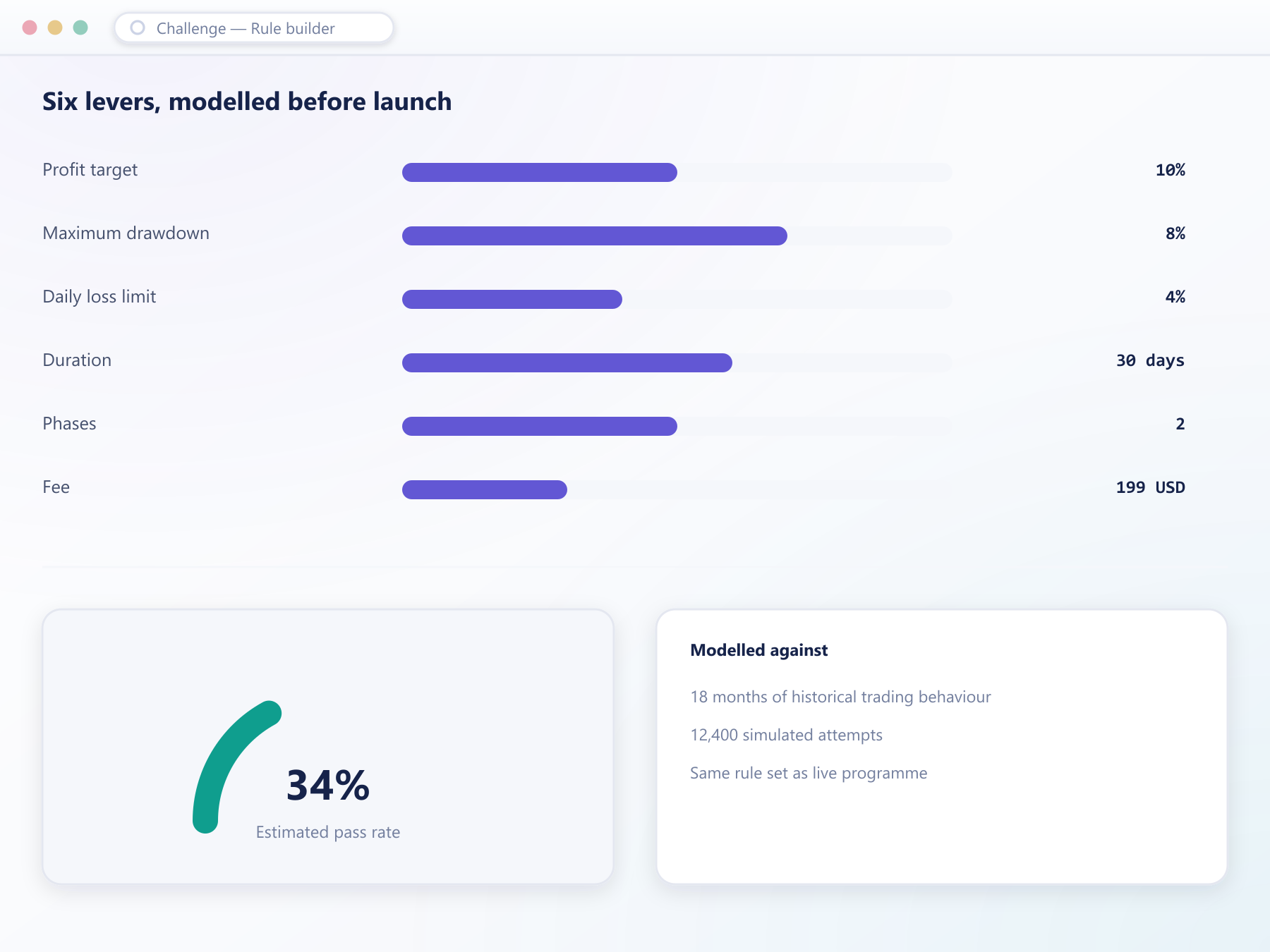
Every lever, modelled against pass rate before launch
Profit target, drawdown, duration and fee sit in one schedule so the trade-off between them is visible before a single trader buys an attempt.
The tension
Both extremes cost money, in different currencies
Too hard is not free money
A programme almost nobody passes maximises fee revenue for one quarter and then acquires a reputation. Traders compare notes publicly, and the acquisition cost rises faster than the fees.
Too easy is not generous
If the pass rate is high and the funded rules are loose, you are funding accounts that were never evaluated. The cost arrives later, in the profit share you pay on luck.
Model it before you launch it
Pass rate can be estimated from the rule set against historical behaviour. Launching and finding out is the expensive version of the same exercise.
FAQ
Challenge design: common questions
6 short answers to what teams ask before a demo.
Maximum drawdown, by a wide margin. It drives pass rate more than the profit target does and is consistently the least examined of the settings. Two programmes with the same target and different drawdown rules are not comparable.
Configurable from 1–3. A second phase filters out traders who passed on luck, and it also doubles the point at which people abandon. Which matters more depends on whether your revenue is fee-led or profit-share-led.
Yes, and you should. A rule set can be evaluated against historical trading behaviour to estimate how many attempts would have passed. Launching and finding out costs the same information at a much higher price.
Yes. Different account sizes, targets and fee levels can run in parallel, each with its own rule set. Most firms end up with a range rather than one product.
New rules apply to new purchases. Traders already in an evaluation keep the rules they agreed to, and the version they are on is recorded. Changing the terms underneath somebody mid-attempt is the fastest way to a public dispute.
That is a commercial decision rather than a technical one, and it depends on whether your model is fee revenue or profit share. What matters is that you chose it deliberately and can defend it.
Still have a question?
A specialist will answer it directly, with your set-up in mind.
Ask a specialistWhat pass rate are you actually running?
Most firms discover theirs a quarter after launch. Modelling the rule set first turns it into a decision rather than a result.