Evaluations
A rule checked afterwards is a rule you argue about
If the trade executed and the breach was found later, the trader kept trading past the limit and the account state is ambiguous. Every enforcement from that point is a negotiation you are likely to lose publicly.
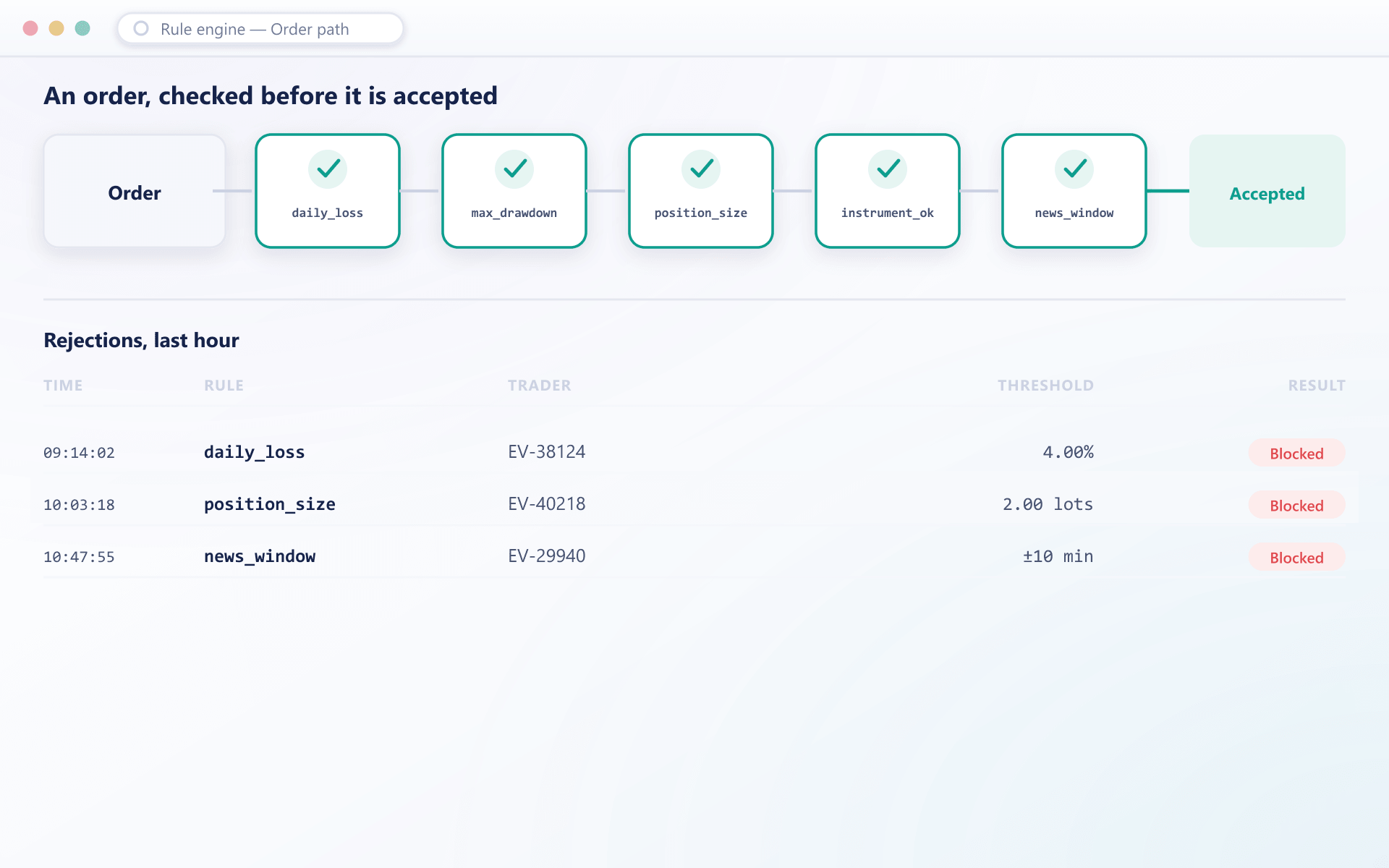
Blocks the order that would cross the daily floor
Measured from peak or from initial balance, as configured
Caps lot size per instrument and in aggregate
Refuses trading in instruments outside the programme
Blocks entry inside a defined window around scheduled events
Evaluated at completion, not at order time
Caps the share of profit that may come from one day
See it live
Every rule, configured per programme
Daily loss limits, drawdown and instrument restrictions sit in one configuration surface the engine checks at order time, not reviewed after the fact.
Three kinds of rule
And being honest about which is which
Not everything can be enforced in the moment. Programmes that pretend otherwise are the ones whose disputes end up on public forums.
Blocking rules
Applied to the order itself. The trade never happens, so the account state stays clean and there is nothing to unwind or explain afterwards.
Terminating rules
A breach that ends the evaluation, evaluated continuously against the account rather than at a daily cutoff. The moment it happens is the moment it is recorded.
Completion rules
Conditions that can only be assessed at the end — minimum trading days, consistency. These cannot block anything in the moment and must be stated plainly up front.
Before any rule can be measured
Whether positions net decides what drawdown even means
Hedging
A trader may hold opposing positions in the same instrument at once. Every rule that counts exposure has to decide whether those net off, because a programme that ignores the question can be gamed into showing no drawdown at all.
Netting
Opposing orders reduce a single position rather than opening a second one. Drawdown and exposure read more simply, at the cost of strategies that genuinely depend on holding both sides.
Declared per programme
The model is fixed when the challenge is designed, not chosen by the trader afterwards, so every account in a programme is measured on the same basis.
FAQ
Rule engine: common questions
6 short answers to what teams ask before a demo.
Most are, and those are the valuable ones. Some — minimum trading days, consistency requirements — can only be assessed at completion by their nature. Being clear about which is which is what prevents disputes, so we state it rather than blur it.
Whichever you configure, and the difference is substantial. Trailing drawdown from peak equity is considerably harder to pass than static drawdown from the starting balance, and traders read the distinction carefully.
It is refused, with the rule and the threshold named in the rejection. The trader sees why immediately, which is both fairer and cheaper than a support conversation the following day.
Yes. Each programme carries its own rule set, and traders keep the version they signed up under. Changing rules underneath an active attempt is the fastest route to a public complaint.
A schedule of events with a window either side during which entry is blocked. The events and window lengths are yours to configure, since what counts as high-impact varies by the instruments you offer.
Usually. The practical question is whether it can be evaluated at order time or only afterwards, and that answer determines whether it will be enforceable or merely stated. We will tell you which before you commit to it.
Still have a question?
A specialist will answer it directly, with your set-up in mind.
Ask a specialistWhich of your rules cannot be enforced?
Every programme has one or two. Knowing which they are before launch is the difference between a clear term and a dispute.