Funding
Scaling should be earned, not requested
Increasing capital because a trader asked is a decision with no basis behind it. Increasing it because a defined record was met is a decision you can defend, repeat and reverse.
See it live
Every tier’s ceiling, in one schedule
Qualifying criteria, review periods and allocation ceilings for each tier sit in a single table, so an increase — or a decrease — is read off it rather than negotiated.
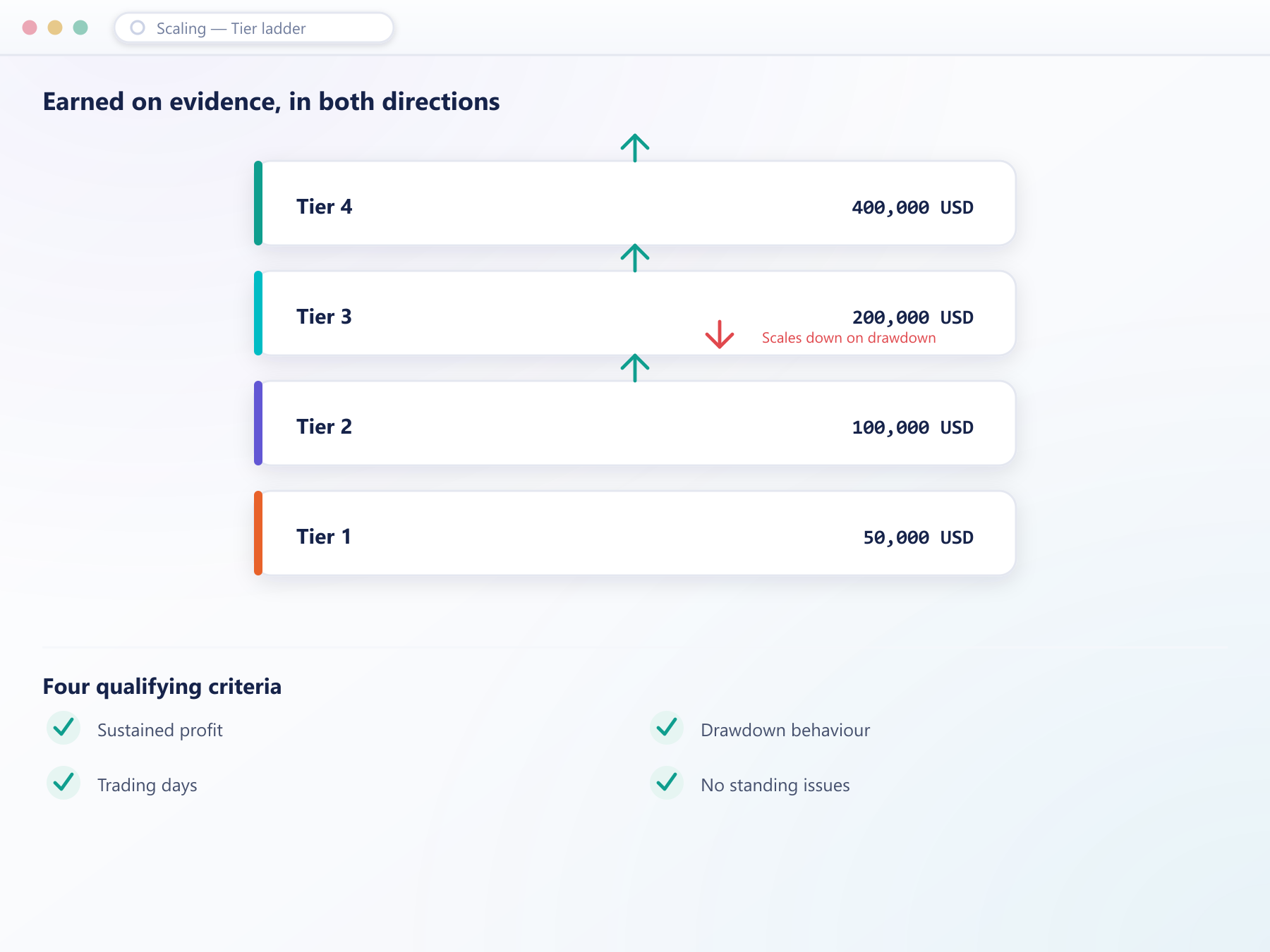
Four criteria
And return is the weakest of them
- 1Sustained profit
A target achieved over a review period rather than in one week. Sustained is the operative word — a single strong month is variance more often than it is skill.
- 2Drawdown behaviour
How the trader handled losing periods matters more than the return did. A trader who never approached the limit is a different proposition from one who repeatedly grazed it.
- 3Trading days
Enough activity for the record to mean something. Scaling on a handful of trades is scaling on a sample too small to interpret.
- 4No standing issues
No breach under review, no payout dispute open. Increasing capital while something is unresolved is how a small problem gets a bigger balance attached to it.
The part programmes leave out
A mechanism that only goes one way is not a mechanism
Scaling down is not a punishment
It is the same mechanism running in the other direction. A programme that only scales up has a ratchet, and a ratchet accumulates risk in exactly the accounts that have stopped performing.
Ceilings exist for a reason
A maximum allocation per trader caps what any single relationship can cost you. Traders understand a ceiling; what they do not accept is one that appears only when they reach it.
Review on a schedule, not on request
Assessments happen at defined intervals. Reviewing when a trader asks means the assessment is triggered by their confidence rather than by their record.
FAQ
Scaling plans: common questions
6 short answers to what teams ask before a demo.
On a fixed cycle rather than on request. Reviewing when a trader asks means the assessment is prompted by their confidence rather than by their performance, and those are different things.
Yes, and a programme without it has a ratchet. Capital accumulates in accounts that have stopped performing, which is precisely the opposite of what the mechanism is for.
Sustained profit over a review period, drawdown behaviour through losing stretches, enough trading days for the record to mean something, and no open dispute. Return alone is the weakest of the four.
There should be. A ceiling caps what a single relationship can cost you, and traders accept one that was stated at the start. What they do not accept is a limit that appears only when they reach it.
It can, and it is a common way to reward progression without unbounded capital growth. The split at each tier is configured and visible on the account rather than negotiated case by case.
The assessment is. Whether the increase applies automatically or waits for confirmation is your choice — most firms automate increases and keep a human in the loop for decreases, which is the harder conversation.
Still have a question?
A specialist will answer it directly, with your set-up in mind.
Ask a specialistHas any account ever scaled down?
If not, you do not have a scaling plan — you have a ratchet, and it is quietly concentrating capital in the accounts that stopped performing.