Languages
“Margin call” has one correct translation per market
Not two, not whichever the translator preferred on the day. In a financial interface, terminology consistency is a control rather than a matter of house style.
See it live
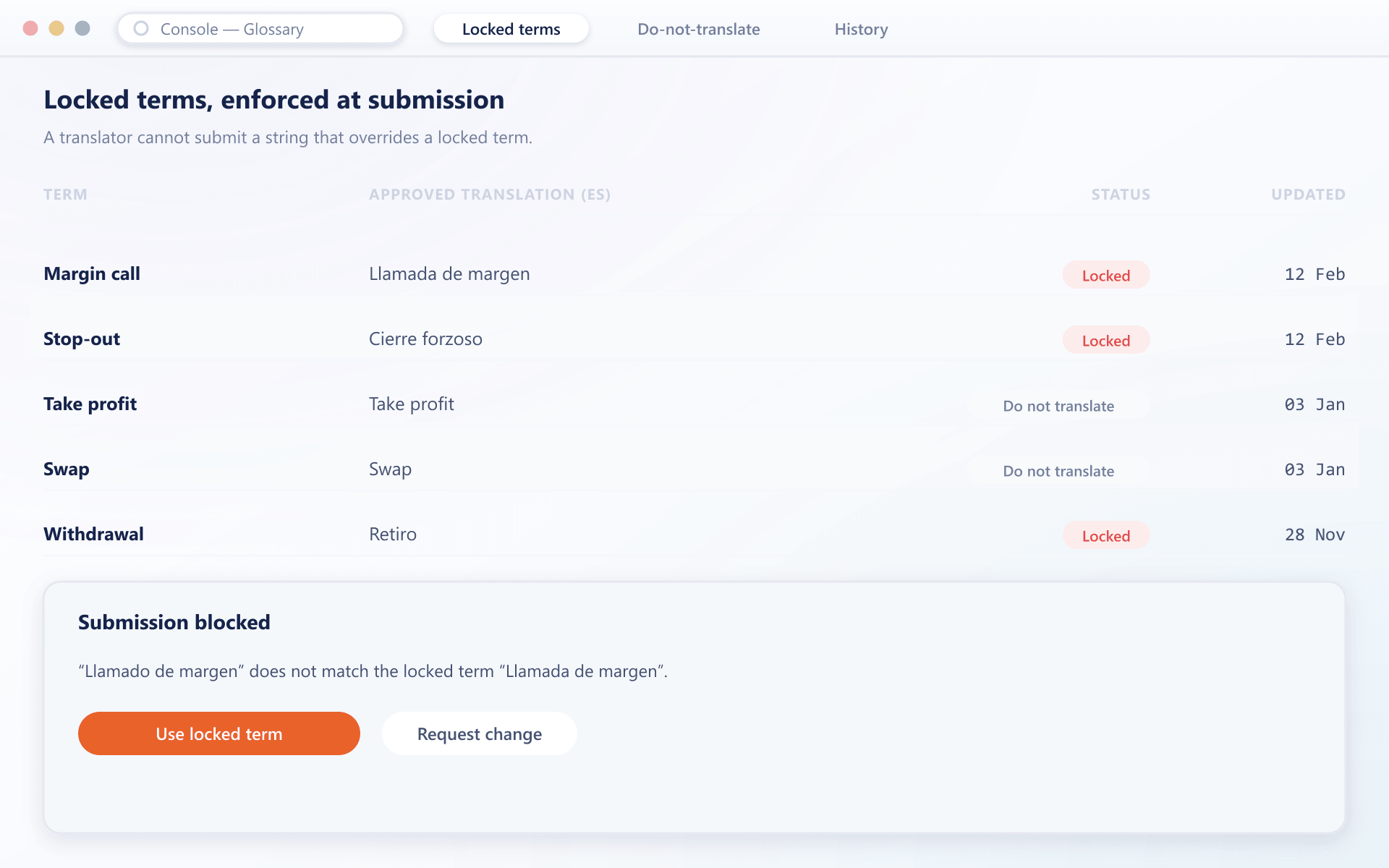
Locked terms enforced, not just documented
The review panel shows a translator exactly which terms are locked before they can submit, so a regulated word never reaches production by accident.
Three tiers
Not every word needs the same protection
Regulated and legally weighted wording
Cannot be changed by a translator. Editing requires a named approver.
Product and market terminology
A suggested translation is enforced unless a reviewer overrides it deliberately.
General interface and marketing copy
Translated normally, with the glossary offered as reference rather than constraint.
What inconsistency costs
Three consequences, and only the last one is merely inconvenient
A client acted on the wrong words
If a translated interface described an obligation inaccurately and a client relied on it, the position is considerably worse than an untidy sentence. This is the reason the glossary exists.
Support answers a different question
When the interface and the support script use different translations of the same term, the agent and the client are discussing two things that they both believe are one.
Nobody can audit it
Without a glossary there is no defined correct version, so a review of your translated disclosures has nothing to compare against and becomes a matter of opinion.
FAQ
Terminology: common questions
6 short answers to what teams ask before a demo.
Because in a financial interface an imprecise word can misdescribe an obligation. In most products that is untidy; here a client who relied on the wrong wording has a legitimate complaint, which makes it a control rather than a style preference.
A translator cannot change it. Where regulated wording has an approved translation for a market, it is applied and editing it requires a named approver rather than the person doing the translation work.
You do, ideally with local legal or compliance input for the locked tier. We provide the mechanism to enforce it; we do not tell you what a regulated term should say in a market we do not operate in.
Yes, and it frequently must. Two markets sharing a language can have different accepted regulatory terms, so the glossary is keyed by locale rather than by language.
The glossary is applied to the draft, so a machine suggestion arrives already using the correct terms. It removes the most common category of error before a reviewer even sees the text.
Most firms do not. It is usually built from your existing English interface — the recurring terms are extracted, you decide the correct translation for each market, and that becomes the starting set.
Still have a question?
A specialist will answer it directly, with your set-up in mind.
Ask a specialistMost firms do not have one yet
It is usually built from your existing English interface: extract the recurring terms, decide the correct translation per market, and that is the starting set.