Compare
All-in-one brokerage stack or separate vendors
A brokerage needs a trading platform, a CRM and back office, a liquidity bridge, payments and liquidity. You can buy them from one provider or choose a specialist for each layer. Both approaches work, and they fail in different places. This page sets out where.
Separate vendors let you choose the product you rate highest in every layer, and you own the integrations between them. An all-in-one stack gives up some choice per layer in exchange for one client record, one support desk and fewer joins to maintain. A hybrid, with one core stack and a specialist where it matters, is common and often the most sensible setup.
At a glance
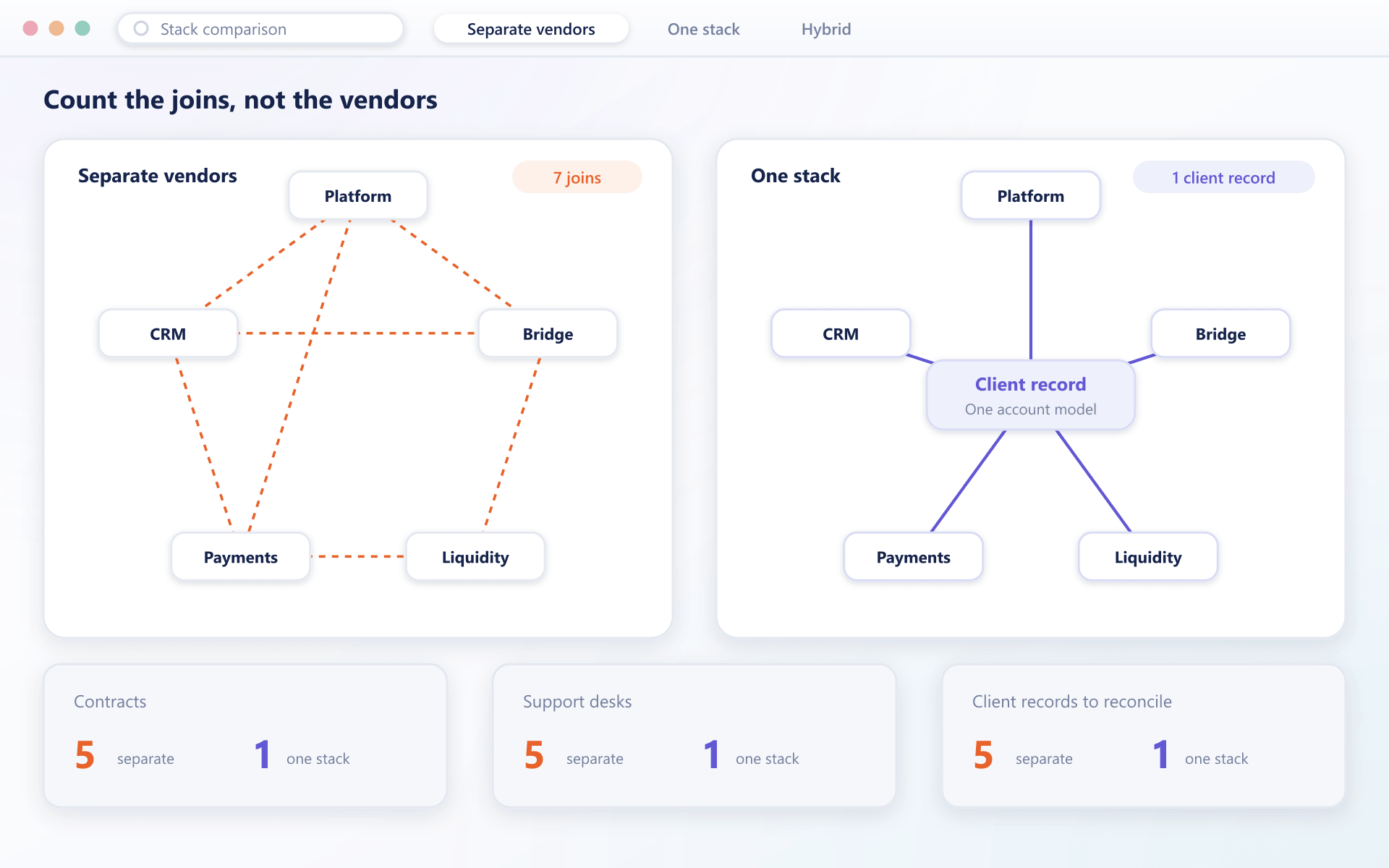
Count the joins, not the vendors
Every pair of systems that exchange data needs an integration that someone builds, monitors and re-tests. That number, more than the number of logos, decides how much work a stack creates.
The options
What each one gives you, and what it takes back
A separate vendor per layer
A specialist for each job: a platform vendor, a CRM, a bridge, one or more payment providers and liquidity providers, connected by your team or an integrator.
- Suits
- Established brokers with an in-house technical team and firm views on specific products.
- You gain
- Choice. Each layer can be the product you rate highest, and each can be replaced without touching the others.
- It costs you
- Every connection between vendors is yours to build, monitor and re-test when either side changes. Problems that cross two systems tend to belong to nobody.
One provider for the whole stack
Platform, CRM, bridge, payments and risk tools from one provider, sharing one client record and one account model.
- Suits
- New brokerages and lean teams that want one accountable party and a shorter path to launch.
- You gain
- Fewer joins. Data is already connected, there is one contract and one support desk, and a change in one layer is tested against the others before it reaches you.
- It costs you
- You accept the provider's version of each layer. If one module is weaker than a specialist product, you either live with it or replace that piece.
A core stack plus specialists
One provider for the core (client record, CRM, payments) and a specialist where you have a reason for one, such as a third-party trading platform or an existing liquidity provider.
- Suits
- Brokers who want to keep one platform or liquidity relationship and consolidate everything else.
- You gain
- Consolidation where it saves the most, and freedom where a specific product matters to your clients.
- It costs you
- Each specialist adds an integration back. Keep their number deliberate, or the hybrid drifts back into a fragmented stack.
Side by side
The criteria that separate them
| Criterion | A separate vendor per layer | One provider for the whole stack | A core stack plus specialists |
|---|---|---|---|
| Choice in each layer | Any vendor in any layer | The provider's module in each layer | Your choice where it matters, the core elsewhere |
| Integrations you maintain | One for every pair of systems that exchange data | Handled inside the stack | One for each specialist you add |
| Client record | Copied between systems and reconciled | One shared record | One record, synced to each specialist |
| When something breaks | Split across vendors | One support desk | One desk for the core, specialists for their part |
| Contracts and invoices | One per vendor | One | One, plus one per specialist |
| Time to launch | Longest, as every integration is built and certified | Shortest, as the stack arrives connected | In between, set by the specialist integrations |
| Replacing a component later | Redo that vendor's integrations | Possible where modules are separable; check before signing | Straightforward for specialists, deliberate for the core |
| Margin and collateral | Held separately with each provider | Can sit in one account when liquidity is from the same provider | One account in the core, separate with specialists |
In practice
How the differences show up
Where the cost actually sits
Licence fees are the visible part of either option. With separate vendors, the larger cost is the work between them: building integrations, keeping them working through each vendor's releases, and reconciling the same client across several systems. An all-in-one stack moves that work to the provider and prices it in. Compare the two over three years, and count the people on your side who look after the joins.
What happens when something breaks
A deposit that never reaches a trading account can involve the payment provider, the CRM, the bridge and the platform. With separate vendors, each one can show that its own part worked, and your team pieces the rest together. With one provider, the incident has one owner. The difference shows most on a busy news day, when several things go wrong at once.
Control and lock-in
Separate vendors keep you independent of any single provider, though each contract still has its own exit terms and data export. With one provider, the useful question is which parts can be separated. Ask whether the CRM can run with another platform and the bridge with another liquidity provider, and get the answer in writing. MultiPrimeX keeps connectivity and liquidity separable for this reason.
Launch speed
A stack that arrives connected removes most integration work from the launch plan. What remains is the work neither option can shorten: licence approval, bank and payment-provider onboarding, and configuring instruments, client groups and fees. When those are the critical path, the choice of stack moves the launch date less than it first appears.
MultiPrimeX
Where MultiPrimeX fits
MultiPrimeX is an all-in-one stack built to be used as a hybrid. Every product shares one account model, and each one can run next to a third-party product: TradeX or an integrated MT5, Prime Liquidity or your existing provider through BridgeX.
FAQ
All-in-one or separate vendors: common questions
6 short answers to what teams ask before a demo.
Often over three years, and rarely on the first invoice. Separate vendors can look cheaper line by line, but the integration and reconciliation work between them continues for as long as you run them, and it sits on your side. Compare total cost including the staff time each option needs.
Yes. That is the hybrid route. MT5 & Third-Party Platform Integration connects an existing platform to the MultiPrimeX CRM, payments and risk tools, so clients keep the platform they know.
Which modules can run with third-party products, how client data is exported if you leave, who owns an incident that crosses two modules, and how releases are tested across the whole stack before they reach you.
Sometimes, in a particular layer. The question is whether that advantage outweighs the integration work it brings. For many brokers it does in one or two layers and not in the rest, which is why the hybrid route is common.
In steps. Agree the account and identity model first, move the layers where a mistake is cheapest, run old and new in parallel with a fixed end date, and move payments last.
It is a stable setup as long as the number of specialists stays deliberate. One core stack with one or two specialist products is easy to run. It becomes a fragmented stack again when specialists are added without a clear reason.
Still have a question?
A specialist will answer it directly, with your set-up in mind.
Ask a specialistTell us what you run today
List the vendors you use now and the ones you are evaluating. We will tell you which layers are worth consolidating and which are better left where they are.