Compare
Build in-house, buy turnkey, or white label
Before choosing vendors, a brokerage has to decide how much of its technology it wants to own. Building gives the most control and takes the longest. Turnkey is the shortest path and leaves the least to manage. White label sits in between, one component at a time.
Build in-house if technology is how you plan to compete and you can fund a team for years before revenue. Choose turnkey if you want to trade as soon as your licence allows and would rather spend on clients than on code. Use white label when you already run a brokerage and want to add or replace one part under your own brand.
At a glance
The question is how much you want to own
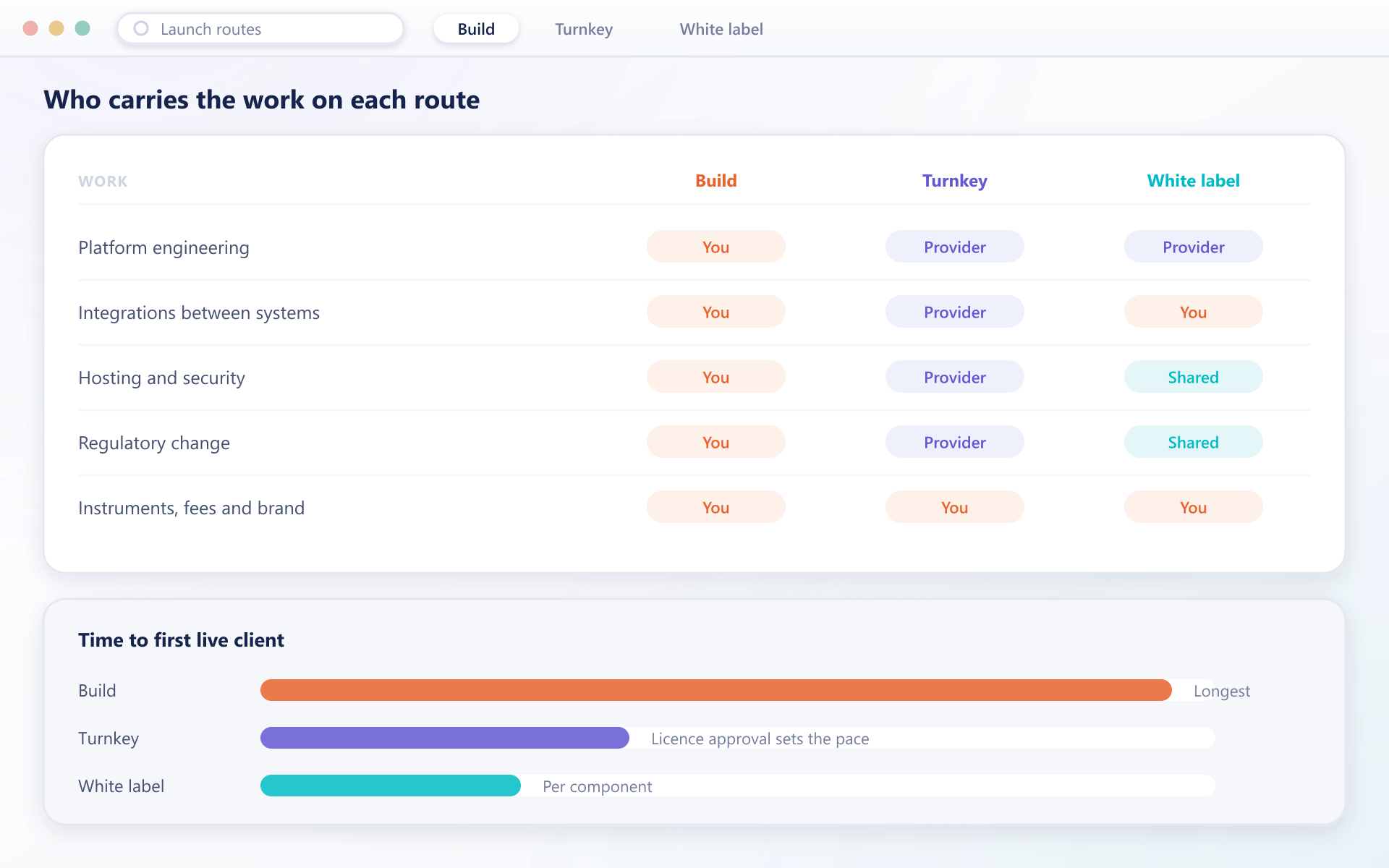
Each route moves the same work to a different place. Building keeps all of it with your team, turnkey hands most of it to a provider, and white label splits it one component at a time.
The options
What each one gives you, and what it takes back
Build in-house
Your own engineers build and run the platform, CRM, integrations and back office, and you buy only market data and liquidity.
- Suits
- Well-funded firms whose edge is the technology itself, with time before they need revenue.
- You gain
- Complete control of the roadmap, the data model and the client experience.
- It costs you
- Years of engineering before you match what can be bought, then permanent maintenance, security and regulatory work. Hiring and keeping that team is a business in its own right.
Buy a turnkey package
A provider assembles the whole brokerage, configures it for your jurisdiction and brand, and hands it over ready to trade.
- Suits
- First-time brokerages, and teams that want one accountable party through launch.
- You gain
- The shortest path from licence to live trading, with one contract and one support desk.
- It costs you
- Less freedom to pick each component. You work within the provider's stack and may pay for parts you later replace.
White label one component
One part of the stack, such as the trading platform, the CRM or copy trading, runs under your brand while the rest of your setup stays as it is.
- Suits
- Operating brokers adding a product or replacing one weak layer.
- You gain
- A branded product without building it, and without changing the systems that already work.
- It costs you
- You still own the integration between the white label and the rest of your stack. Several white labels from different providers turns into the separate-vendor setup.
Side by side
The criteria that separate them
| Criterion | Build in-house | Buy a turnkey package | White label one component |
|---|---|---|---|
| Time to first live client | Longest, as the product has to exist first | Shortest; licence and payment approvals set the pace | Short for the component, then depends on your stack |
| Upfront cost | Highest: a team before any revenue | Setup fees plus recurring licences | Setup fee and licence for one component |
| Ongoing cost | Salaries, infrastructure, security, regulatory change | Recurring fees for the whole stack | Recurring fee plus your own integration work |
| Roadmap control | Complete | The provider's, with configuration on your side | The provider's, for that component |
| Your brand | Everywhere | Everywhere | On the white-labelled component |
| Who answers when it breaks | Your team | The provider | The provider for the component, you for the joins |
| Regulatory change work | Yours | Mostly the provider's | Shared |
| Usually the right start for | Firms whose product is the technology | New brokerages | Existing brokerages |
In practice
How the differences show up
The real cost of building
The licence line on a build is zero, which flatters it in year one. The cost arrives as salaries, infrastructure and the integrations nobody planned for: payment providers, KYC vendors, liquidity and reporting. Each changes on its own schedule, and each change is work for your team. A fair comparison runs over three years and includes the months before the first client trades.
What turnkey does not remove
A turnkey package takes the technology off the critical path. It does not remove the licence application, bank and payment-provider onboarding, or the decisions only you can make: instruments, client groups, leverage, fees and onboarding rules. Plan for those whichever route you take.
When white label is the right size
White label works best as a targeted change: adding copy trading to an existing brokerage, putting a branded terminal in front of an existing book, or replacing a CRM that has become the bottleneck. It works less well as a way to assemble a whole brokerage, because the joins between components remain yours.
Changing route later
Routes are rarely permanent. Brokers start on turnkey and replace components as they grow, and white label customers sometimes consolidate onto one stack. What keeps a change of route cheap is a shared account model and a clean data export, so ask about both before you sign.
MultiPrimeX
Where MultiPrimeX fits
MultiPrimeX offers turnkey packages and white label components built on the same products, so a broker can start on one route and move to the other without changing platform.
FAQ
Build or buy: common questions
6 short answers to what teams ask before a demo.
Rarely as a first step. Building makes sense when the technology is the product you plan to sell and you can fund a team for years before revenue. Most new brokerages compete on market, service and marketing, and buy the technology.
Scope. Turnkey covers the whole brokerage, from platform and CRM to payments, liquidity and risk, configured and handed over. White label covers one component under your brand, which you connect to the rest of your setup.
The technology is rarely the slowest part. Licence approval and payment-provider onboarding usually set the date, so a timeline is confirmed once your jurisdiction and scope are known.
Yes, and many brokers replace one component at a time as they grow. Check that the provider's modules can run alongside a third-party or in-house component, and how client data is exported.
For one component, yes. For a whole brokerage, several white labels from different providers can cost more once the integration work between them is counted. That is the case turnkey is designed for.
You should. Confirm in the contract that client records, trading history and documents can be exported in a usable format, and how quickly.
Still have a question?
A specialist will answer it directly, with your set-up in mind.
Ask a specialistTell us where you are starting from
A licence in progress, a live brokerage, or a technology idea. We will tell you which route fits and what it involves.