Compare
A-book, B-book or hybrid execution
Every broker decides what happens to a client's trade once it is placed: pass it to the market, take the other side, or decide client by client. That choice shapes the broker's revenue, risk, licence and the technology it needs.
An A-book broker passes client trades to liquidity providers and earns from spreads and commission, with little market risk. A B-book broker takes the other side of client trades, earns when clients lose and carries the market risk. A hybrid broker routes each client or instrument to one book or the other, and most growing brokers end up there.
At a glance
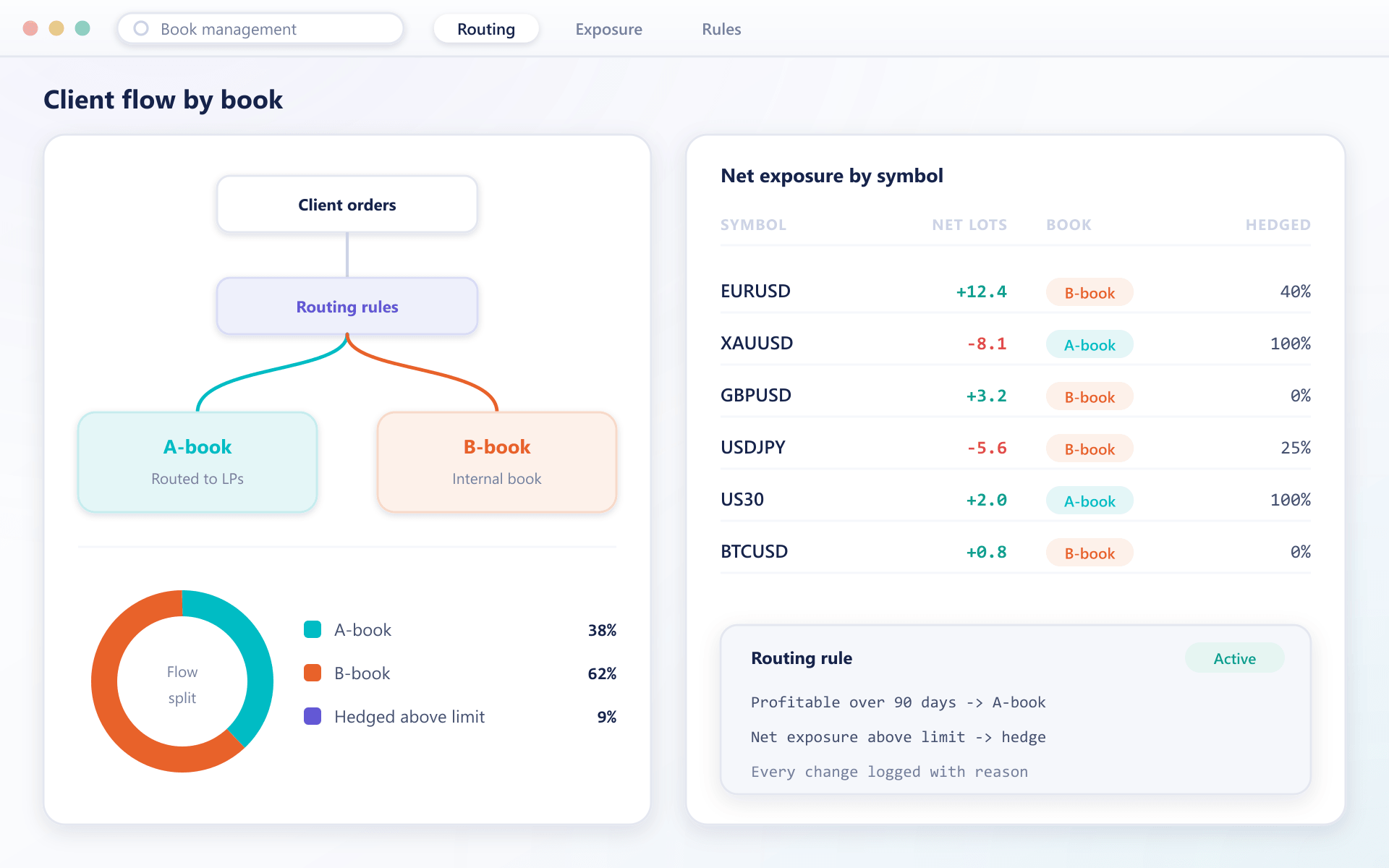
One trade, two possible destinations
Routed out, the trade becomes a hedge with a liquidity provider. Kept in, it becomes part of the broker's own exposure. A hybrid broker makes that call by client and by instrument, and needs to see the result in real time.
The options
What each one gives you, and what it takes back
A-book (pass to market)
Client trades are passed to liquidity providers. The broker earns a markup on the spread or a commission, and its profit does not depend on whether clients win.
- Suits
- Brokers serving profitable or high-volume traders, and those positioning on transparency.
- You gain
- Little market risk, and no conflict of interest with clients' results.
- It costs you
- Thinner revenue per trade, dependence on liquidity providers' pricing and fills, and a hedging cost on every trade.
B-book (take the other side)
The broker takes the other side of client trades and manages the net exposure itself. Client losses are broker revenue and client profits are broker losses.
- Suits
- Brokers with large, diversified books of mostly retail clients and strong risk management.
- You gain
- Higher revenue per client, and no liquidity cost on internalised trades.
- It costs you
- Market risk that can turn quickly in fast markets, a conflict of interest that regulators watch closely, and usually a licence for dealing on own account with higher capital requirements.
Hybrid (decide per client)
Each client, group or instrument is routed to one book or the other, often with B-book exposure above a set threshold hedged out.
- Suits
- Most growing brokers, once they have enough trading history to profile clients.
- You gain
- Risk is passed on where it is concentrated and kept where it is diversified.
- It costs you
- It needs good data and tooling: client profiling, exposure monitoring, routing rules, and records of why each decision was made.
Side by side
The criteria that separate them
| Criterion | A-book (pass to market) | B-book (take the other side) | Hybrid (decide per client) |
|---|---|---|---|
| How the broker earns | Spread markup and commission | Client losses, plus spread | Both, by client segment |
| Market risk | Low | High, managed by the broker | Kept only where it is diversified |
| Conflict of interest | Low | Built in; must be managed and disclosed | Present on the internalised share |
| Liquidity and hedging cost | Paid on every trade | Only when the broker chooses to hedge | Paid on routed flow and on hedges |
| When clients profit | Broker revenue unaffected | Broker loses | Profitable clients can be routed out |
| Technology needed | Bridge, liquidity, execution monitoring | Exposure monitoring, risk limits, stop-out controls | All of these, plus routing rules and client profiling |
| Licence and capital | Often lower capital requirements | Usually dealing on own account, with more capital | Usually licensed as dealing on own account |
In practice
How the differences show up
Where the revenue comes from
An A-book broker earns the same whether clients win or lose, so its revenue grows with volume. A B-book broker earns most when clients lose, which is why consistently profitable traders are usually routed to the market once they are identified. Over time, the split between the two books becomes one of the main levers on a broker's P&L.
What can go wrong
A-book risk is mostly operational: a liquidity provider widens spreads or rejects orders, or a bridge mishandles a reconnect. B-book risk is market risk: a weekend gap or a news spike moves many client positions the same way at once. Hybrid brokers carry a smaller version of both, plus the risk of routing rules that nobody has reviewed in months.
What regulators look at
Regulators focus on conflicts of interest and fair treatment of clients. Brokers that deal on their own account are generally expected to show a best-execution policy, conflict disclosures and capital that matches their exposure. Check the rules in your jurisdiction before choosing a model, because they can decide it for you.
The tooling each model needs
A-book needs a reliable bridge, good liquidity and execution monitoring. B-book needs real-time exposure, risk limits and stop-out controls. Hybrid needs both, plus routing rules by client and instrument, and a record of why each client sits in the book it does.
MultiPrimeX
Where MultiPrimeX fits
MultiPrimeX covers each part of the model you choose: BridgeX for routing and partial hedging, Prime Liquidity for routed flow, RiskDesk for exposure and book management, and TradeX for brokers running their own terminal.
FAQ
A-book and B-book: common questions
6 short answers to what teams ask before a demo.
An A-book broker passes client trades to liquidity providers and earns from spreads or commission. A B-book broker takes the other side of client trades, so it earns when clients lose and pays when they win.
In most major jurisdictions, yes, under a licence that allows dealing on own account and with conflict-of-interest rules attached. Requirements differ by regulator, so check yours before choosing a model.
Because client books are mixed. Much retail flow is diversified and can be internalised, while a smaller group of consistently profitable or large traders is safer routed to the market. A hybrid model treats each group accordingly.
Usually from trading history: profitability, trade size, holding time, strategy and how often positions are opened around news. The rules should be written down and reviewed, and each routing decision recorded.
It reduces market risk but does not remove it. Exposure can exist in the gap between a client trade and its hedge, and the broker still depends on its liquidity providers' pricing and fills.
Yes, if the technology supports routing by client group and instrument. Moving from A-book to hybrid is common once a broker has enough history to profile clients. Check that your licence covers the model you move to.
Still have a question?
A specialist will answer it directly, with your set-up in mind.
Ask a specialistTell us how your book looks today
Your client mix, instruments and the jurisdiction you are licensed in. We will show how routing, hedging and exposure monitoring would work for that book.