Platforms
The layer between your platform and your providers
Bridge and aggregation software is where symbol mappings quietly go wrong and routing rules quietly go stale. We will administer the one you have — and if it has stopped serving you, we will tell you that too.
See it live
Every session, mapping and route in one reference
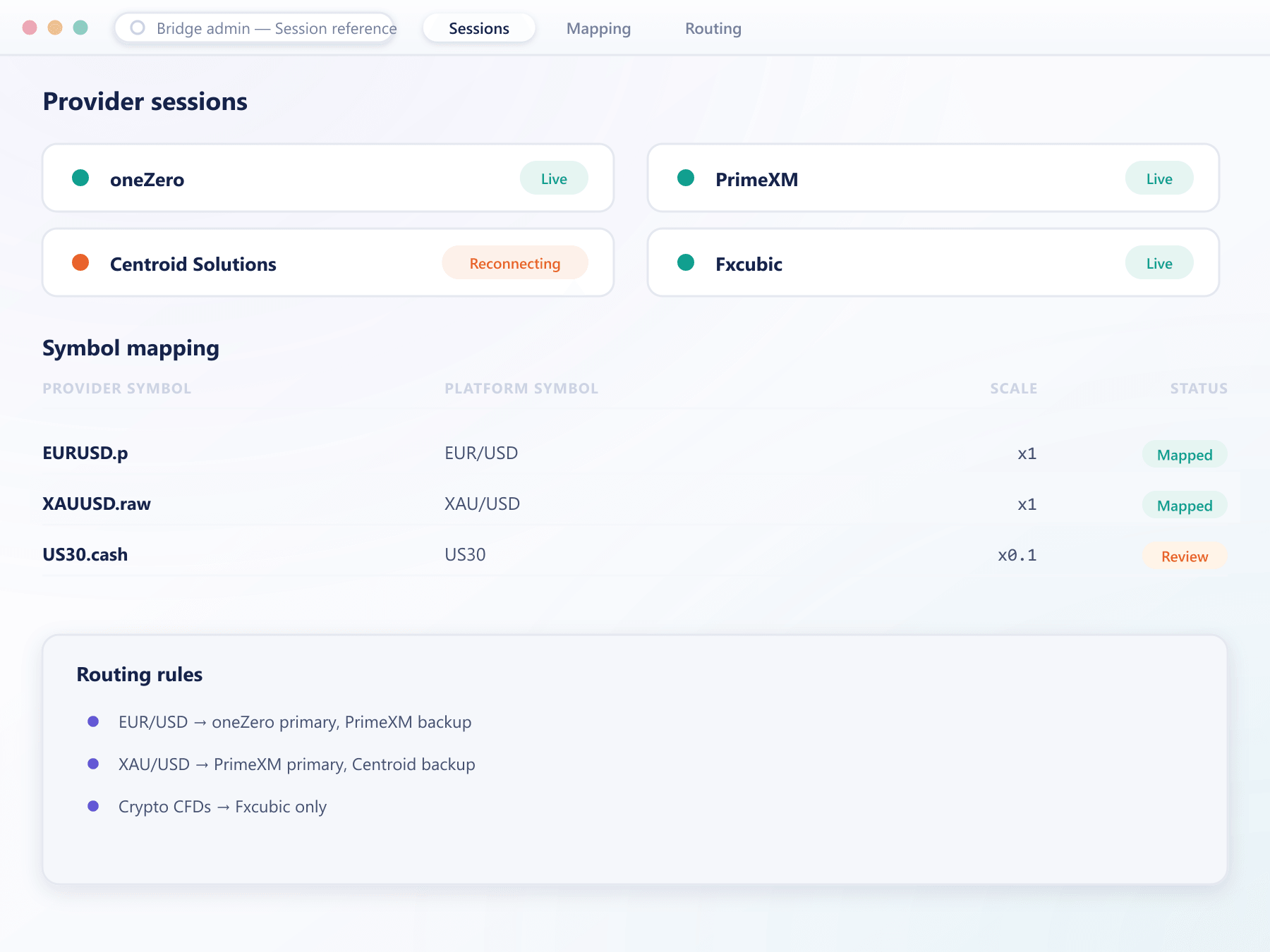
Session state, symbol mappings and routing rules for each connected provider, kept in the same reference our engineers actually work from.
What we administer
Six surfaces, whichever software it runs on
Sessions
Connection state, sequence handling, reconnection behaviour and certification with each counterparty. A dropped session that reconnects silently is still an incident and is treated as one.
Symbol mapping
Where a provider names or scales an instrument differently, the mapping absorbs it. Getting this wrong is how a position ends up a hundred times the intended size.
Routing rules
Which flow goes to which destination, under what conditions, and what happens when the preferred destination is unavailable. Written as rules rather than held in one person's head.
Markup policy
Spread and markup applied per instrument group and per client segment, reviewed against what the flow is actually earning rather than left at the value it launched with.
Execution quality
Fill rates, rejection patterns, slippage distribution and latency per destination, reported regularly so a degrading provider is a conversation rather than a surprise.
Failover behaviour
What the bridge does when a feed goes stale or a destination stops responding, tested deliberately instead of discovered during a market event.
Two honest paths
Keeping your bridge is a legitimate answer
We sell a bridge of our own. That is exactly why the comparison below is worth stating plainly rather than leaving implied.
Keep what you have
You already run bridge or aggregation software and it works.
We administer it as it stands, under the same change control as the rest of your stack
Sessions, mappings, routing rules and markups become maintained rather than inherited
Execution quality reporting is added on top so provider performance is visible
No migration, no cutover, no change to your provider relationships
Move to BridgeX
Your licensing, capability or support arrangement has stopped working for you.
Aggregation, routing and execution control on infrastructure we build and own
Provider connections rebuilt and validated rather than copied across
One vendor for the bridge and the platform administration around it
Run in parallel first, cut over only once execution matches side by side
If you do decide to move
Nobody switches bridges on a specification sheet
The two run alongside each other against the same providers until the comparison is settled by measurement.
- 01
Connect
The new bridge is connected to the same providers and configured to mirror the routing you run today, without receiving any client flow.
- 02
Shadow
It prices and evaluates alongside the existing bridge so the two can be compared on identical conditions rather than on claims.
- 03
Compare
Fill rates, rejections, slippage and latency are measured side by side over a period long enough to be meaningful.
- 04
Switch
Flow moves across in stages, starting with a segment you choose, with the previous bridge left running until you are satisfied.
FAQ
Bridge administration: common questions
6 short answers to what teams ask before a demo.
Yes — oneZero, PrimeXM, Centroid Solutions and Fxcubic are the ones we see most often, and most desks already run one that works. Replacing something that works is rarely the right first move; we take on its administration in the same way we take on a trading server.
No. The two paths are offered separately and priced separately. A migration only makes sense when something specific about your current arrangement has stopped working — licensing, capability, or the support behind it.
By running both against the same providers under the same conditions and comparing fill rates, rejections, slippage and latency over a meaningful period. Nobody should switch bridges on the strength of a specification sheet.
Symbol mapping that was correct when it was set up and has drifted since, usually after a provider changed a contract specification. It stays invisible until a position turns out to be a different size than anyone intended.
We handle the technical connection and report on execution quality. Which providers you trade with, and on what commercial terms, stays with you — we give you the evidence to have those conversations.
That is the normal approach. Flow moves by segment, starting with one you choose, and the previous bridge stays running and reachable until you decide it is no longer needed.
Still have a question?
A specialist will answer it directly, with your set-up in mind.
Ask a specialistFind out what your routing is actually doing
We will review your mappings, routing rules and execution quality per destination, and give you the findings whether or not you change anything.