Services
Configuration is a discipline, not a ticket queue
Every setting on a trading platform was correct on the day someone typed it. What decides whether it is still correct today is whether anyone is reviewing it against the outside world.
Session and holiday calendars, stock splits and other corporate actions, monitoring thresholds, routine instrument additions
Swap rate revisions, spread and markup changes, new client groups, provider weighting
Leverage bands, margin policy, liquidation thresholds, instrument removal
See it live
Leverage tiers and swap tables, kept current
The configuration surface itself — leverage bands, rollover and swap settings per instrument group — reviewed on a schedule rather than left at its launch values.
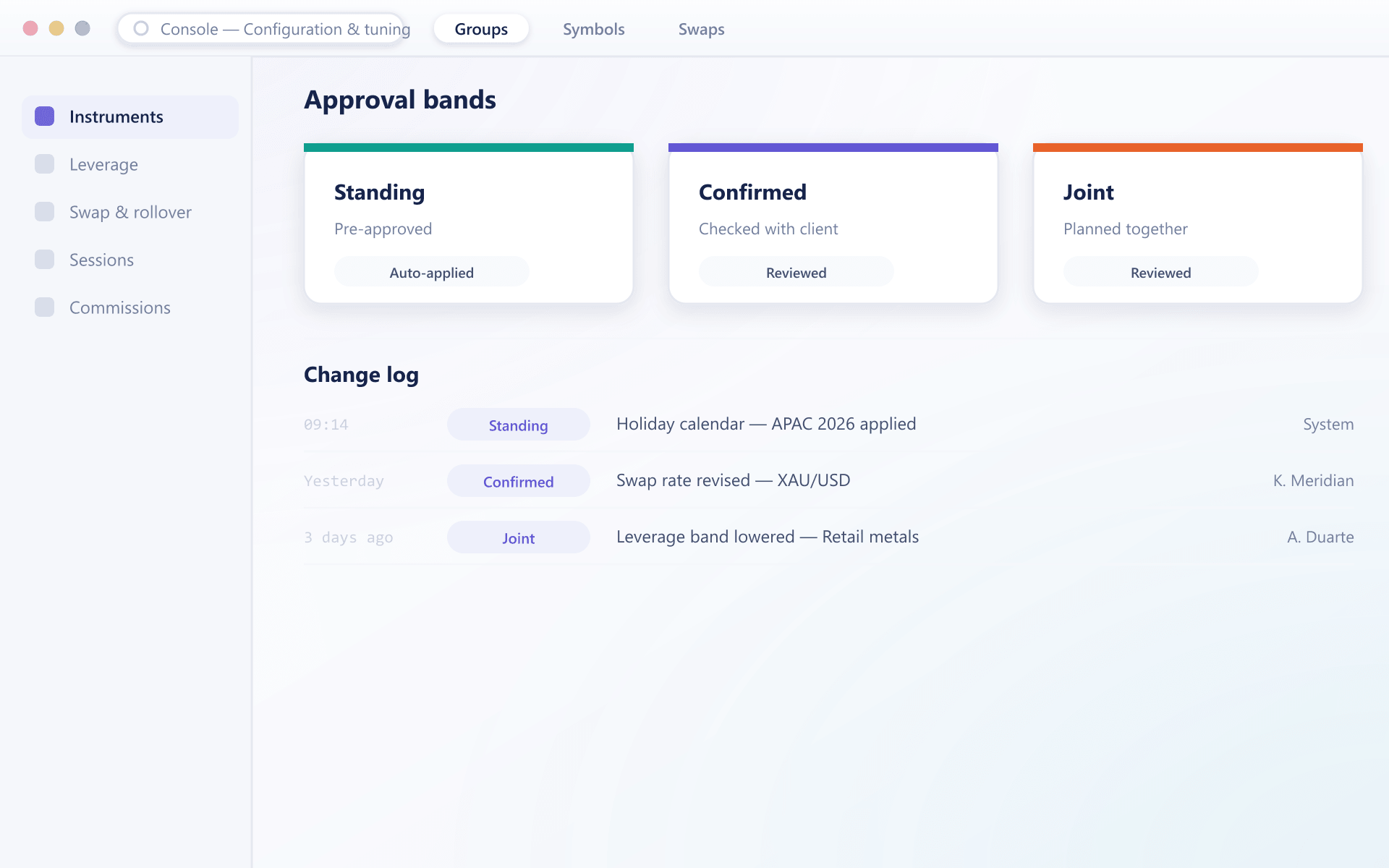
Why the bands exist
Not every change deserves the same ceremony
Treating a holiday calendar update like a leverage change slows both down. Treating a leverage change like a calendar update is how clients get hurt.
Work that has to happen on a schedule and carries no commercial judgement. Waiting for sign-off on these is how a calendar gets missed.
Changes that alter what something costs or earns. We propose them with the reasoning attached; you decide.
Changes that alter client risk. These are scheduled deliberately, with the effect on open positions calculated before anything is applied.
The lifecycle of a change
Four steps, every time, regardless of size
Request
Every change starts as a written request: what is changing, why, which groups and instruments it touches, and what reversing it would involve.
Review
A second engineer checks the request against the current state. On anything touching instrument economics, the effect on existing positions is calculated rather than assumed.
Schedule
Changes land in a window appropriate to their blast radius. Symbol economics move outside market hours; a monitoring threshold does not need to wait for the weekend.
Record
The applied change, its author, its approver and its reversal step are written to a log you can read yourself without submitting a request to us.
What we usually find first
Four kinds of drift, on almost every inherited environment
Swaps that stopped matching
Rates set at launch and never revisited against what providers actually charge. The gap accrues nightly and is invisible in any single day's numbers.
Groups that multiplied
A new client group cloned for each special case until nobody can say which segment is on which terms, or why three of them differ by a single basis point.
Symbols that never left
Instruments that stopped being traded years ago, still carrying live specifications, still visible to some groups, still an exposure nobody is watching.
Markups nobody owns
A spread adjustment made for one client in one market that quietly became the default because it was applied at the group level rather than the account level.
FAQ
Configuration and tuning: common questions
6 short answers to what teams ask before a demo.
For standing work — session calendars, holiday schedules, corporate actions, monitoring thresholds — yes, under pre-agreed approval, because waiting for sign-off is how a calendar gets missed. Anything that changes what an instrument costs or earns is confirmed with you first.
Every applied change is written to a log with its author, approver, reasoning and reversal step. You can read it directly rather than requesting a report from us.
On a fixed cycle, checked against what your providers actually charge rather than against the last value in the platform. This is the single most common place we find money leaking on an inherited environment.
Yes, and it is usually the highest-value work on a long-lived environment. We map the current group and symbol structure against the segments you actually sell to, then consolidate in stages rather than in one disruptive change.
Splits, dividends and similar adjustments are applied ahead of the relevant date from a maintained calendar. Handling them reactively, after a client asks why a position looks wrong, is the failure mode this replaces.
Yes — it is your platform and your access is unaffected. In practice most desks find it works better to route changes through one process, because two people changing configuration independently is how state stops being knowable.
Still have a question?
A specialist will answer it directly, with your set-up in mind.
Ask a specialistFind out what has drifted
We will compare your swaps, groups, symbols and markups against what they should be, and hand you the list.