Services
The cutover is rehearsed before it is real
Whether it is a first build or a move off something you have outgrown, the risky part is never the installation. It is the sequence, the timing and the reconciliation — so those are the parts we run twice.
See it live
The rehearsal, staged the same way as the cutover
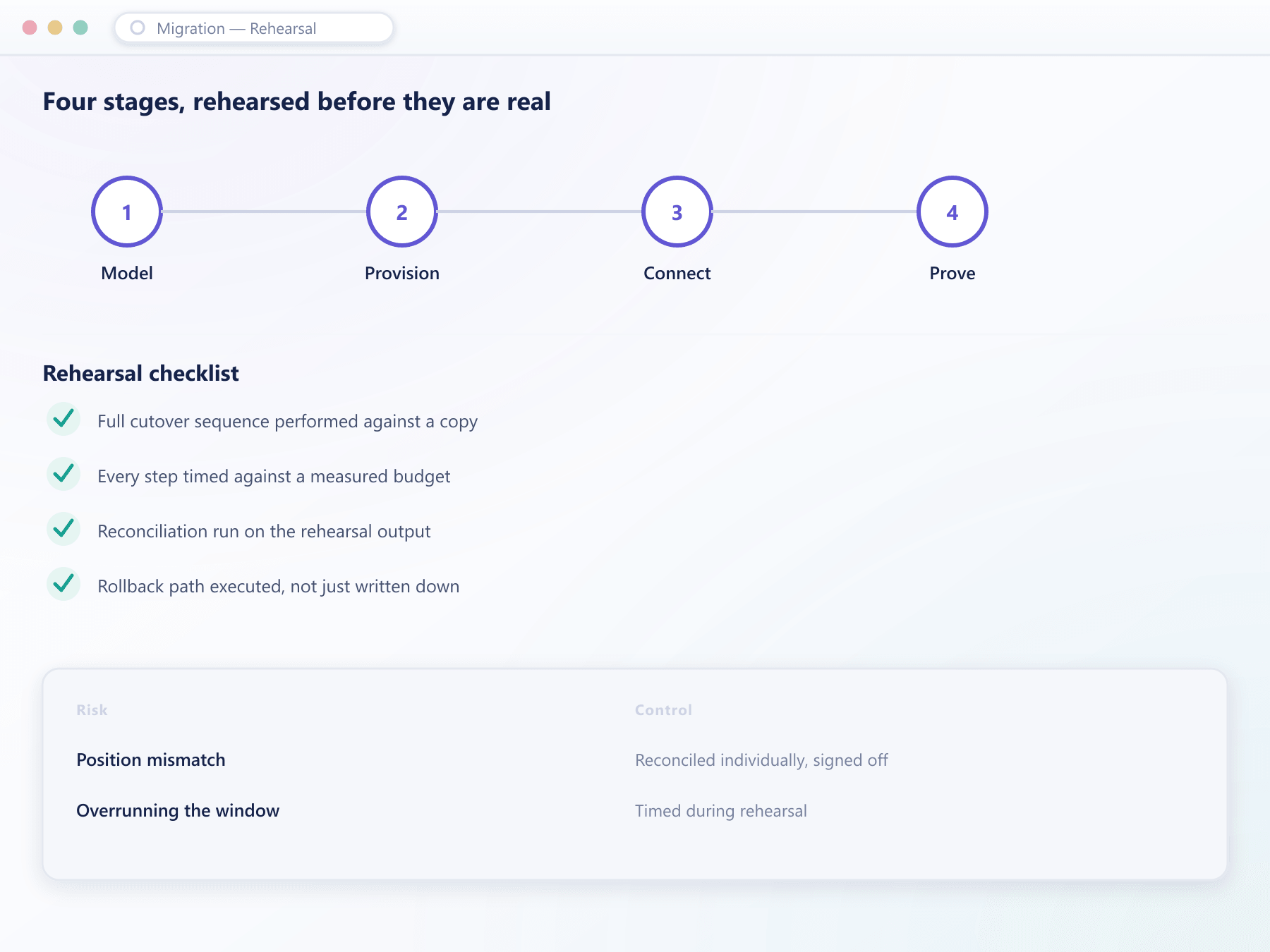
Model, provision, connect and prove — each phase timed during rehearsal so the live window has a measured duration rather than an estimate.
A new build
Four stages, and the first one has nothing to do with software
Model
Decide the structure before installing anything
How instruments group, how client segments differ, which providers serve which flow. These decisions are expensive to reverse later and cost nothing to get right at the start.
Provision
Build the environment on the right ground
Servers placed for proximity to your providers, sized for your expected load, with the standby topology in place from day one rather than added after the first outage.
Connect
Bring up providers one at a time
Each connection is certified and observed on its own before it contributes to a client-facing price, so a misbehaving feed is identified in isolation instead of in aggregate.
Prove
Trade it before anyone else does
Orders are placed through every path — each instrument group, each client segment, each destination — and the resulting positions, margin and statements are checked against expectation.
Migration risk
Six things that go wrong, and what stops each one
Every open position reconciled individually and signed off before clients reconnect
Ledgers compared on both sides; differences investigated rather than adjusted away
Contract sizes and precision compared instrument by instrument against the source
Credential reset communicated ahead of the window with a tested recovery path
Full sequence timed during rehearsal so the window has a measured duration
Source environment left intact and reachable until reconciliation is signed off
The rehearsal
The night itself should be boring
A cutover that has been performed once already, end to end, is an execution task. One that has only been planned is an experiment with your clients’ positions.
The full cutover sequence performed against a copy, start to finish
Every step timed, so the live window has a duration rather than a hope
Reconciliation run on the rehearsal output and checked line by line
The rollback path executed too, not just written down
A named owner assigned to each step before the live run
FAQ
Setup and migration: common questions
6 short answers to what teams ask before a demo.
The build itself is usually days once provider credentials and instrument requirements are settled. What extends a project is almost never the installation — it is third-party approvals and decisions about how the book should be structured.
Skipping the rehearsal. Every step in a cutover is individually straightforward; what goes wrong is the sequence, the timing and the reconciliation, and none of those can be verified from a written plan alone.
Usually a credential reset, communicated ahead of the window with a recovery path that has been tested. Everything else should be invisible to them, and if it is not, the migration was not rehearsed properly.
Yes. The source environment stays intact and reachable until reconciliation on the target has been signed off. The rollback path is executed during the rehearsal, so it is a proven route rather than a paragraph in a plan.
It is carried across where the target platform supports it. Where it does not, history is archived in a queryable form so client statements and any regulatory request can still be answered.
Often, yes — by client segment or by instrument group. Both environments run under the same change control and connect to the same providers during the transition, so behaviour stays consistent while the move happens.
Still have a question?
A specialist will answer it directly, with your set-up in mind.
Ask a specialistBring us the move you have been putting off
We will tell you what it involves, what it risks and how long the window needs to be — before anyone commits to a date.