Platforms
cTrader, configured around your book rather than a default
Group profiles, price streams and symbol settings are where the commercial decisions actually live. Getting them right is the difference between a platform that reflects your business and one that constrains it.
See it live
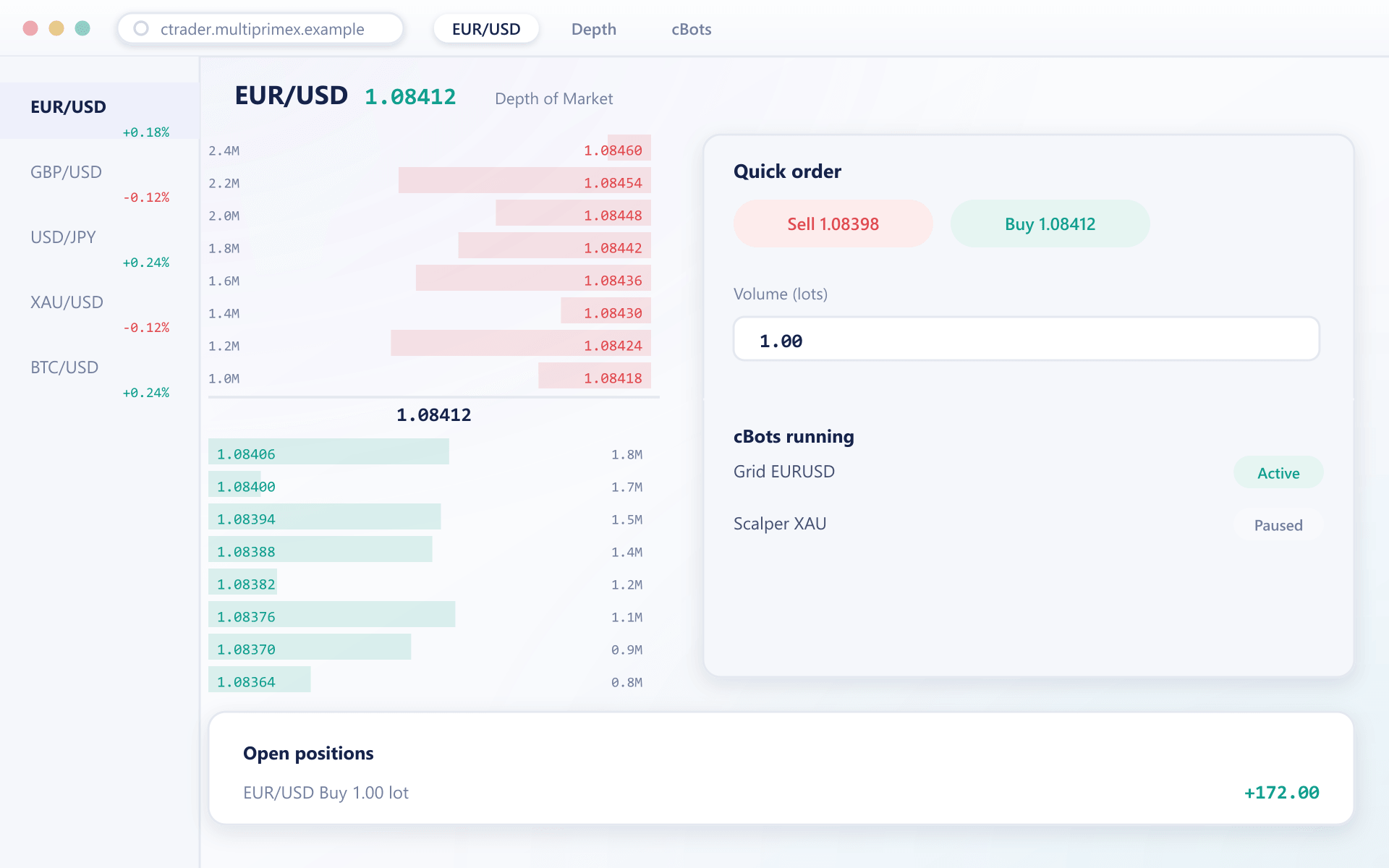
The terminal your clients actually trade on
Group profiles, price streams and symbol settings are configuration decisions — this is what a client sees once they are applied.
How a price reaches a client
Three stages, each of them configuration
- 1
Source
Each provider feed is connected and validated on its own before it is allowed to influence a client-facing price, so a bad source is identified at the edge.
- 2
Shape
Markup, minimum spread and filtering rules are applied per symbol group. The rules are written down and reviewed rather than accumulated by successive one-off adjustments.
- 3
Distribute
The shaped stream reaches the group profiles entitled to it. Different client segments can see genuinely different pricing without maintaining separate environments.
Group profiles
The single most useful thing to get right
Almost every question about who pays what, who can trade what, and who sees which price resolves to a group profile.
Segments that mean something
Retail, professional and institutional groups differ in leverage, commission, permitted instruments and the pricing they receive — configured deliberately rather than cloned from whichever profile existed first.
Instrument entitlement
Which symbols a group can trade is part of the profile, so restricting an instrument for one segment does not require withdrawing it from the platform.
Commission and markup
Both are set per profile, which is what allows a raw-spread offering and a marked-up offering to coexist on the same server without contradiction.
Swaps and dividends
Financing and dividend adjustments are maintained against what your providers actually charge, and applied per instrument group rather than by a single global rule.
The other half
Back office is part of the platform
Trading configuration and operational access drift apart the moment they are administered by different people. We treat them as one surface.
Role-scoped access
Support staff, dealers and finance see the functions their job needs and nothing beyond it.
Attributable actions
Every administrative action carries the person who performed it, which is what makes an audit answerable.
Reporting that reconciles
Operational reporting is derived from the same records as client statements, so the two never disagree.
Partner structures
Introducing broker hierarchies and their commission arrangements are configured and maintained alongside the trading setup.
FAQ
cTrader administration: common questions
6 short answers to what teams ask before a demo.
Yes. Markup, commission, minimum spread and instrument entitlement are all properties of a group profile, so a raw-spread offering and a marked-up offering coexist on one environment without needing separate servers.
Each feed is connected and observed on its own first — quote continuity, staleness behaviour and rejection patterns — before it is permitted to contribute to a client-facing price. Problems are then found at the edge rather than in the book.
We do, on a review cycle checked against what your providers actually charge. Dividend adjustments on equity instruments are applied ahead of the ex-date rather than in response to a client query.
Yes. Role scoping, access reviews, partner structures and operational reporting are part of the same engagement, because separating them is how permissions quietly drift.
It commonly does. Provider connections are configured once and shared, so pricing and routing behave consistently across both environments rather than being maintained twice and drifting apart.
Group profiles. On most inherited environments they have multiplied over time until nobody can say which clients are on which terms, and that is where both revenue leakage and risk exposure tend to hide.
Still have a question?
A specialist will answer it directly, with your set-up in mind.
Ask a specialistStart with who is on which terms
We will map your existing group profiles against the segments you actually sell to, and show you where the two have stopped matching.