Controls & Compliance
Screening after settlement is just reporting
If the check runs once the money has moved, you no longer have a decision to make. You have a completed transaction and a disclosure to write.
See it live
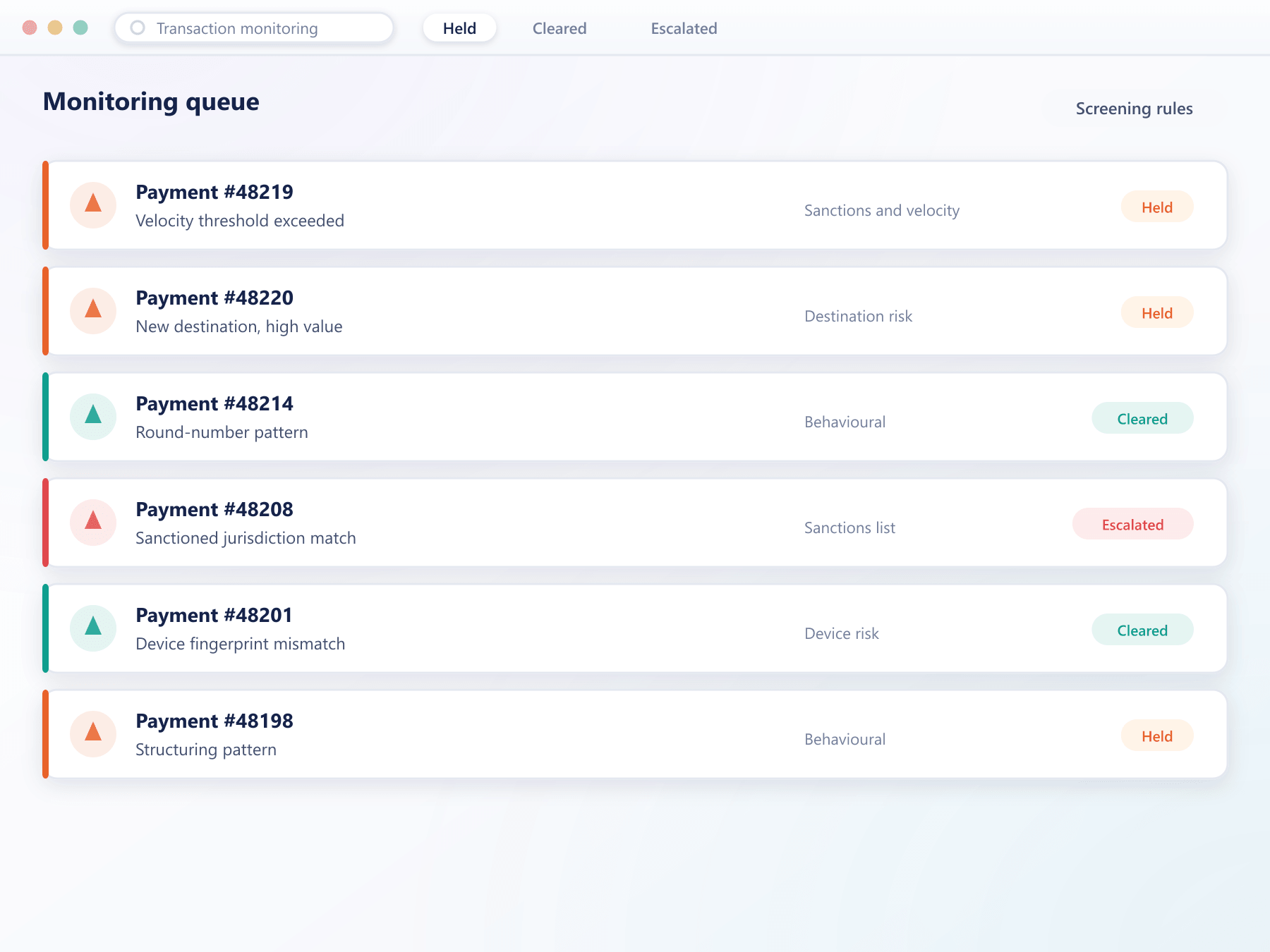
Every check, and its outcome, in one queue
Pass, hold, escalate or block — each screening decision lands with the signal that caused it attached, so a held transaction is never a mystery to whoever picks it up.
What runs on the path
Every check runs before the money moves, not after
Sanctioned and flagged destinations
Destination addresses and bank details are checked against the lists you subscribe to before a movement is authorised. Finding out afterwards leaves you with a completed transaction and a disclosure to make.
Source-of-funds signals
Where an incoming digital asset transfer carries risk indicators from its own history, that context arrives with the deposit rather than being something you would have to go and look for.
On-chain risk scoring
Digital asset addresses carry a score derived from what they have been associated with — mixers, sanctioned entities, known theft. The score arrives with the transaction and can gate it, rather than being something you look up later.
Withdrawal address whitelisting
Outbound destinations can be restricted to an approved list, with new entries subject to their own approval and a cooling period before first use. It is the control that survives a compromised operator account.
Pattern rules
Structuring, rapid in-and-out movement, and behaviour that departs sharply from a client's own baseline. Rules are yours to tune, because a threshold that fits one book generates noise on another.
Velocity and cumulative exposure
Amount alone is a weak signal. Ten transactions below a threshold in an hour is the pattern worth catching, and it is invisible to any check that looks at one movement at a time.
Four outcomes
Every check ends in one of these, and every one is recorded
Nothing raised. The movement proceeds and the check is recorded.
Paused for review. The client is told it is being checked, not that it failed.
Routed to a named reviewer with the signals that caused it attached.
Refused, with the reason recorded and the decision attributable.
Recording the passes matters as much as recording the blocks. It is the difference between having a control and claiming one.
FAQ
Payment screening: common questions
6 short answers to what teams ask before a demo.
Before. Screening that runs after settlement is reporting, not control — you end up with a completed transaction and a disclosure to make rather than a decision you got to take.
Yes. The monitoring path is designed around a provider you nominate rather than one we impose, because this is a relationship most firms already have and have already justified to a regulator.
They answer different questions. BrokerOS screens the person — who they are, whether they should be onboarded, what their risk rating is. This screens the movement — this destination, this amount, this pattern, right now. Both are needed and neither replaces the other.
It goes to a review queue with the signals that caused the hold attached, and the client is told it is being checked rather than that it failed. The reviewer's decision, their identity and their reasoning are recorded together.
Yes, and you should. Thresholds that fit one book generate constant noise on another, and a monitoring system producing alerts nobody reads is worse than none because it creates a record of things you did not act on.
Yes. Being able to show that a check ran and returned nothing is as important as recording the ones that raised something — it is the difference between having a control and claiming one.
Still have a question?
A specialist will answer it directly, with your set-up in mind.
Ask a specialistBring your compliance officer
This is the part of a payment review that needs somebody from the second line in the room rather than a summary afterwards.