Treasury & Custody
The wallet model decides what you can prove later
Nobody thinks about balance structure until an auditor asks a question that should take a minute to answer and takes a fortnight instead.
See it live
Segregation, visible, not just asserted
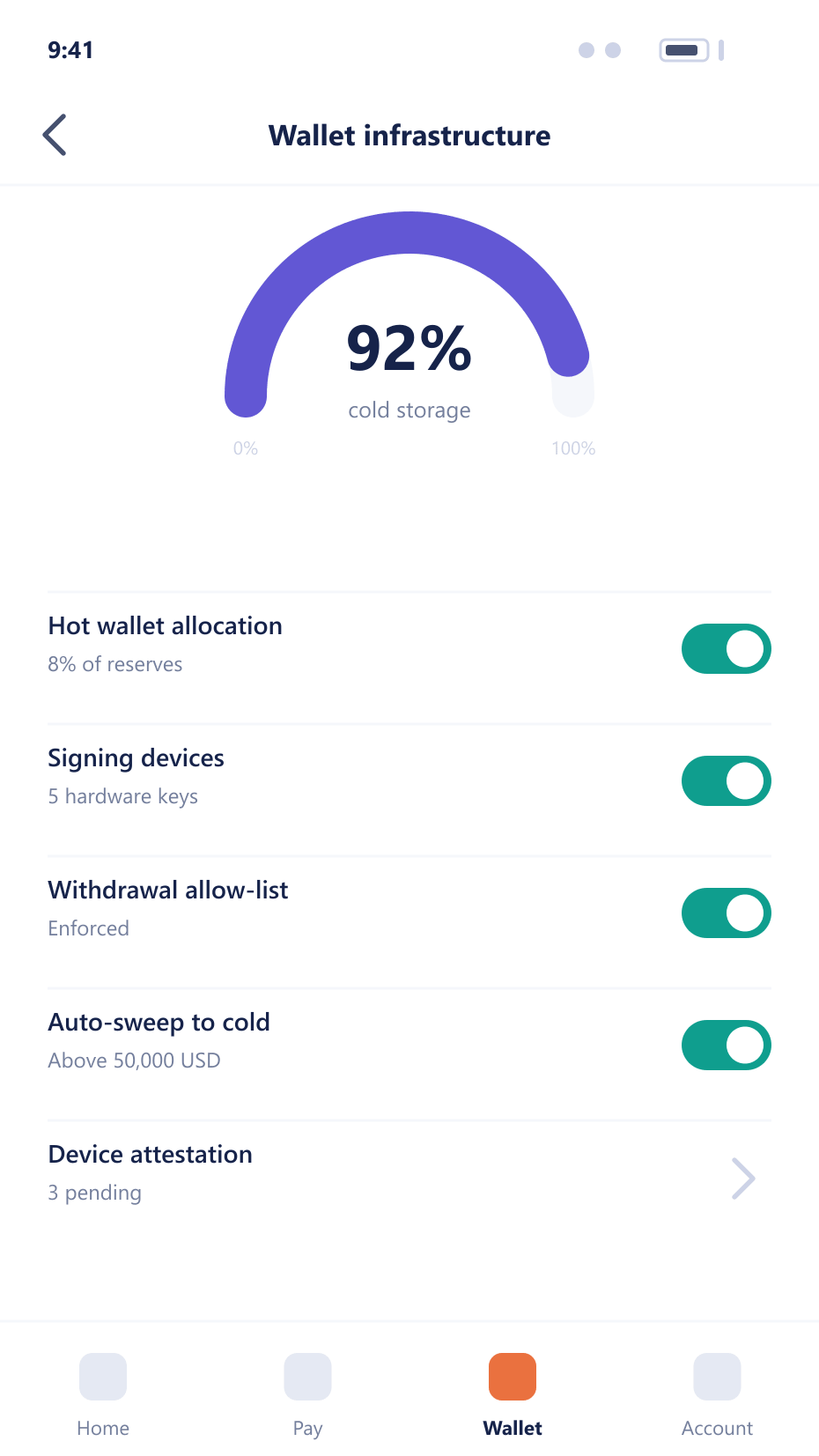
Device approval, key access and the security controls behind a client’s wallet, in the same interface they would use to review their own account.
Four layers
From a client identity down to the funds in treasury
One identity, many balances
Each client has an account that holds sub-balances per asset and per currency. A single client trading in three currencies and holding two digital assets is one record, not five unconnected ones.
Assigned, not improvised
Addresses are assigned to a client on a policy you choose — permanent per client, or fresh per payment. Either way the mapping is recorded, which is what makes an incoming transfer attributable without guesswork.
Moving funds into treasury
Received funds are consolidated into treasury on a schedule and threshold you set. Sweeping too eagerly wastes network fees; sweeping too rarely leaves value spread across addresses.
Client money is not your money
Client liability and operating funds are held and reported separately at the ledger level, so the question of what is actually yours has an answer that does not require a spreadsheet.
What it lets you answer
Four questions that should never take a fortnight
A wallet structure is worth exactly as much as the questions it can answer without anyone assembling a spreadsheet first.
What each client is owed, per asset, at any point in time
Which incoming transfer belongs to which client, and why
The total client liability against the total held
Every movement between client balance and treasury, with its reason
FAQ
Wallet infrastructure: common questions
6 short answers to what teams ask before a demo.
Each client has their own account with per-asset balances, and deposit addresses are assigned to them by a policy you choose. Whether that means a permanent address or a fresh one per payment is configuration — the mapping is recorded either way, which is the part that matters.
Client liability and operating funds are separate at the ledger level, not merely in reporting. The total owed to clients and the total you hold are both derivable at any moment, which is the question regulators tend to open with.
Consolidating received funds into treasury. Doing it on every deposit wastes network fees; doing it rarely leaves value scattered across addresses where it is harder to manage. The schedule and threshold are yours to set against your own volumes.
Yes, and this is the main practical reason the address mapping is recorded rather than derived. An incoming transfer resolves to a client without anybody having to work it out from amounts and timing.
The account is closed but its history is retained for your retention period, and any residual balance follows your unclaimed-funds policy. Deleting the record is not an option, because the obligation to be able to answer questions about it outlives the relationship.
No. It is the payment ledger, and it is designed to reconcile against your accounting rather than replace it. Exports are structured so the two agree instead of requiring a manual bridge each month.
Still have a question?
A specialist will answer it directly, with your set-up in mind.
Ask a specialistCan you answer those four today?
If any of them would need someone to go and work it out, that is the gap worth closing before anything else.