Treasury & Custody
Idle balances are a decision, not a default
A treasury that holds proof-of-stake assets is already making a choice about yield — it is just making it by not deciding. Staking turns that into a position you set deliberately, with a liquidity floor underneath it.
See it live
The floor, the staked portion, and what it is earning
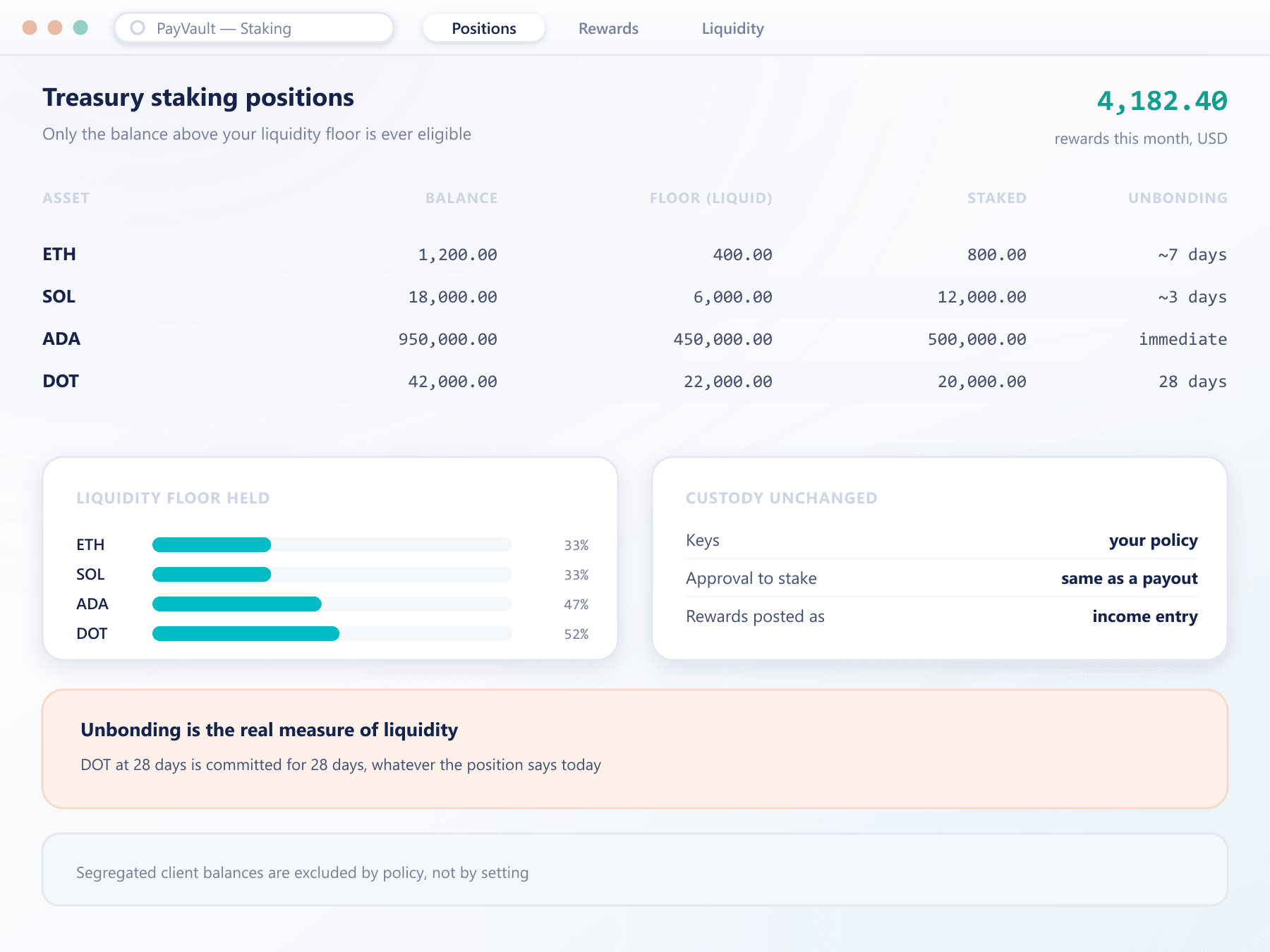
Each asset shows what must stay liquid, what is currently delegated, the exit period that applies and the rewards credited so far.
How it works
Four things that make this a treasury function rather than a bet
A liquidity floor you set
You define the balance that must stay immediately withdrawable per asset. Only what sits above that floor is eligible, so a staking position can never be the reason a client withdrawal waits.
Custody is not transferred
Assets are staked from wallets that remain under your key policy. Delegation is not the same as handing the balance to somebody else, and the distinction is what makes this defensible to an auditor.
Unbonding stated up front
Every protocol has its own exit period, from immediate to several weeks. The applicable period is shown before you commit, not discovered when you need the balance back.
Rewards recorded as income
Protocol rewards land as a distinct ledger entry against the originating wallet, so they reconcile as income rather than appearing as an unexplained balance increase.
What you decide
Four settings, and the last one is the one auditors ask about
Proof-of-stake networks only
Only assets whose protocol pays a staking reward are eligible. Stablecoin and fiat balances are not staked here — treating them as though they were is how a treasury ends up exposed to something it did not price.
The surplus above your floor
Expressed as a percentage of the balance or an absolute ceiling, reviewed as the balance moves rather than fixed at the moment you turned it on.
Bounded by unbonding
The real commitment is the exit period, not the term you choose. Your effective liquidity is the floor plus whatever unbonds within your worst-case withdrawal window.
Same authority as a payout
Starting, increasing and unwinding a position each require the approval level you already apply to moving funds, and each is written to the audit trail.
Three things worth saying plainly
What a yield figure does not tell you
Yield is not free money
A staking reward is compensation for taking protocol risk and giving up immediate access. If a rate looks unusually high, the difference is being paid for something — usually a longer exit or a weaker validator set.
Slashing is a real outcome
Several networks penalise validator misbehaviour by destroying part of the stake. Validator selection matters, and anyone who describes staking as risk-free has not read the protocol rules.
Client funds are not yours to stake
Whether segregated client balances may be staked at all is a regulatory question in your jurisdiction, not a product setting. The platform enforces the separation; the decision has to come from your own advice.
FAQ
Staking: common questions
6 short answers to what teams ask before a demo.
Only to the portion actually staked, and only for the protocol's unbonding period. The liquidity floor you set is never staked, so the balance you committed to keeping available stays available.
That is a regulatory question rather than a product one, and in most jurisdictions the answer for segregated client balances is no. The platform keeps the separation enforceable; whether your own treasury balances may be staked is for your compliance advice to decide.
You do. Staking delegates validation rights, not custody — the assets remain in wallets governed by your existing key policy and approval thresholds.
They are credited to the originating wallet as a separate ledger entry, labelled as protocol reward income, so your reconciliation shows where the increase came from instead of an unexplained movement.
Three things: the exit period, during which you cannot move the balance; validator performance, since several networks slash for misbehaviour; and the price of the asset itself, which staking does nothing to hedge.
It can be requested at any time, but the protocol's unbonding period still applies. That period is the honest measure of how liquid the position is, and it is shown before anything is committed.
Still have a question?
A specialist will answer it directly, with your set-up in mind.
Ask a specialistTell us what is sitting idle
Send us the assets and balances your treasury holds and we will show which portion would be eligible once your liquidity floor is respected.