Treasury & Custody
Knowing the balance is not the same as knowing what is free
Most treasury problems are not shortages. They are a large number in one place and a payout run needing a smaller number somewhere else.
Everything, everywhere, converted to one denomination
What is owed to clients and is not yours to use
What can actually fund a payout run right now
Committed but not yet arrived, in either direction
Four numbers that are routinely conflated, and the confusion is where shortfalls come from.
See it live
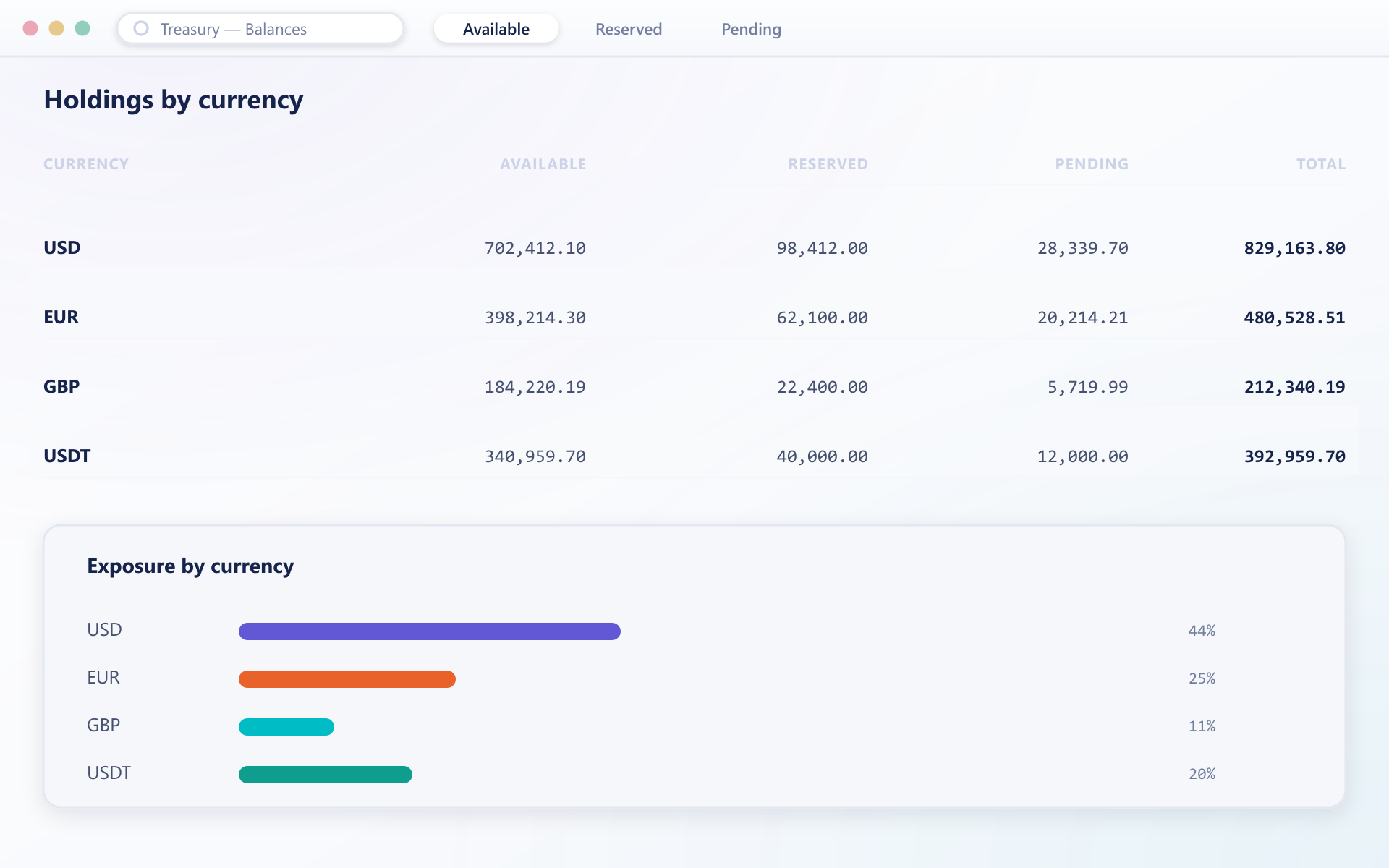
Held, liability, available and in transit — one screen
The four numbers above are not spread across systems here. Holdings, exposure and currency split sit in the same view, updated as the ledger updates.
Running short
The failure should happen while it is still cheap
Before the run, not during
A payout batch that discovers a shortfall halfway through leaves some clients paid and some not. Thresholds are evaluated before the run is assembled so the problem surfaces while it is still an inconvenience.
Floors per asset and provider
Minimum balances are set per asset and per provider account, because running dry in one currency while holding plenty in another is the common failure rather than a shortage overall.
Rebalancing as a suggestion
Where funds are in the wrong place, the shortfall and the surplus are shown together. Whether to move them stays a decision a person makes, not an automatic transfer nobody authorised.
FAQ
Treasury and balances: common questions
6 short answers to what teams ask before a demo.
Held is everything you have. Available is what you could actually spend, once client liability and funds already committed to pending payouts are taken out. Treating the first as if it were the second is how a payout run fails halfway.
It reflects the payment ledger as movements are recorded, including funds in transit in both directions. There is no overnight batch between something happening and it being visible.
Yes, and it matters more than the aggregate. Holding enough in total while being short in the specific account a payout needs is the shortfall that actually happens.
No, by design. Shortfalls and surpluses are surfaced together with the suggested movement, and a person authorises it. Automatic transfers between treasury accounts are the kind of convenience that becomes an incident.
Total client liability and total held are both derived from the same ledger and can be compared at any moment. If they diverge, that is visible immediately rather than at the next reconciliation.
Yes. Exports are structured to reconcile rather than to be re-keyed, and settlement reporting derives from the same records, so the payment ledger and the accounting ledger describe the same events.
Still have a question?
A specialist will answer it directly, with your set-up in mind.
Ask a specialistWhat is available to you right now?
If answering that means opening more than one system, that is the thing worth fixing first.