Digital Assets
Somebody is carrying that price move. Decide who.
Between the moment a client sends and the moment they are credited, the value can change. That exposure does not disappear because nobody assigned it — it just lands somewhere by accident.
See it live
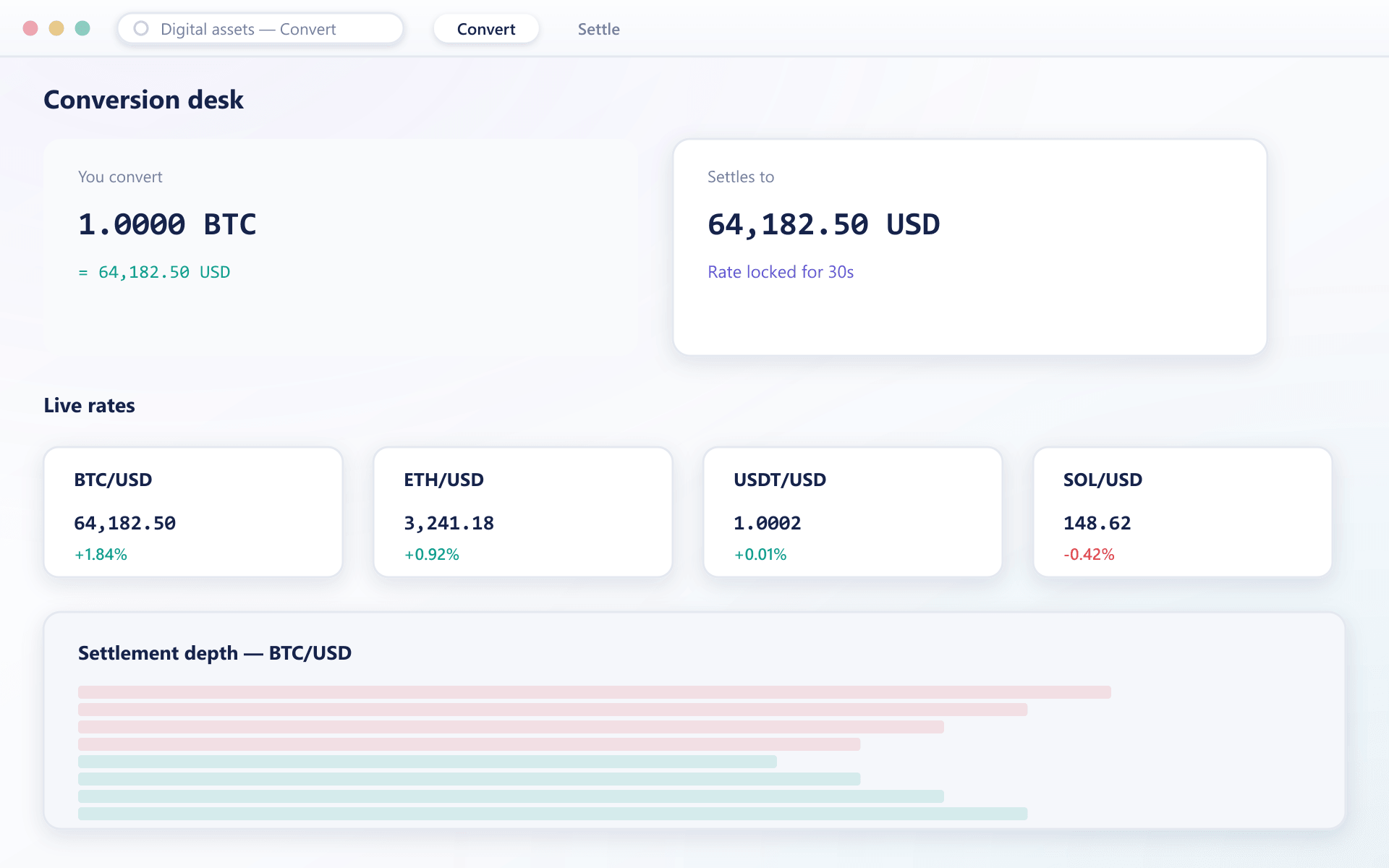
The rate, the window, and who is carrying it
Every held quote shows its expiry and the exposure it represents, so the policy you picked is something you can watch operating rather than something you assume is running.
Three policies
Each of these is defensible. Not choosing is not.
exposure: Nobody holds it
The asset is converted to your settlement currency as soon as it confirms. You never carry a position, and the client is credited a stable amount. The simplest policy and the right default for most desks.
exposure: You hold it
The balance stays in the asset it arrived in. Appropriate for stablecoins and for desks that deliberately want the exposure, and a decision that should be revisited rather than inherited.
exposure: You hold it, briefly
The client is quoted a rate before they transfer, and that rate applies if they send within the window. Best experience for the client, and the exposure window is yours to size.
The quote window
The one setting that is genuinely a risk decision
The window has a cost
Every second between quoting a rate and receiving the funds is exposure someone is carrying. A longer window is a better client experience and a larger position — that is the whole trade-off.
Size it against your volumes
The right hold duration depends on your typical transfer size and the volatility of the assets you accept. It should be a calculated number rather than a round one somebody picked.
Report it separately
Conversion gains and losses are reported apart from your fee income, so nobody mistakes a favourable month of price movement for improved payment margin.
Off-chain movement
Not every transfer needs a blockchain
When both sides of a movement are on the platform, settling it on-chain buys you a confirmation wait and a network fee for no benefit.
Internal transfers settle instantly
A movement between two accounts on the platform does not touch a blockchain. It settles against the ledger immediately, with no confirmation wait and no network fee.
No fee on flow that never leaves
Consolidating balances, funding a client account or rebalancing between your own wallets costs nothing in network fees, because nothing is broadcast.
Recorded the same way regardless
An off-chain movement produces the same ledger entry, the same approval trail and the same reporting line as one that settled on-chain. Reconciliation does not need to know which route it took.
FAQ
Conversion and settlement: common questions
7 short answers to what teams ask before a demo.
No. Automatic conversion on receipt means you can accept an asset as a funding method without ever carrying a position in it. For most desks this is the right default, and holding should be a deliberate exception rather than what happens by omission.
Whoever your policy assigns it to. Converting on receipt puts it with the client; quoting before send puts it with you for the length of the quote window. Both are legitimate — what is not legitimate is not knowing which one you are running.
It is configurable, and it should be calculated rather than chosen. A longer window is a better client experience and a larger exposure, and the right number depends on your transfer sizes and the volatility of the assets involved.
Whatever you nominate, and it can differ by client segment or by region. Assets convert into it on receipt unless policy says to hold, so your treasury reporting stays in one denomination.
Yes, deliberately. Mixing them makes a volatile month look like a change in payment margin, which then leads to decisions being made on a number that does not mean what it appears to.
Yes. Conversion policy, settlement currency and quote window are all set per client group, so a professional segment that wants to hold an asset and a retail segment that should not can coexist.
On liquidity venues you select, not ours. Most desks route through one or more major exchanges — Binance, Bybit, Kraken and Bitstamp are common choices — and the account and the commercial terms with that venue stay yours.
Still have a question?
A specialist will answer it directly, with your set-up in mind.
Ask a specialistWork out which policy you are actually running
Most desks discover they are running one by accident. It takes about twenty minutes to establish which, and considerably less to fix.