Digital Assets
The same token on two networks is two decisions
Asset lists are usually presented as a single number. What actually matters is which networks each asset is supported on, because that is where the fees, the speed and the failure modes live.
See it live
Pick the network, not just the token
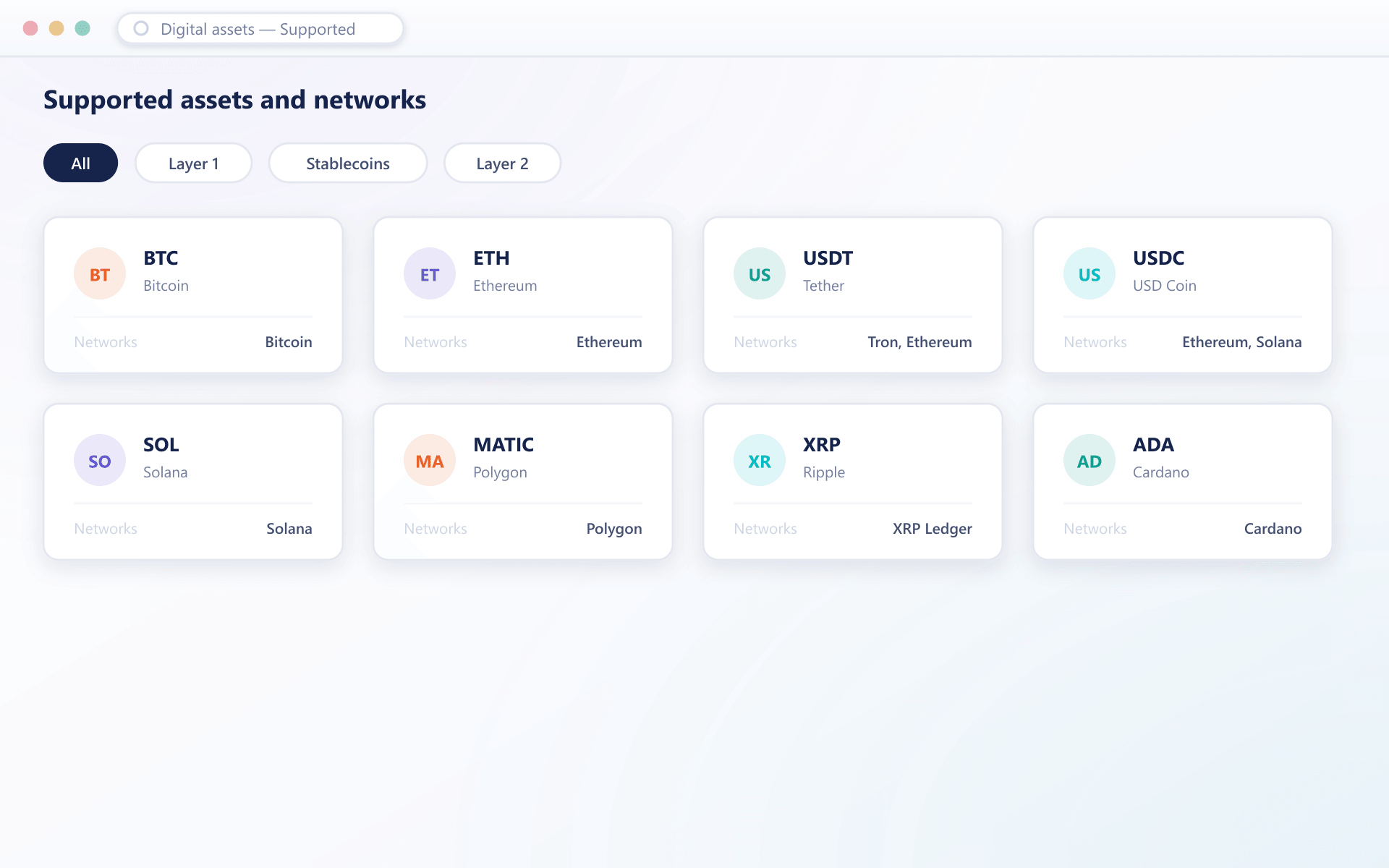
The instrument picker your clients use surfaces each supported network separately, because a listing is a per-chain decision even when the token is the same.
Configured per network
Five settings that exist once per chain, not once per asset
Finality differs; one number cannot serve every chain
Below the network fee, a transfer costs more than it is worth
Catches a wrong-network send before the client loses funds
Who absorbs the network fee on the way out
Accepting an asset does not oblige you to send it back the same way
Before an asset is added
Four questions, and the technical work is the last of them
Is there real client demand
The question is not whether an asset is popular in general but whether your clients are asking for it. Listing on speculation adds surface area with no volume behind it.
Can it be converted reliably
An asset you can accept but cannot convert leaves you holding an exposure you did not choose. Conversion depth matters more than market capitalisation.
Does it survive the compliance question
Some assets carry regulatory characteristics that make them a poor fit regardless of demand. That review happens before the technical work, not after.
Which networks, specifically
A widely used stablecoin exists on several chains with different fees, speeds and risks. Supporting the token is not one decision — it is one per network.
FAQ
Supported assets: common questions
6 short answers to what teams ask before a demo.
The published figure is 80+ across the major networks — Ethereum, Solana, TRON and TON among them — and it moves as assets are added. The more useful question is usually whether the specific assets your clients ask for are covered, which is worth checking directly rather than against a total.
Because it exists on more than one network, and those are genuinely different things. Fees, confirmation times, address formats and failure modes all differ, so each network is configured and supported separately.
Address format rules catch most of these before the transfer is made. Where funds have already been sent to an address on an unsupported network, recovery depends on the chains involved — sometimes possible with manual work, sometimes not, and we will tell you which straight away.
Mostly they are not, technically. What differs is the treasury decision: a stablecoin balance can reasonably be held, where a volatile asset usually should not be. That is a policy setting rather than a different code path.
The technical work is usually short. What sets the timeline is the review before it — demand, conversion depth and the compliance position — which is deliberately not skipped to make a launch date.
Yes, and it is a common configuration. Accepting an asset as a funding method and sending it back out are separate settings, so you can take deposits in something you have no intention of paying out in.
Still have a question?
A specialist will answer it directly, with your set-up in mind.
Ask a specialistSend us the list your clients ask for
We will tell you which are supported today, on which networks, and what the others would involve — rather than pointing at a total.