Digital Assets
Accepting crypto is four decisions, and none of them are technical
The engineering is the easy half. What actually decides whether this works is when a transaction becomes yours, at what rate, and who was holding the exposure until then.
See it live
Confirmations, tolerance bands, and the rate — together
The four decisions on this page are not abstract settings. Here is what they look like once they are configured against a live market.
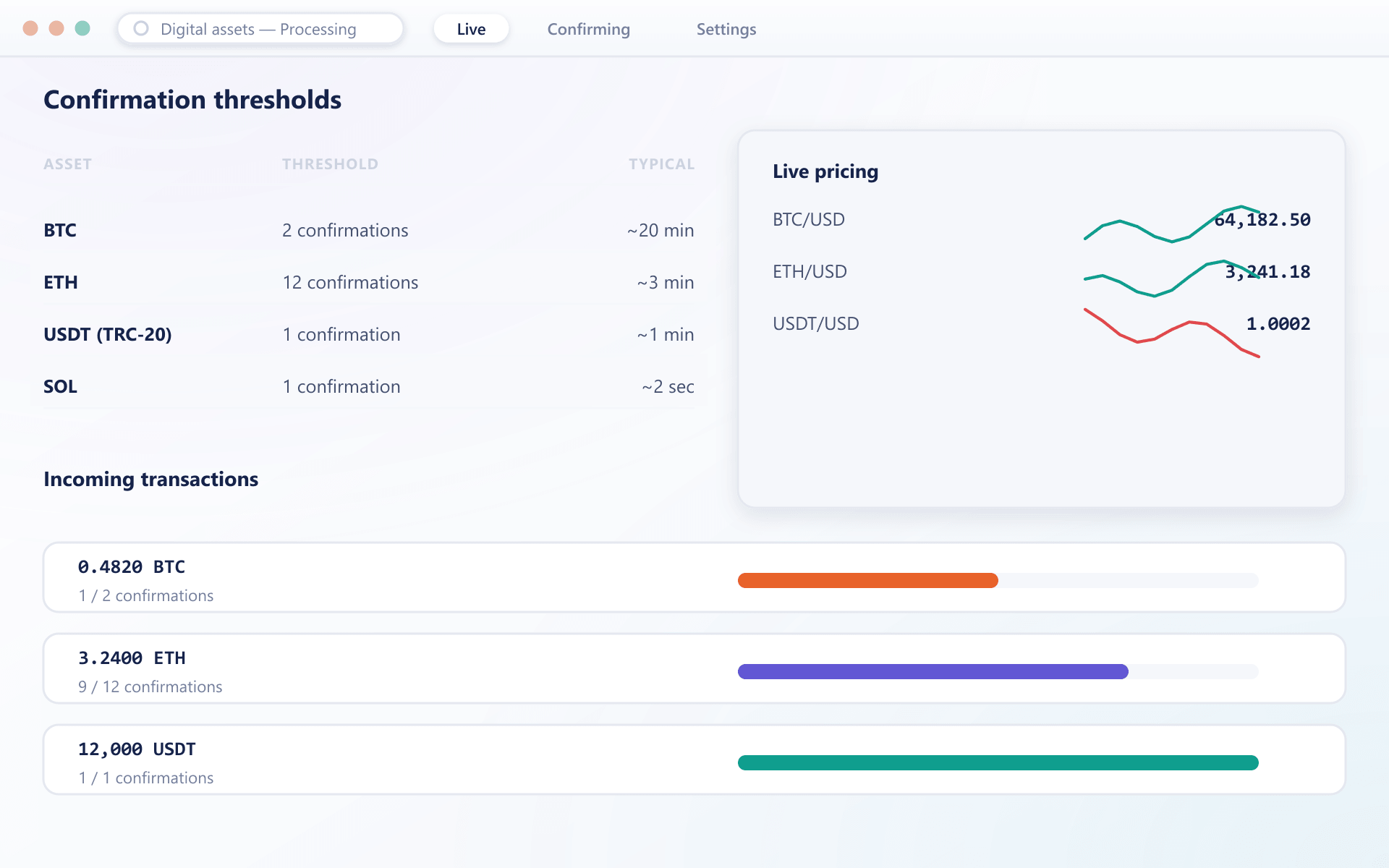
The four decisions
Each of these is configuration, and each has a wrong default
How many confirmations
Set per network, not globally. A fast-finality chain and a slow one should not share a threshold, and the right number is a function of the value at risk rather than a default someone copied.
What rate applies, and when
The rate can be taken at detection, at confirmation, or held from a quote issued before the client sends. Each choice puts the price move on a different party, and that should be deliberate.
Address per client or per payment
A permanent address per client is simpler for them and easier to reconcile. A fresh address per payment is better for privacy. Both are supported and the trade-off is yours.
What counts as the right amount
Networks charge fees that can arrive on either side of the transfer. Tolerance bands decide when a near-miss is credited as intended and when it becomes a decision.
The awkward cases
Six things that will happen, and what the platform does about each
Credited as received or held, per your tolerance band and policy
Surfaced with both figures; excess credited or returned by policy
Detected where recoverable, flagged for manual handling where not
Credits on reaching threshold, however long that takes
Credit held until the threshold is safely past the reorg depth
Below-minimum transfers recorded but not credited or alerted on
FAQ
Crypto processing: common questions
6 short answers to what teams ask before a demo.
As many as you configure for that network. There is no correct universal number — it depends on the finality characteristics of the chain and the value you are willing to have at risk. Setting one threshold for every asset is the common mistake.
Whoever your policy says. The rate can be fixed at detection, at confirmation, or held from a quote issued before the client sends. What matters is that it is a decision you made rather than an outcome you discovered.
It is compared against a tolerance band you set, which exists because network fees can legitimately reduce the received amount. Inside the band it credits as intended; outside it, the mismatch is surfaced with both figures for a decision.
Either model is supported. A permanent address per client is simpler for them and easier to reconcile; a fresh address per payment is better for privacy. The choice is a configuration rather than a constraint.
The confirmation threshold is what protects against it. Credit is held until the transaction is past a depth where a reorg is no longer a realistic concern for that network, which is exactly why the threshold is set per chain.
No. Automatic conversion on receipt is available, so you can accept an asset as a funding method without ever carrying a position in it. Whether you convert is a treasury decision, not a technical limitation.
Still have a question?
A specialist will answer it directly, with your set-up in mind.
Ask a specialistTell us which assets you plan to accept
We will go through confirmation thresholds, tolerance bands and conversion policy against those specific chains rather than in the abstract.