Platform Essentials
Nothing happens on the platform without a record
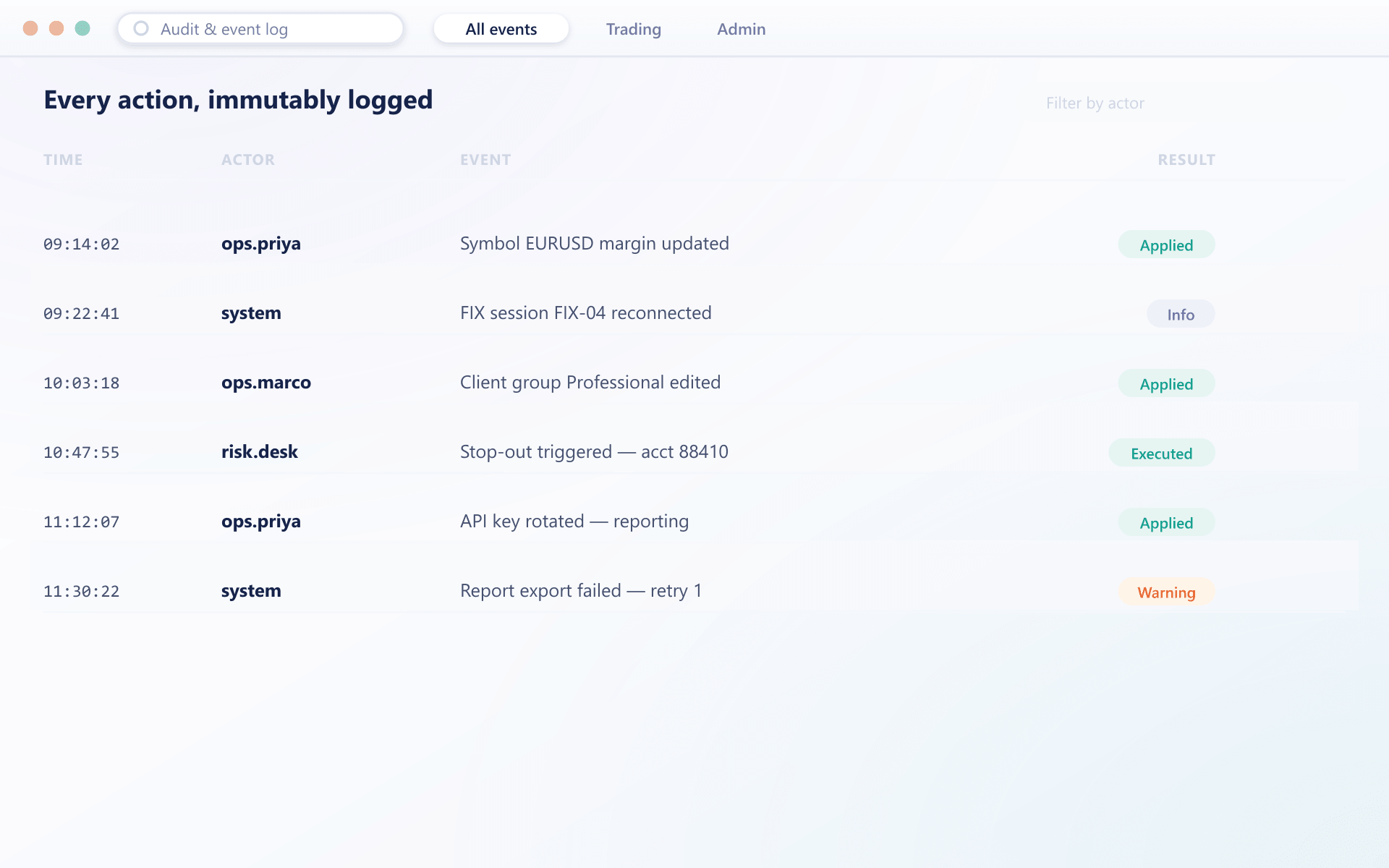
Orders, fills, balance movements, configuration changes, operator actions and client security events are all written to an append-only log with a timestamp and an origin. Nothing is edited, and nothing is deleted.
See it live
Every working and filled order, on the record
Working, filled and cancelled orders sit in one queryable table, each row carrying the sequence and origin that the event log traces back to.
What gets recorded
The log is the substrate, not a feature bolted on
Trading events
Submission, amendment, trigger, partial fill, full fill, expiry and cancellation, each with the sequence assigned by the engine.
Balance movements
Deposits, withdrawals, fills, fees, financing, funding payments and internal transfers, each traceable to the event that caused it.
Configuration changes
Every console change with its previous and new value, the operator identity and the timestamp. There is no unattributed change path.
Security events
Logins, failed attempts, session revocations, key issuance and withdrawal approvals, visible to both the client and your desk.
Query and export
The log is filterable by account, period, event type and origin, and any filtered view can be exported for an auditor or a regulator.
Why the log can be trusted
Four properties that make a record defensible rather than merely present
Entries are never modified
A correction is a new entry that references the original, not an edit. The original therefore remains readable, which is what an auditor asks for.
Ordering is fixed at write time
Events carry the sequence assigned when they occurred, so the order of a set of actions is not open to interpretation later.
Every entry has an origin
Client actions carry the session and channel; operator actions carry the operator identity and role. Nothing is anonymous.
State can be reconstructed
Because balances and positions are derived from the log, any account can be reconstructed as it stood at a chosen moment.
What a complete record makes possible
Audit is the obvious use. The everyday ones matter more.
Retained for the life of the accountRegulatory readiness
A request for a period of activity is answered by a filtered export rather than a project.
Short investigations
Client disputes and internal questions resolve from evidence in minutes instead of days.
Operational insight
Patterns in rejections, configuration changes and security events tend to reveal problems before they escalate.
Internal accountability
Attributed configuration changes remove the ambiguity about who altered a limit and when.
FAQ
Audit and event log: common questions
5 short answers to what teams ask before a demo.
No. The log is append-only. A correction is written as a new entry referencing the original, so the original remains readable and the correction is itself part of the record.
The object changed, the previous and new values, the operator identity and role, and the timestamp. Where an approval step was required, the proposal and the approval are both recorded.
Yes. The log can be filtered by account, period, event type and origin, and any filtered view can be exported in a format suitable for handing over.
For the life of the account. Because balances, positions and reporting are all derived from it, truncating it would break the platform's ability to explain its own state.
Yes, the parts that concern them: their orders, balance movements and security events. Operator actions and platform configuration changes are visible to your desk only.
Still have a question?
A specialist will answer it directly, with your set-up in mind.
Ask a specialistTest the log against a real question
Bring a scenario your compliance team worries about and we will answer it from the log during the call.