For Crypto Brokers
Screening that happens before the balance moves
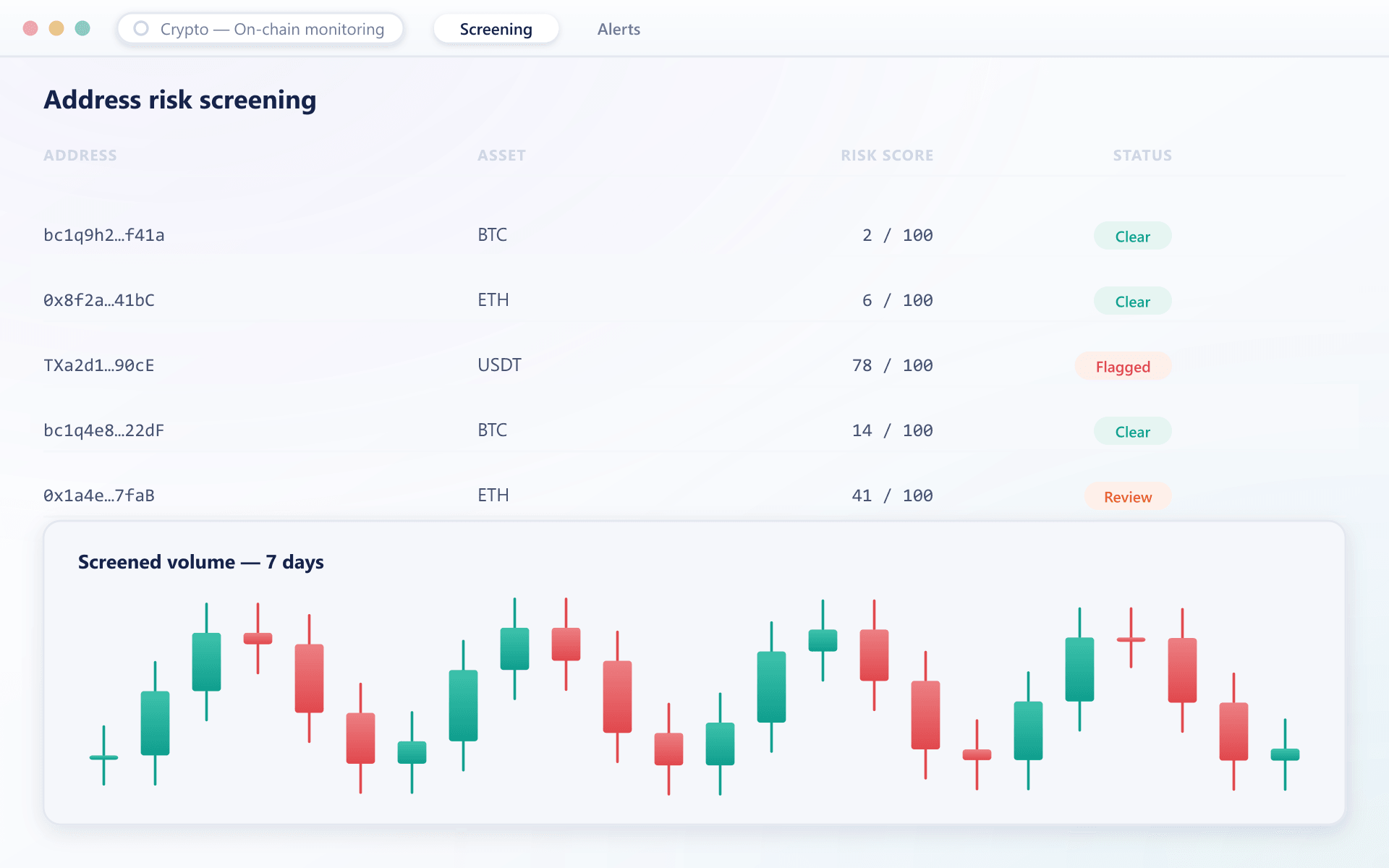
Incoming and outgoing transfers are screened through the analytics provider you use. Risk scores above your threshold place the transfer on hold in a review queue, and every decision is recorded with its reason.
Risk score
Below threshold
Proceeds automatically
Above threshold
Held for review, nothing moves
The threshold position is configured per asset and per client group.
Where screening sits in the flow
Screening only works if it is in the path, not a report someone reads afterwards
Provider agnostic
The platform integrates with the transaction analytics provider you have selected rather than mandating a particular one.
Both directions
Incoming deposits are screened before crediting and outgoing withdrawals before execution, because the obligations differ but both matter.
Configurable thresholds
The risk score at which a transfer is held is set per asset and per client group, so the policy can be proportionate.
Review queue
Held transfers arrive in a queue with the score, the reason given by the provider and the account context beside them.
Recorded decisions
Release or rejection is recorded with the operator identity and the reason, which is exactly what a regulatory review asks to see.
See it live
Watch a screened transfer move through its price
The chart tracking an asset is the same view an operator checks against when a held transfer needs context before a release decision.
A transfer through screening
What happens between a transfer arriving and a balance changing
- 01Submission
Sent to the provider
The transfer details are submitted to your analytics provider as soon as they are known, before any balance is credited or debited.
- 02Scoring
A risk score comes back
The provider returns a score and its reasoning. Both are stored against the transfer, so the basis of the decision is retained.
- 03Decision
Proceed or hold
Below the configured threshold the transfer proceeds automatically. Above it, the transfer is held and enters the review queue.
- 04Review
An operator decides, with a reason
Held transfers are released or rejected by an operator, and the decision is recorded with their identity and their stated reason.
What in-path screening is worth
The alternative is discovering a problem after the funds have already moved.
Problems stopped, not reported
A transfer held before crediting is a decision you still control; one flagged afterwards is an incident.
Proportionate policy
Thresholds per asset and group let you apply strict handling where it is warranted without holding everything.
Defensible decisions
A recorded reason on every release makes a regulatory review a matter of reading records rather than reconstructing intent.
Provider independence
Because the integration is generic, changing analytics provider does not mean rebuilding the funding path.
FAQ
Transaction monitoring: common questions
5 short answers to what teams ask before a demo.
The one you choose. The integration is generic, so the provider remains your commercial and compliance decision and can be changed without rebuilding the funding path.
Yes. Deposits are screened before crediting and withdrawals before execution. The thresholds can differ between the two directions, since the obligations usually do.
It is held and enters the review queue with the provider's score and reasoning alongside the account context. Nothing is credited or executed until an operator decides.
Yes. The score at which a transfer is held is configured per asset and per client group, which lets the policy be strict where warranted without holding routine activity.
The provider score and reasoning, the operator who decided, the reason they gave and the timestamp. That record is what a regulatory review examines, so it is written for every decision without exception.
Still have a question?
A specialist will answer it directly, with your set-up in mind.
Ask a specialistReview your screening policy with us
Bring your provider and your current thresholds and we will configure the path during the call.