Revenue Tools
Financing charges applied correctly, every night
Swap rates are configured per instrument for the long and short side independently, applied at the rollover time you set, with the multi-day convention handled on the day you choose.
Rollover schedule
EUR / USD
22:00Triple: WednesdayXAU / USD
22:00Triple: WednesdayUS 500
21:00Triple: FridayBTC / USDT
00:00Triple: NoneIllustrative schedule. Times and conventions are configured per instrument.
What the financing engine handles
Small configuration mistakes here get expensive quietly
Independent long and short rates
Each side of an instrument carries its own rate, including the case where one side is credited rather than charged.
Rollover time you set
The moment financing is applied is configured per instrument, so instruments following different markets can roll at different times.
Multi-day charging
The convention of charging several days ahead of a weekend or holiday is configurable, including which day it falls on.
Visible in advance
Current rates are shown on the instrument specification and the ticket, so a client can see the cost of holding before they open.
Its own ledger entry
Each financing charge is a separate entry linked to the position it applies to, which is what makes statements explicable.
See it live
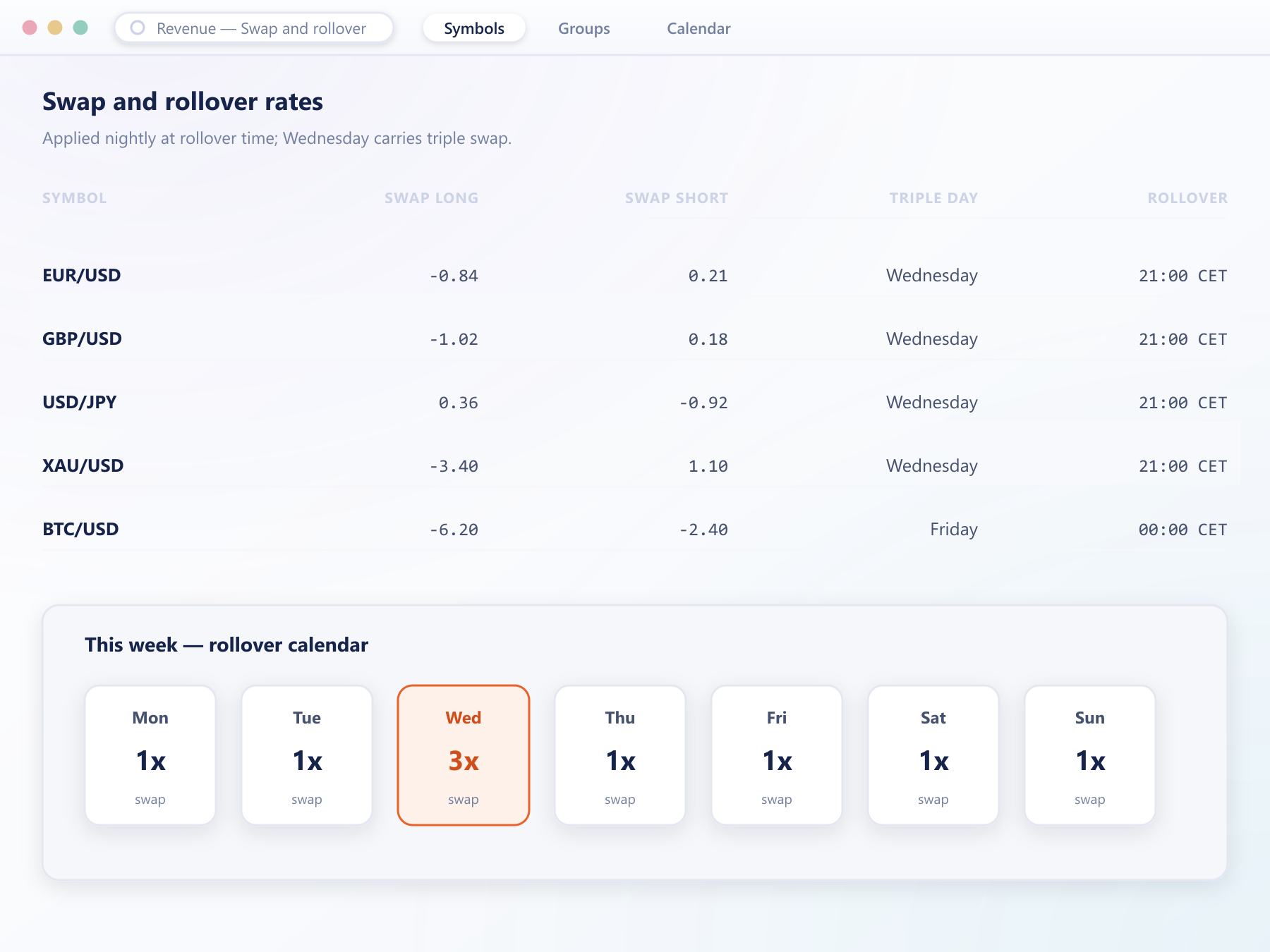
Rollover time and rates, set on one screen
Long and short rates by client group sit next to rollover time and the multi-day convention, so financing configuration never spans two screens.
What happens at rollover
The sequence that runs against every open position
- Selection
Open positions are identified
At the rollover time for an instrument, every position open at that moment is selected. Positions closed before it are unaffected.
- Calculation
The rate is applied to the position
The applicable long or short rate is applied to the position size, multiplied by the number of days the convention calls for on that date.
- Posting
Charged or credited to the balance
The result is written as a ledger entry against the account in the instrument's financing currency, referencing the position.
- Reporting
Aggregated as a revenue line
Because financing entries are discrete, financing income by instrument and group is available directly in reporting.
Why financing deserves attention
It is steady revenue that requires no client activity at all.
Revenue from held positions
Clients holding positions generate income without trading, which smooths revenue between active periods.
A risk lever
Adjusting the rate on one side of an instrument changes the cost of holding it, which influences how the book leans.
No manual process
Rollover runs on schedule for every instrument, so nobody has to remember which day the triple charge falls on.
Explicable statements
A discrete entry per charge means a client asking what a deduction was for gets a precise answer.
FAQ
Swap and rollover: common questions
5 short answers to what teams ask before a demo.
Yes. Each side carries its own rate, and one side can be credited rather than charged where the underlying financing economics justify it.
At the time configured per instrument. Instruments following different underlying markets can roll at different moments, which matters when you list across time zones.
It is configurable: you choose how many days are charged and which day of the week carries the additional charge, per instrument.
Yes. Current long and short rates appear on the instrument specification and on the ticket, so the cost of holding is visible before a position exists.
Yes. Each financing charge is its own ledger entry referencing the position it applies to, entirely separate from commission and markup entries.
Still have a question?
A specialist will answer it directly, with your set-up in mind.
Ask a specialistReview your financing model with us
Bring your current swap rates and conventions and we will configure them during the call.