For FX & CFD Brokers
Keep the flow worth keeping, hedge the rest
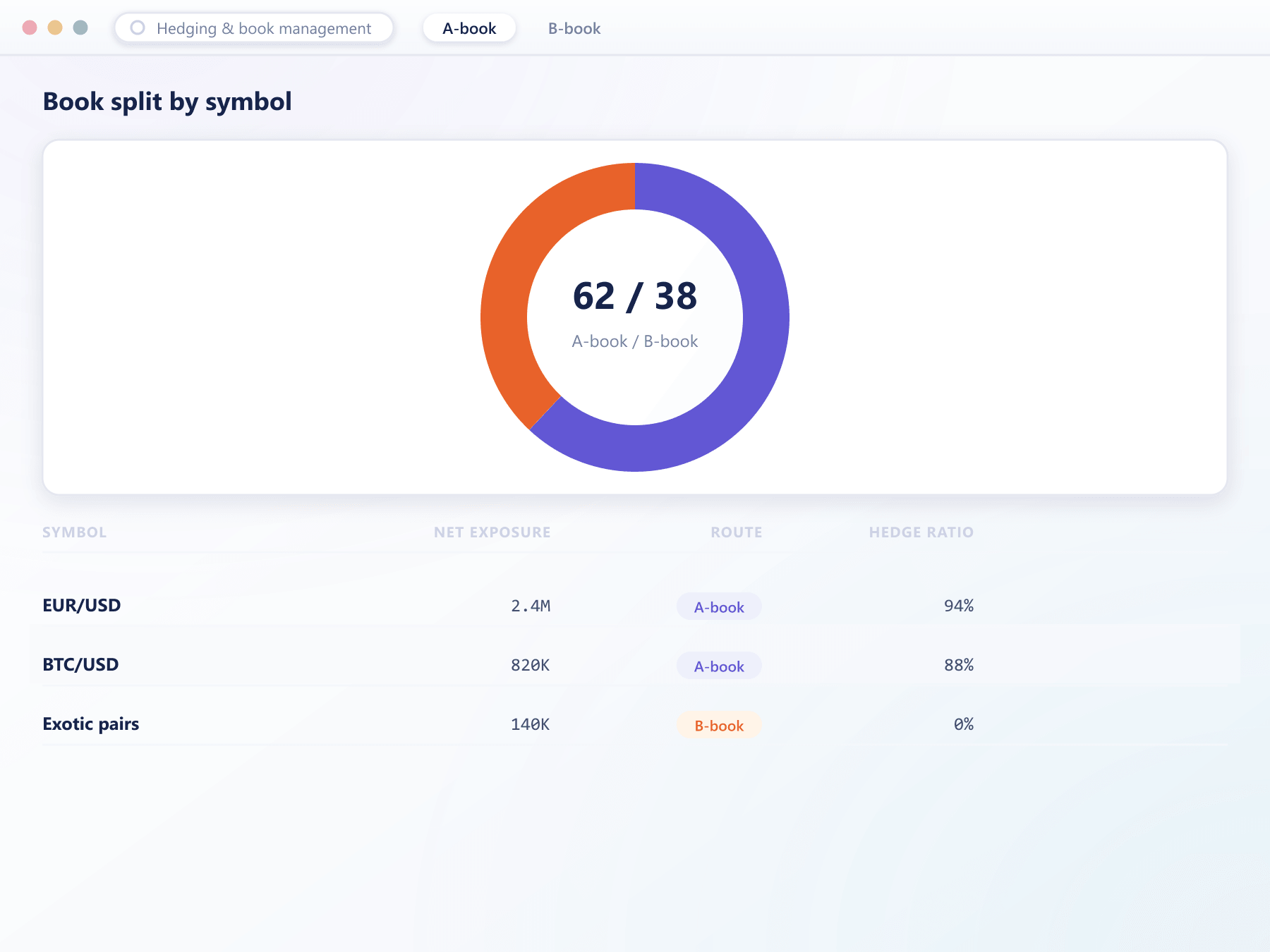
Routing is a rule, not a fixed setting. Decide per instrument, per client group or by exposure threshold whether flow is internalised or hedged externally, and watch net exposure move in real time as it happens.
Where the flow went today
Retained
Hedged
EUR / USD
62% / 38%XAU / USD
28% / 72%UK 100
84% / 16%Illustrative split. The threshold that produces it is yours to set per instrument.
The controls behind book management
Most desks want a mix, and the mix should be changeable without a project
Routing rules
Rules decide the destination of flow based on the instrument, the client group, the order size or the current net exposure.
Internalisation
Opposing client flow can match against itself before anything reaches an external venue, which is the cheapest execution available.
Threshold hedging
Exposure below a threshold is retained and anything above it is hedged, so small flow is not sent out at unnecessary cost.
Automatic execution
Where a rule calls for hedging, the order is placed on the connected liquidity source without a manual step.
Live net exposure
Aggregate exposure by instrument and asset class updates on every fill, with the largest contributing accounts identified.
See it live
Equity and margin health, watched as exposure shifts
A margin-health gauge alongside equity and margin rows is what a desk watches as net exposure moves and routing rules decide what gets hedged.
What happens to a client fill
The path from an execution to a hedge, or to no hedge at all
The client trade executes first
The client’s order is matched and confirmed immediately. Book management happens behind that, so it never delays a client’s execution.
The routing rule is evaluated
The applicable rule is resolved from the instrument, the group and the current net exposure. The first matching rule determines the destination.
Kept where it should be kept
Where the rule internalises, the exposure joins the book and offsets against opposing client flow, with no external cost.
Sent out where it should not
Where the rule hedges, an order is placed on the connected source, and the hedge is linked to the client fill that triggered it.
Why routing rules pay for themselves
The difference between hedging everything and hedging what matters is usually the margin.
Lower execution cost
Internalised flow costs nothing to execute, and most desks internalise far more than they expect once they measure it.
Bounded risk
Threshold rules mean retained exposure never exceeds a figure your risk committee agreed to.
Responsive to conditions
Tightening a threshold before a known event is a console change that takes effect on the next fill.
Honest attribution
Linking hedges to the fills that caused them makes it possible to measure the real cost of serving a client segment.
FAQ
Hedging and book management: common questions
5 short answers to what teams ask before a demo.
The instrument, the client group, the order size, and the current net exposure on that instrument. Rules are evaluated in order and the first match determines the destination.
No. The client's order is matched and confirmed first. Routing and any resulting hedge happen behind that, so a client's fill is never held while a hedge is arranged.
Net exposure below the configured threshold is retained on the book. Once exposure crosses it, the excess is hedged automatically, which avoids sending small flow out at unnecessary cost.
Yes. Aggregate net and gross exposure by instrument and asset class updates on every fill, with the accounts contributing most to it identified.
Yes. Each hedge references the fill or the exposure movement that triggered it, which is what makes it possible to measure the true cost of serving a given instrument or client group.
Still have a question?
A specialist will answer it directly, with your set-up in mind.
Ask a specialistModel your routing rules with us
Describe how you want flow handled today and we will express it as rules in a live environment.