Platform Essentials
The part of a trading venue nobody sees until it fails
A matching engine is only as available as what it runs on. The platform is delivered as managed infrastructure, so capacity, failover and patching are our problem rather than a hire you have to make.
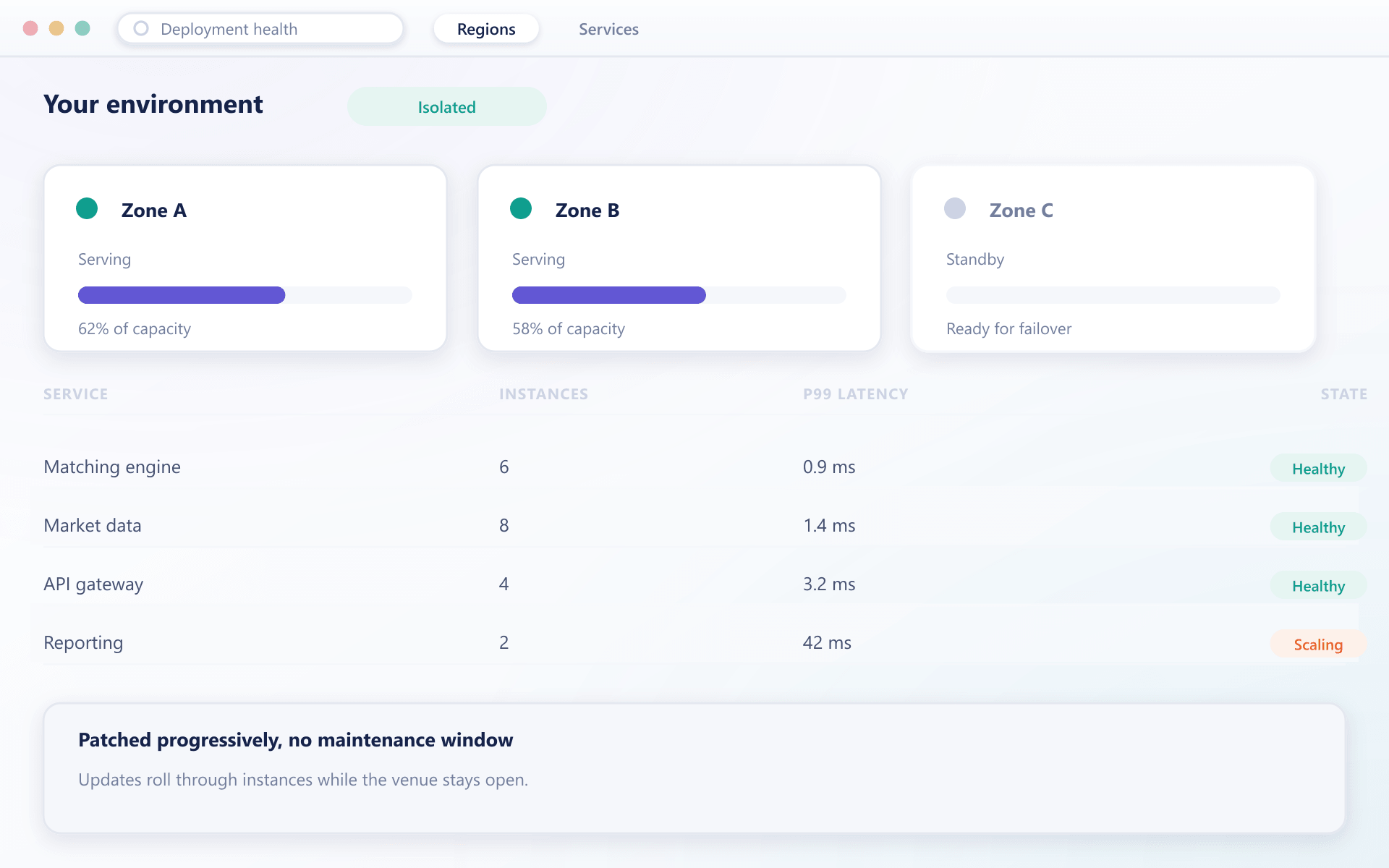
What running it involves
Operated, not handed over
You get a venue that is already deployed, monitored and scaled, rather than a build you then have to keep alive.
Deployed, not installed
A new environment is provisioned from a known configuration rather than assembled by hand, so two deployments behave the same way.
Capacity that follows load
Compute scales with activity, so a volatile session does not depend on someone having predicted it last quarter.
Failover that has been tested
Services run across availability zones with health checks and automatic redirection, and the path is exercised rather than assumed.
Patching without a maintenance window
Updates roll through instances progressively, so keeping current does not mean choosing a night to be offline.
Monitoring you can see too
Latency, error rates and engine health are visible to your team rather than only to ours, because you will be asked about them.
How it runs
From agreement to live venue
Environment provisioned
Your deployment is created from the standard configuration, isolated from every other tenant.
Configured to your book
Instruments, groups, leverage and liquidity routing are set up against your actual trading model.
Exercised before clients arrive
Order flow, failover and reporting are tested on the real environment rather than on a slide.
Operated continuously
Scaling, patching and monitoring continue after go-live without becoming a line on your headcount plan.
Infrastructure questions
Who is responsible for what
4 short answers to what teams ask before a demo.
Not for the platform. Capacity, failover, patching and monitoring sit with us. Your team owns configuration and the business decisions around it.
No. Each deployment is isolated, which is what makes it possible to configure and update one without affecting another.
Capacity scales with load rather than being fixed at provisioning. The engine is sized for burst rather than for the average.
Yes. Latency, error rates and engine health are exposed to your team, because you will be answering for them to clients and regulators.
Still have a question?
A specialist will answer it directly, with your set-up in mind.
Ask a specialistAsk us the operational questions
Bring your availability expectations and we will walk through how the deployment actually behaves under them.