Platform Essentials
The component everything else on the platform trusts
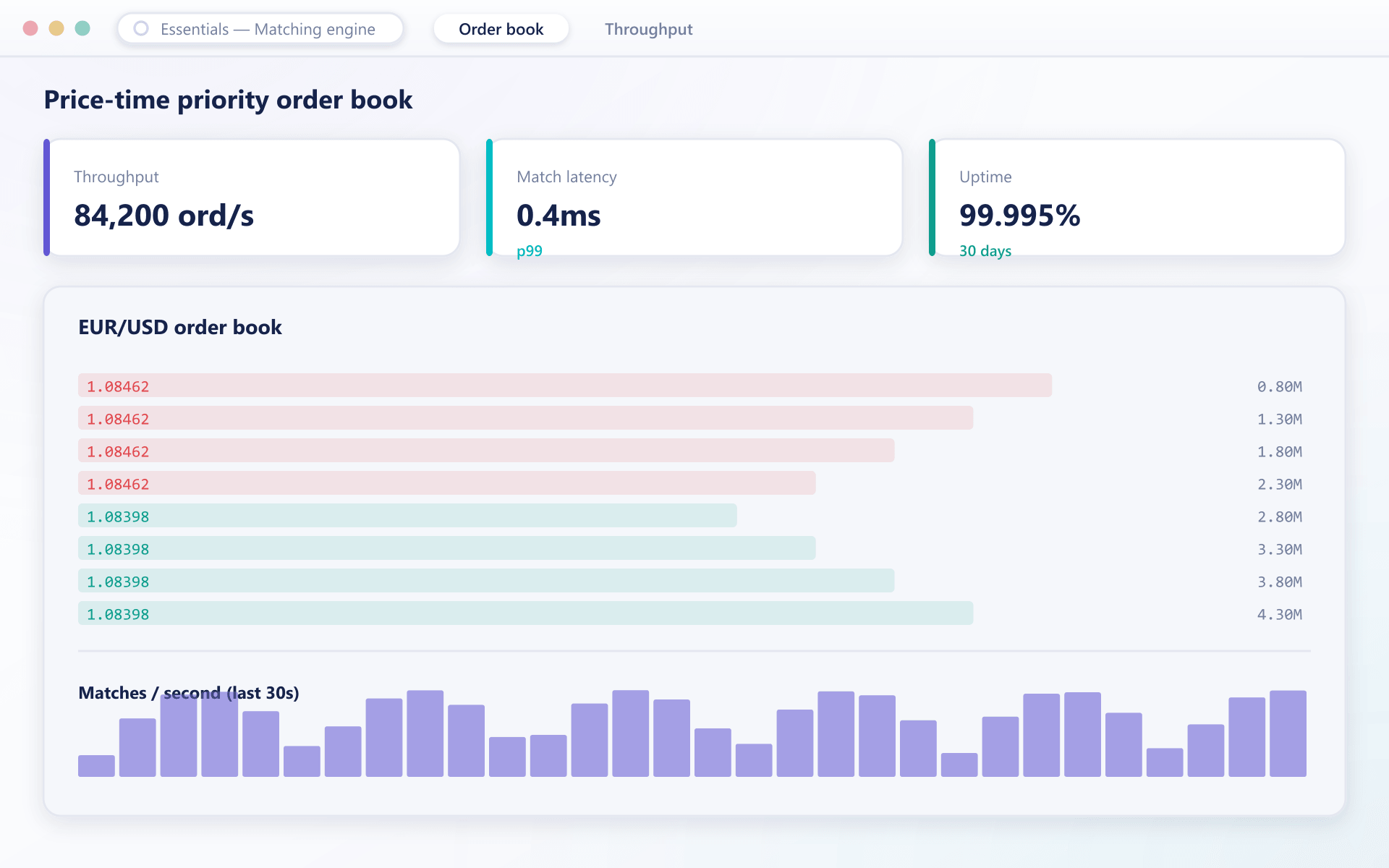
One book per instrument, price-time priority, deterministic ordering and a single event stream that the terminal, the ledger, the risk engine and reporting all read from. If they ever disagreed, this is why they would not.
Bid queue · EUR/USD
Price-time1.08620
1.0
14:02:09.1141.08620
0.5
14:02:09.2711.08619
2.0
14:02:09.402Same price, earlier arrival wins. Sequence is assigned once, on arrival, and never reordered.
What it guarantees
Predictable under load, not fast on a quiet day
A matching engine earns its place by being reproducible. Every guarantee here is something a professional counterparty will ask about.
Price-time priority
Better prices match first, and at the same price the earlier order matches first. There is no discretionary ordering anywhere in the path.
Deterministic sequencing
Orders are assigned a sequence on arrival and processed in that order, which is what makes the outcome reproducible from the event log.
Partial fills preserved
A partially filled order keeps its original price and time priority for the remaining quantity rather than being resubmitted behind everyone else.
One book per instrument
Each instrument has its own independent book, so activity in one market cannot delay matching in another.
See it live
The terminal your clients open reads this engine directly
Chart, order ticket and positions table are all fed by the same sequenced event stream described on this page, with no intermediate cache to fall out of step.
One event, many consumers
Why the terminal and the ledger can never disagree
Every acceptance, fill, cancellation and expiry is emitted once. Everything downstream is a consumer of that one stream.
Event stream
Emitted once, sequenced, immutable
Terminal
Order state and fills, pushed live
Balance ledger
Reservations, settlements and fees
Risk engine
Exposure and margin recalculation
Reporting
Volume, revenue and execution quality
FAQ
Matching engine: common questions
5 short answers to what teams ask before a demo.
Price-time priority. Better-priced orders match first, and among orders at the same price the earlier arrival matches first. There is no discretionary or pro-rata allocation in the path.
It remains on the book at its original price with its original time priority. It is not resubmitted, so a partial fill never costs an order its place in the queue.
No. Each instrument has an independent book, which means high activity in one market cannot delay matching in another.
Yes. Orders are sequenced on arrival and processed in that order, and every resulting event is logged. The sequence of events for any period can be replayed to explain exactly what happened.
Yes. Both reach the engine through the same path and are sequenced by arrival. There is no privileged interface that would give one class of client an ordering advantage.
Still have a question?
A specialist will answer it directly, with your set-up in mind.
Ask a specialistAsk us the hard questions about matching
Bring your technical team. We will go through sequencing, partial fills and the event model in detail.