For Crypto Brokers
Perpetual contracts where every mechanic is a setting
Funding interval, rate bounds, mark price source, index construction and position limits are all configuration. Nothing about how your perpetual market behaves is fixed by the platform.
See it live
Chart, book and funding history in one dashboard
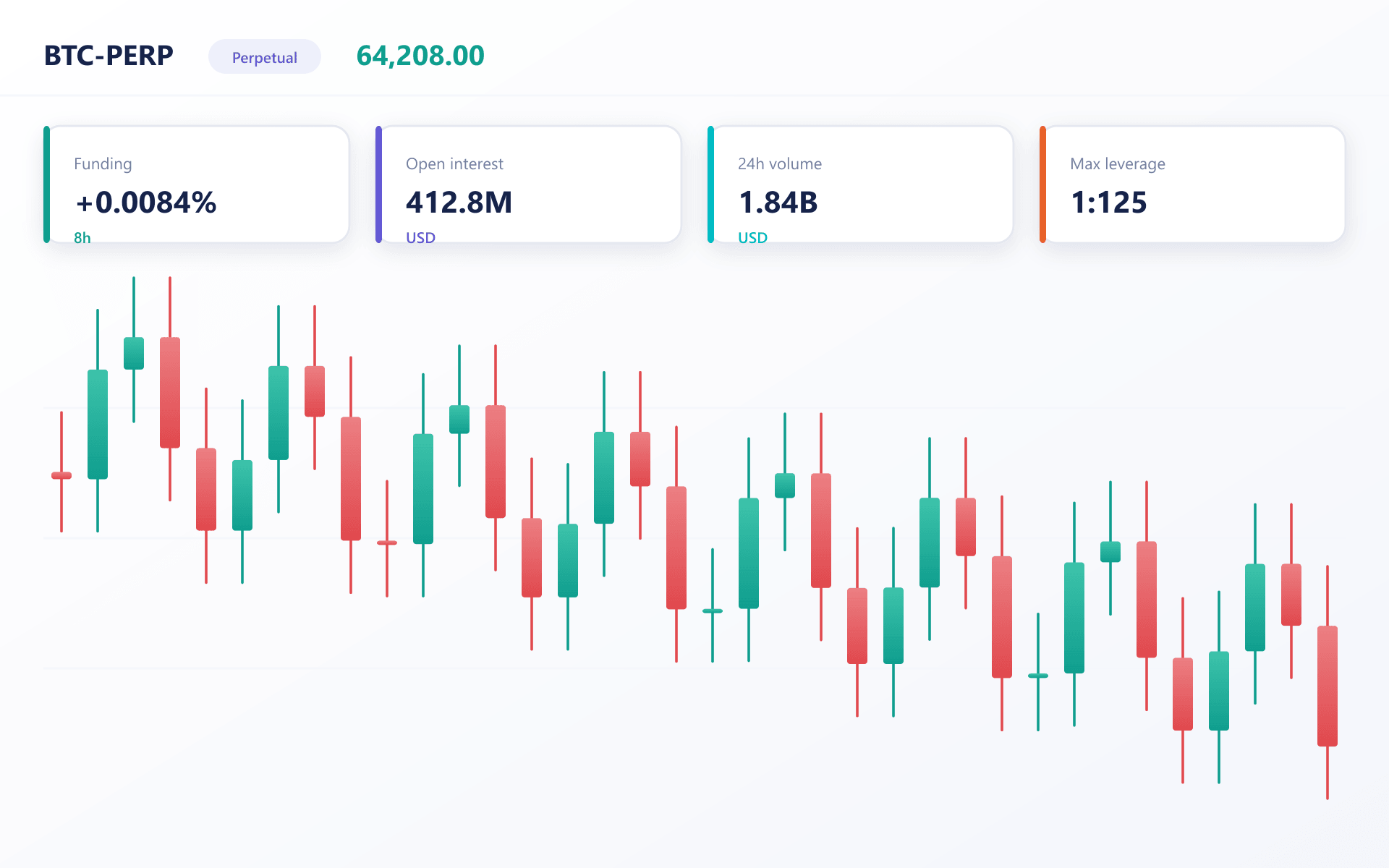
A perpetual market dashboard puts the price chart, the order book and the funding-rate history the client needs to size a position all in one view.
The mechanics that define a perpetual market
These decisions determine whether a contract tracks its underlying or drifts away from it
Funding interval and bounds
How often funding settles and the maximum rate in either direction are set per contract, along with the inputs the rate is derived from.
Mark price sourcing
Valuation and liquidation use a mark price from the source you nominate, which prevents a thin local book from triggering liquidations.
Index construction
Where the index is built from several references, the constituents and their weighting are configured, with outlier handling included.
Position limits
Caps on position size per account and in aggregate, which keeps a single participant from dominating a contract.
Funding on the ledger
Each funding payment is written as its own ledger entry on both sides, so a client can see exactly what they paid or received and when.
A funding cycle end to end
What keeps the contract anchored to its underlying
- Index
The reference is constructed
Constituent references are combined by the configured weighting, with outliers excluded, producing the index the mark price is anchored to.
- Mark
The mark price is derived
The mark used for valuation and liquidation is derived from the index rather than the last local trade, which keeps a thin moment from cascading.
- Rate
The funding rate is computed
At each interval the rate is computed from the configured inputs and clamped to the bounds you set, so an extreme reading cannot produce an extreme charge.
- Settlement
Paid between the two sides
Funding transfers between long and short holders, with a ledger entry on each account referencing the position and the interval.
Why perpetuals are worth listing
They are the highest-volume product in digital assets, and the mechanics decide whether yours works.
Volume and revenue
Perpetuals attract the most active traders, and their volume carries commission as well as funding flow.
Markets that track
Well-configured funding and index construction keep the contract anchored, which is what keeps professional participants engaged.
Contained cascades
Mark pricing from an external index means a local liquidity gap does not trigger a chain of liquidations.
No custody requirement
Cash-settled contracts let you offer exposure to assets you do not want to hold.
FAQ
Perpetual futures: common questions
5 short answers to what teams ask before a demo.
At the interval configured per contract. Both the interval and the maximum rate in either direction are settings, so the contract can be tuned to the behaviour of its underlying.
A mark price derived from the configured index rather than the last local trade. This prevents a thin moment in your own book from triggering liquidations that the wider market does not justify.
From the reference sources you nominate, combined by a configured weighting with outlier exclusion. If a constituent becomes unavailable or diverges beyond a threshold, it is dropped from the calculation.
Yes. Caps can be set per account and in aggregate for the contract, which prevents a single participant accumulating a position large enough to distort the market.
Each funding payment is a separate ledger entry on the account referencing the position and the interval, so it appears in history and on statements like any other charge.
Still have a question?
A specialist will answer it directly, with your set-up in mind.
Ask a specialistConfigure a perpetual contract with us
Bring the underlying you want to list and we will set up its index, funding and limits during the call.