For FX & CFD Brokers
Connect several providers and let the platform choose
Sources are aggregated into a single best price, and routing decides which one an order actually reaches. Failover is automatic, and execution quality per provider is measured rather than assumed.
Source A
Live99.2%11 msSource B
Live98.7%18 msSource C
Degraded91.4%64 msSource D
Standby——Illustrative monitor. Statistics are recorded per provider from your own flow.
What the routing layer does
Aggregation is easy to claim and harder to run well
Price aggregation
Quotes from every source mapped to an instrument are combined into a single best bid and offer, with depth from all of them.
Routing rules
Route by best price, by preferred provider or by a weighting between them, configured per instrument.
Automatic failover
A source that disconnects or begins rejecting is removed from routing automatically and reinstated when it recovers.
Execution statistics
Fill rate, rejection rate, latency and realised slippage per provider, so a commercial conversation is backed by numbers.
Per-source monitoring
Connection state, quote rates and staleness are visible in the console, so a degrading source is noticed before clients complain.
See it live
One watchlist, priced from every connected source
Spreads and sparklines on the watchlist reflect the aggregated best price across providers, the same aggregation this page describes underneath it.
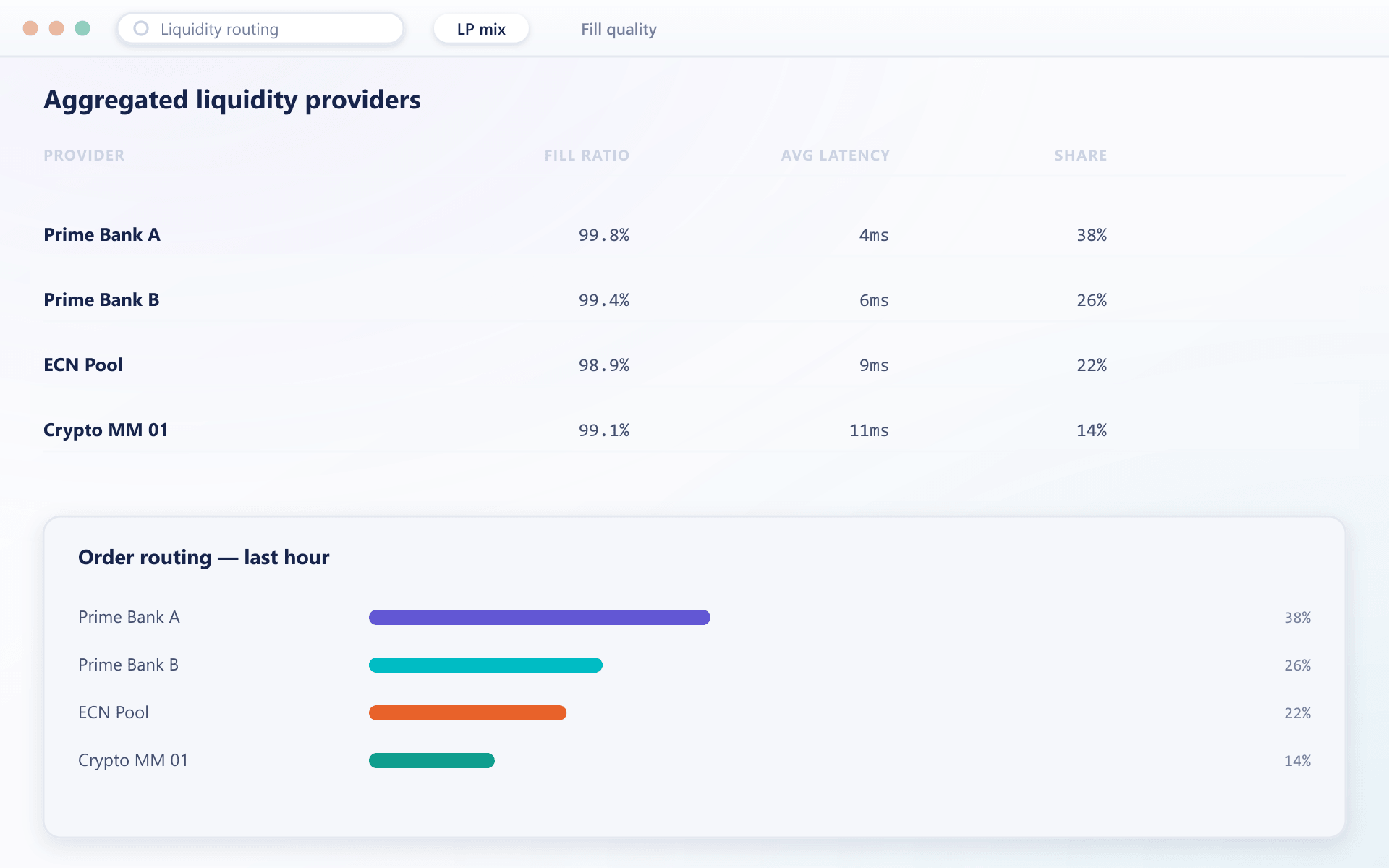
From several feeds to one execution
Where the decisions are made between a click and a fill
Instruments map to sources
Each instrument names the sources that can price and execute it, along with the priority or weighting between them.
One view from many feeds
Quotes are combined into a single book. Stale or outlying prices from any one source are filtered before they reach the aggregate.
The rule picks a destination
When an order needs external execution, the routing rule selects a source based on price, priority or weighting, and sends it there.
The outcome is recorded
Fill or rejection, latency and realised slippage are recorded against the provider, feeding the statistics that inform future routing.
What multiple sources buy you
Dependence on a single provider is a commercial position as much as a technical one.
Better pricing
Aggregating several sources tightens the spread you can offer without changing your markup.
Continuity
Automatic failover means one provider's outage is not your outage.
Negotiating position
Execution statistics per provider turn a renewal discussion into a conversation about measured performance.
Instrument-level control
A provider that is strong on one asset class and weak on another can be used only where it is good.
FAQ
Liquidity routing: common questions
5 short answers to what teams ask before a demo.
There is no fixed limit. Each instrument maps to the sources that can price and execute it, so different instruments can draw on entirely different sets of providers.
By the rule configured for that instrument: best available price, a preferred provider order, or a weighting that distributes flow between providers. The rule is evaluated per order.
It is removed from aggregation and routing automatically once it disconnects or starts rejecting beyond a threshold, and reinstated when it recovers. Clients continue trading on the remaining sources.
Yes. Fill rate, rejection rate, latency and realised slippage are recorded per provider and available in reporting, which gives a factual basis for commercial discussions.
Yes. Stale quotes and prices outside a sanity band are discarded before aggregation, so a single misbehaving feed cannot distort the price clients see.
Still have a question?
A specialist will answer it directly, with your set-up in mind.
Ask a specialistDiscuss your liquidity setup
Tell us which providers you use today and we will map out aggregation and routing for your instrument list.