Revenue Tools
The price your clients see is the one you decided on
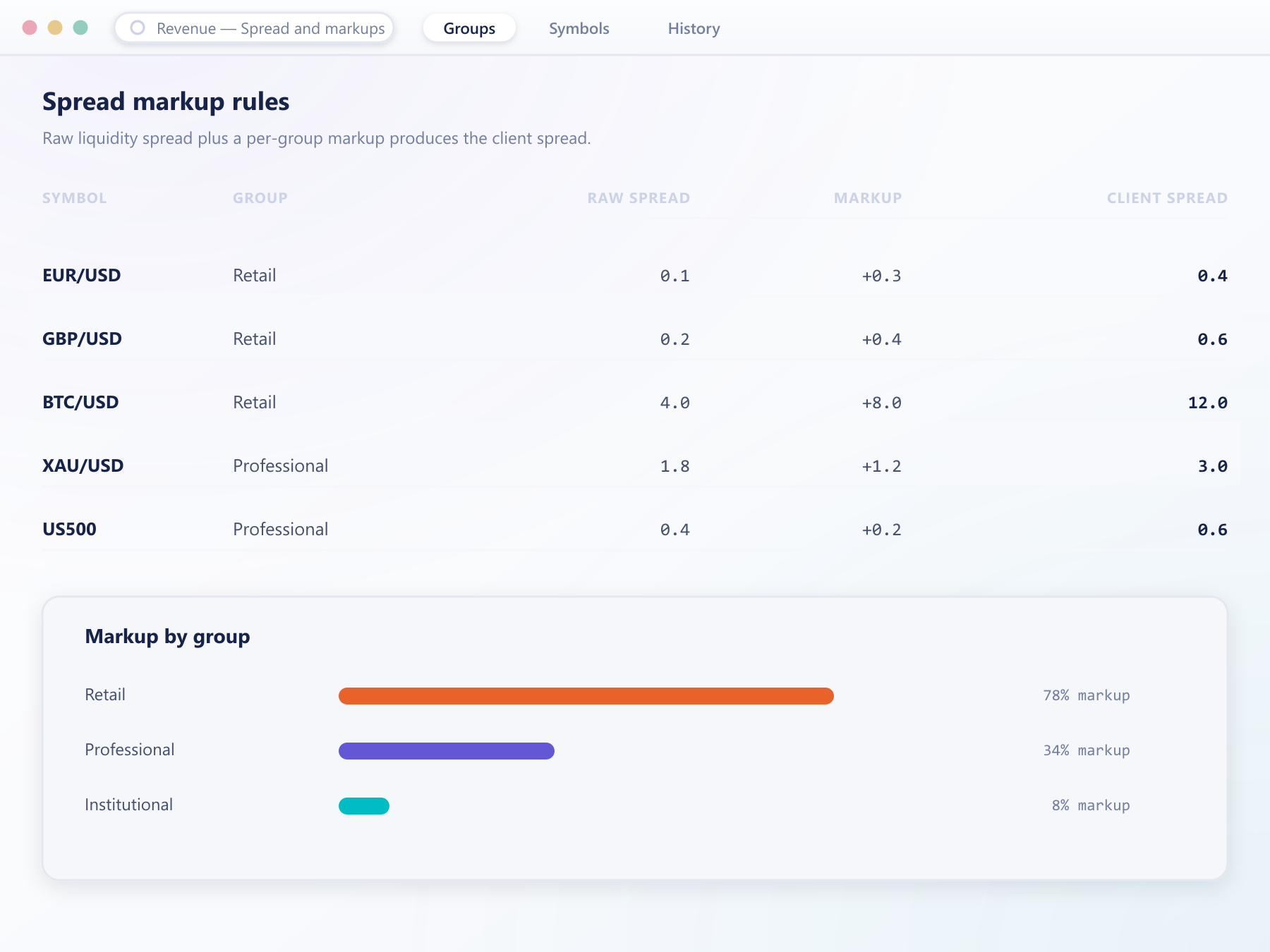
Upstream pricing is shaped before it becomes a client quote: markup in pips or percentage, a minimum spread floor, and asymmetric adjustment where you need it. Both the raw and the shaped price are retained.
One instrument, two prices
Upstream
Client quote
Illustrative values. Markup and floor are configured per instrument and per group.
See it live
The spread clients see, next to the one live now
A watchlist showing live spreads and sparklines is the shaped price this page describes, instrument by instrument, updating as markup and floor are applied.
Ways to shape a price
Five adjustments, applied per instrument
Different instruments need different treatment, so the tools are per-instrument rather than a single global setting.
Markup in pips
A fixed number of pips added to each side of the upstream quote, which is the conventional treatment for currency pairs.
Percentage markup
A proportional adjustment, which behaves more sensibly on instruments whose price varies over a wide range.
Spread floor
A minimum spread that applies when upstream pricing tightens beyond it, protecting margin during quiet conditions.
Asymmetric adjustment
Bid and offer can be adjusted independently where you want to lean the price in one direction.
Raw price retained
Upstream and shaped prices are both stored, so the effect of markup on any period can be examined rather than estimated.
From upstream quote to client price
The four stages a price passes through before it reaches a ticket
- 1Aggregation
Sources combined first
Where several liquidity sources cover an instrument, they are aggregated into a single best view before any shaping is applied.
- 2Filtering
Bad quotes removed
Stale quotes and prices outside a sanity band are discarded before shaping, so a bad tick from one source cannot propagate.
- 3Shaping
Markup and floor applied
The configured markup is applied and the spread floor enforced. Which values apply is resolved from the instrument and the client group.
- 4Quoting
Published to clients and the engine
The shaped price is what the terminal displays, what the API streams and what the matching engine uses, so there is no discrepancy between them.
Why markup control matters
For many desks, spread is the largest single revenue line — and the one most easily lost without noticing.
Protected margin
A spread floor means unusually tight upstream pricing does not quietly erase your revenue on an instrument.
Segmented pricing
Tighter spreads for institutional tiers and standard spreads for retail, from the same upstream feed.
Measurable decisions
Because raw prices are retained, the revenue effect of a markup change can be measured rather than argued about.
Rapid response
Widening a spread during an unusual market event is a console change that takes effect on the next quote.
FAQ
Spread and markups: common questions
5 short answers to what teams ask before a demo.
Per instrument and per client group, as a fixed number of pips, a percentage of price, or both with a minimum spread floor. Bid and offer can be adjusted independently where an asymmetric treatment is wanted.
It sets a minimum spread that applies when upstream pricing tightens beyond it. Without one, unusually tight liquidity would pass straight through to clients and remove your margin on that instrument.
Yes. Both the raw upstream quote and the shaped client price are retained, which lets you measure the actual revenue effect of a markup change over any period.
Yes. The shaped price is what the terminal shows, what the API streams and what the engine matches on. There is no path where a client could be shown one price and filled at another.
On the next quote. It is a console change, so widening spreads during a disorderly market is something your desk does directly rather than requesting.
Still have a question?
A specialist will answer it directly, with your set-up in mind.
Ask a specialistSee markup applied in real time
We will change a markup during the walkthrough and show you the client quote move immediately.