Platform Essentials
One collateral pool behind every position
A trader holding several assets should not have to fund each position separately. Cross-margin lets the whole balance back the book, with the weight of each asset decided by you rather than assumed.
What you control
Collateral is a policy, not a constant
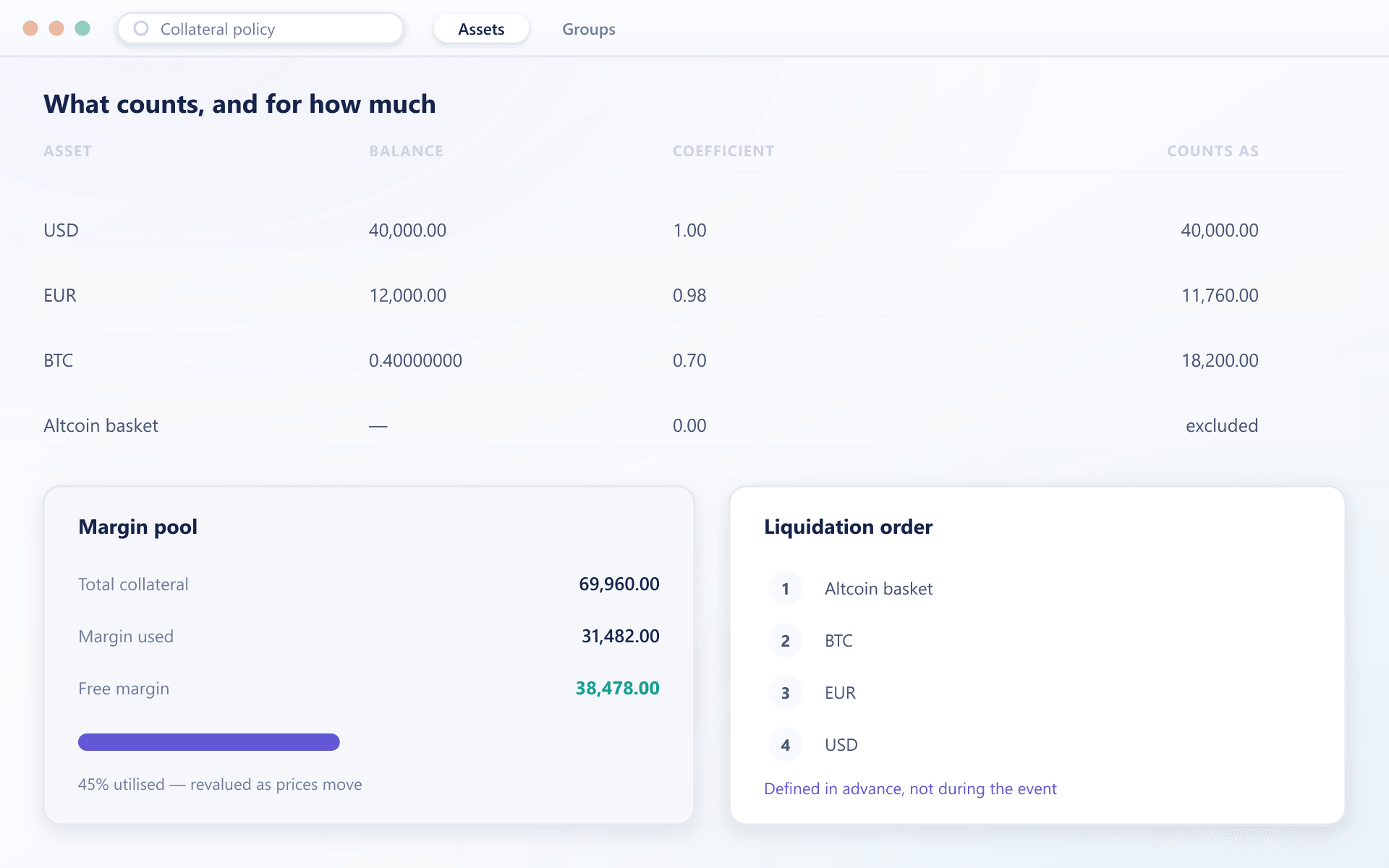
Which assets count, how much they count for, and what happens when their value moves are all configuration on your side.
Any asset as collateral
Fiat balances, digital assets and open profit can all contribute to margin, or be excluded entirely, per account group.
A coefficient per asset
Each asset carries a haircut you set, so a volatile balance supports less exposure than a stable one without having to ban it.
Margin recalculated continuously
Collateral value is revalued as prices move rather than at intervals, so the margin figure a trader sees is the one the engine is acting on.
Different rules per group
A professional group and a retail group can run entirely different collateral policies on the same deployment.
Liquidation with a defined order
When margin runs out, the sequence in which collateral is used is a rule you set in advance rather than a decision made under pressure.
How it runs
From deposit to margin capacity
A balance arrives
Any funded asset becomes a candidate for collateral if you have enabled it for that group.
The haircut applies
Its contribution to margin is its market value multiplied by the coefficient you set for that asset.
Positions draw on the pool
Exposure across instruments is backed by the combined figure rather than by asset-specific buckets.
Revaluation is constant
As collateral prices move, available margin moves with them, and warnings fire before a liquidation becomes necessary.
Collateral questions
How the pool behaves
4 short answers to what teams ask before a demo.
Yes. Set its coefficient to zero and clients can still hold and trade it, but it contributes nothing to margin capacity.
Only if you allow it. Some brokers include it to let winning positions support new exposure, others exclude it to avoid compounding a move.
The order you define. Setting it in advance is the point, because deciding during a liquidation event is how inconsistent outcomes happen.
Yes, per account group, so one deployment can serve both without compromising on either.
Still have a question?
A specialist will answer it directly, with your set-up in mind.
Ask a specialistModel your collateral policy with us
Bring the assets you accept and the haircuts you have in mind and we will configure them on a live environment.