Supported Markets
Spot markets with settlement that actually happens
Each pair has its own central limit order book. A filled trade moves value between two real balances, and those balances reconcile to the wallet movements behind them.
Deposit
Incoming transfers are watched and credited once the confirmation threshold for that asset is reached. The pending state is visible throughout.
Book
A limit order takes its place at a price level by time priority and can be filled by another client, by connected liquidity or partially by both.
Settle
A fill writes ledger entries against both assets in the pair plus a separate fee entry, so a trade never conceals a charge inside its price.
Withdraw
Requests reserve the balance, pass through whatever approval steps you require, and debit only on execution.
See it live
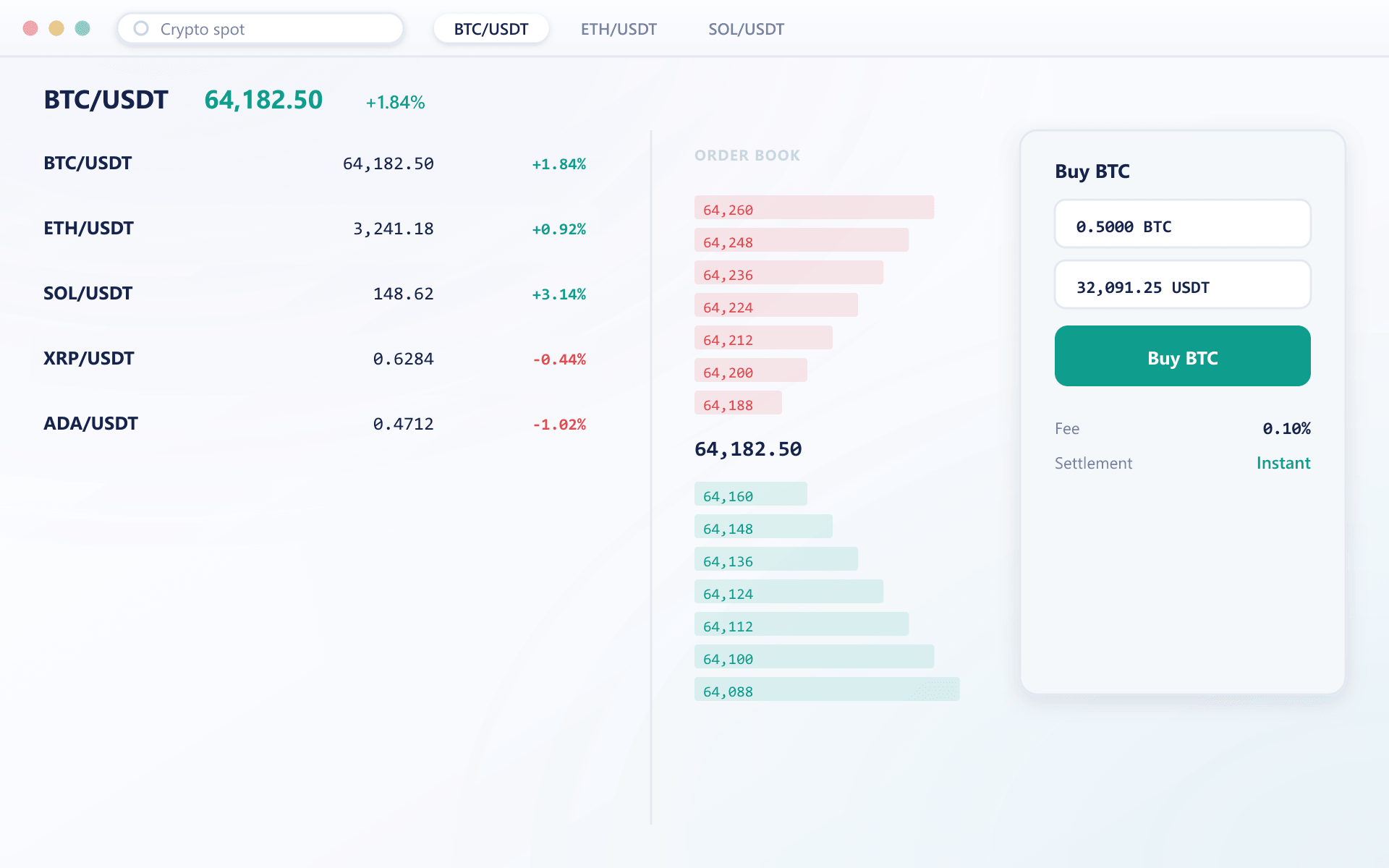
The book a fill actually settles against
A central limit order book per pair is what resting orders match against, the same book described in the deposit-to-settlement flow above.
What makes it credible
Spot trading is judged on whether the book is real and the balance is really there
Central limit order book
Every pair has a genuine book with price-time priority. Client orders rest in it and match against each other as well as against connected liquidity.
Wallet-backed balances
A spot balance corresponds to holdings under custody. Deposits credit on confirmation and withdrawals debit on execution, both written to the ledger.
Precision per asset
Quote precision, minimum order size and quantity step are set per pair, so a high-value asset and a long-tail token both behave sensibly.
Post-only and time in force
Post-only orders guarantee maker treatment, and the standard time-in-force options are available where the pair permits them.
Maker / taker
Per groupStandard
0.10%
0.16%
Volume tier 1
0.06%
0.12%
Market maker
0.00%
0.08%
Illustrative. Rates, tiers and which pairs they apply to are yours to configure.
What a spot book adds to the desk
Lower entry barrier
Clients who will not trade on margin will trade spot.
Internalised flow
Client orders matching each other is flow you do not pay to execute.
Fee income you control
Maker-taker schedules per group let you price where it wins volume.
A path to margin
A spot balance is eligible collateral, so no new deposit is needed.
FAQ
Crypto spot: common questions
5 short answers to what teams ask before a demo.
A real central limit order book per pair, with price-time priority. Client orders rest in it and can match against one another as well as against any connected external liquidity.
Under the custody arrangement you operate. The platform tracks balances and reconciles them to the wallet movements, but does not dictate which custody provider you use.
Separate maker and taker rates configured per pair and per client group, with optional volume tiers. Each charge is written as its own ledger entry rather than being folded into the trade price.
That is configured per asset, since the appropriate threshold differs considerably between networks. The pending state is visible to the client while confirmations accumulate.
Yes, where you enable it. A spot holding can be treated as eligible collateral at the haircut you set, which lets a client open a margin position without funding a separate account.
Still have a question?
A specialist will answer it directly, with your set-up in mind.
Ask a specialistLook at a live spot book
We will place resting orders on both sides during the walkthrough so you can watch the book and the settlement together.