For FX & CFD Brokers
Cost of carry, priced and applied the way you decide
Financing rates sit on the instrument and can be overridden per client group. Swap-free treatment, financing currency and the multi-day convention are all configuration, and the resulting revenue reports as its own line.
EUR / USD
-0.82+0.14USDXAU / USD
-1.40+0.60USDUK 100
-0.31-0.09GBPIllustrative rates. Long and short are priced independently per instrument.
What a margin desk needs from financing
This is where a lot of desks quietly leave money on the table, in both directions
Group overrides
A client group can carry its own financing rates, which is how institutional terms are offered without changing the instrument default.
Swap-free handling
Groups can be marked swap-free, with an alternative administration charge where your commercial model requires one.
Financing currency
The currency a charge is applied in is set per instrument, so it lands on the balance that makes sense for the position.
Rate sources
Rates can be maintained manually or updated from a reference you supply, so they do not drift away from the underlying market.
Reported separately
Financing income is its own reporting line rather than being mixed into commission, which is what makes carry revenue visible.
See it live
Rollover settings beside the leverage they sit next to
Swap and rollover settings are configured on the same screen as leverage tiers by client group, so a group override never means opening a second form.
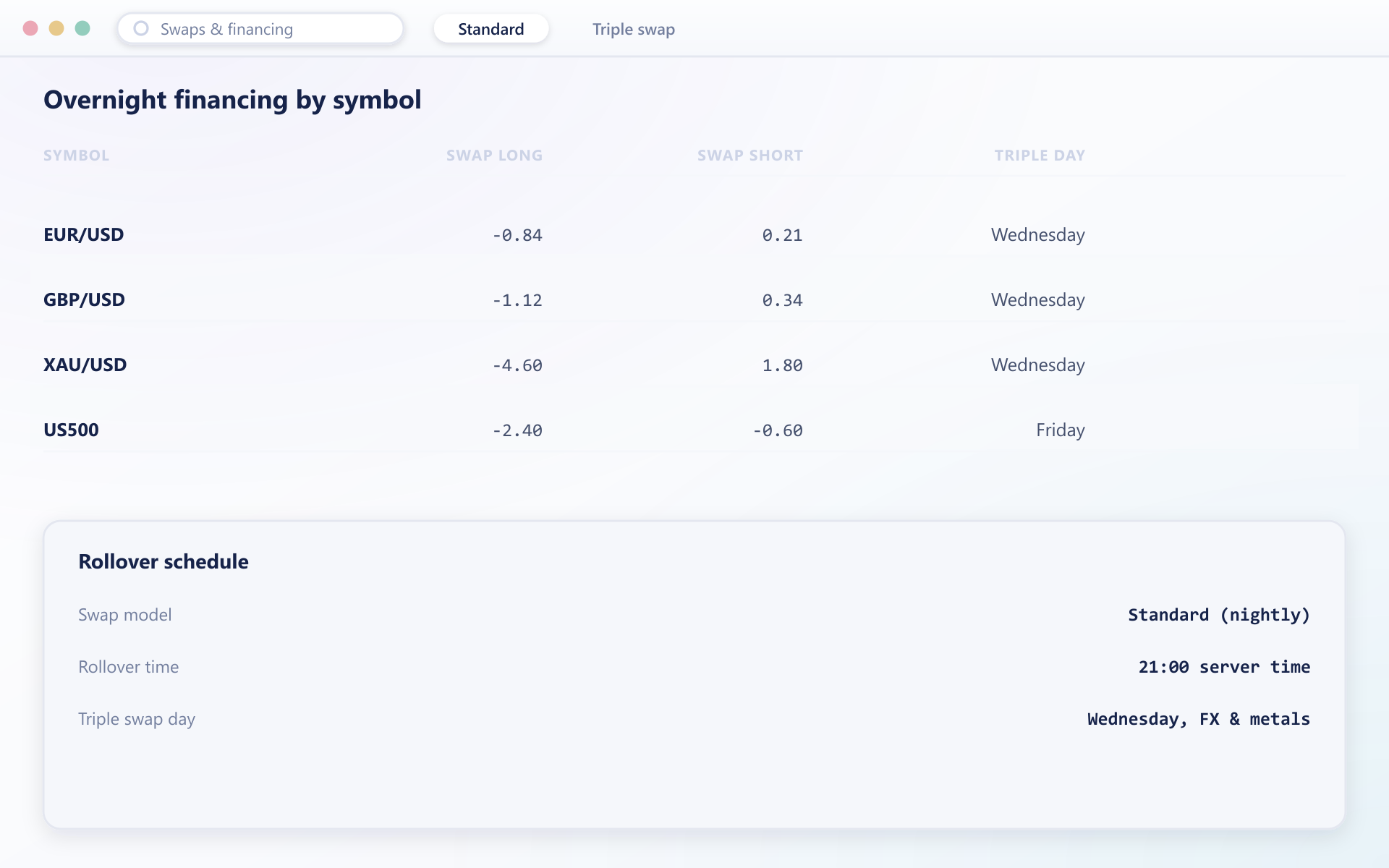
Setting and applying a financing rate
Each layer narrows the one above it
Where the number comes from, and how it reaches the client’s balance.
- Setting
Rates on the instrument
Long and short rates are entered against the instrument along with the financing currency and the rollover time. This is the default every group inherits.
- Overriding
Groups can differ
A group override replaces the instrument rate for clients in that group, which is how a preferential institutional arrangement is expressed.
- Exempting
Swap-free where required
A group marked swap-free is skipped at rollover. Where you charge an alternative administration fee instead, that is applied on its own schedule.
- Applying
Charged at rollover, reported after
At the instrument's rollover time the applicable rate is applied to open positions and written as a ledger entry, which feeds reporting directly.
What deliberate financing achieves
Carry is both a revenue line and a way to influence how the book leans.
Steady revenue
Income from held positions continues between active trading periods, which smooths the revenue curve considerably.
Influence the book
Adjusting one side's rate changes the cost of holding it, which shifts client behaviour without a hard restriction.
Serve more clients
Swap-free handling opens the platform to segments that would otherwise be unable to trade with you.
Institutional flexibility
Group overrides let a specific counterparty be given bespoke carry terms without disturbing anything else.
FAQ
Swaps and financing: common questions
5 short answers to what teams ask before a demo.
Yes. Instrument rates act as the default, and any group can override them. This is how preferential institutional terms are offered without altering what every other client pays.
A client group can be marked swap-free, in which case it is skipped at rollover. Where your commercial model calls for an alternative administration charge instead, that is configured separately with its own schedule.
The financing currency configured on the instrument, so the charge lands on the balance that makes sense for the position rather than being converted unnecessarily.
They can be maintained manually or updated from a reference you supply. Automated updating keeps rates aligned with the underlying market rather than drifting after a rate change.
Yes. Because each financing charge is its own ledger entry, carry revenue is an independent reporting line broken down by instrument and client group.
Still have a question?
A specialist will answer it directly, with your set-up in mind.
Ask a specialist