BTC / USDT · Perpetual
Funding in 02:41Mark price
64,182.40
Index
64,179.85
Funding rate
+0.0091%
Max leverage
20×
Margin health
Healthy
Warning
Restricted
Reduction
Supported Markets
Leveraged digital assets, with the risk engine doing the work
Margin pairs and perpetual contracts share the platform with everything else. Leverage caps, funding mechanics, mark pricing and liquidation logic are configuration, and all of it runs continuously rather than on a schedule.
Staged, not sudden
Four levels, and most accounts never reach the fourth
Healthy
Full trading
Warning
Client notified, nothing restricted
Restricted
Exposure-increasing orders refused
Reduction
Positions reduced in steps
See it live
Chart, book and funding rate on one screen
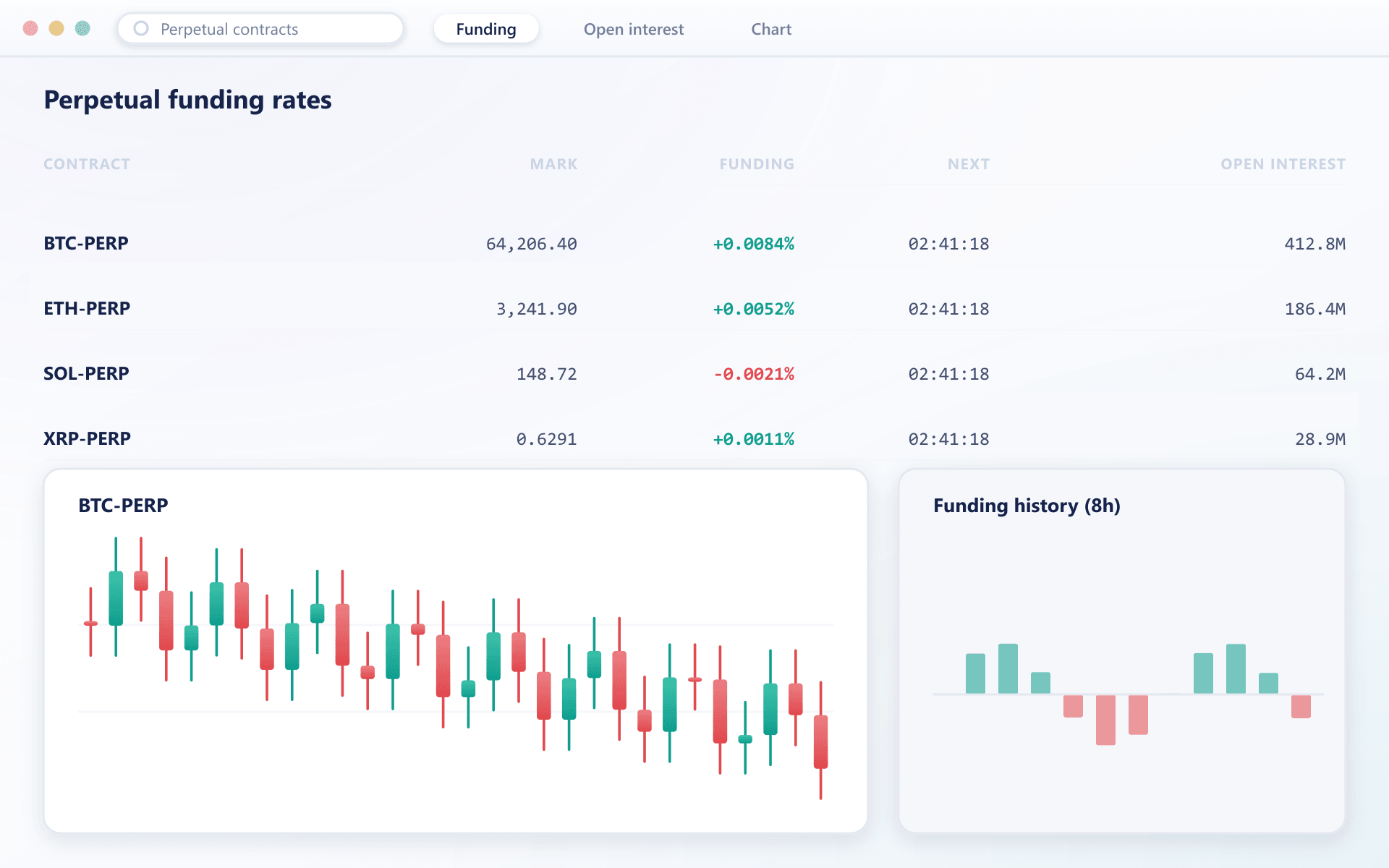
A perpetual market dashboard shows the mark price, order book and funding-rate history described on this page, all in one view.
What makes leverage safe to offer
Leverage on volatile assets is only viable when the risk machinery is genuinely continuous.
Leverage caps per instrument
Each contract carries its own maximum leverage and notional bands, so a major asset and a thin one are not treated alike.
Funding you configure
Interval, rate bounds and the calculation inputs are all settings. Funding payments are written to the ledger like any other charge.
Mark price sourcing
The mark used for valuation and liquidation comes from the feed you nominate, which prevents a thin local book from triggering liquidations.
Continuous evaluation
Margin health is recomputed on every price update rather than on a timer, which is what stops a fast move becoming a deficit.
FAQ
Crypto derivatives: common questions
5 short answers to what teams ask before a demo.
Within bounds you configure, from the inputs you nominate for that contract. Both the interval and the maximum rate in either direction are settings rather than fixed behaviour.
A mark price sourced from the feed you nominate, rather than the last traded price in the local book. This prevents a thin moment in your own book from triggering liquidations that the wider market does not justify.
It does not have to be. Staged liquidation reduces a position progressively to restore margin health, attempting a full close only if that fails. Each step is recorded separately in the event log.
On every price update for the instrument. Nothing waits for a scheduled job, which is what keeps a fast move from producing a deficit before the engine reacts.
Yes. Maximum leverage and the notional bands that step it down are per-instrument settings, and client groups can tighten them further.
Still have a question?
A specialist will answer it directly, with your set-up in mind.
Ask a specialistWatch a liquidation happen safely
On a demo environment we will walk a position through warning, restriction and staged reduction so you can see the whole sequence.