For Crypto Brokers
A funding mechanism that can be explained, not just applied
The rate is computed from inputs you configure, clamped to bounds you set, and published with its history so a client can see what they will pay before the interval settles.
Recent intervals
PublishedThe next interval’s estimate is visible while it is still forming
What makes a funding mechanism credible
Traders will accept a charge they can predict, and not one they cannot
Configurable inputs
Which components feed the rate — premium to index, an interest component, or both — is a setting rather than fixed behaviour.
Clamping bounds
A maximum rate in each direction prevents an extreme reading from producing a charge that damages the market you are trying to build.
Predicted rate
The current running estimate for the next interval is shown in the terminal, so a trader knows what holding will cost before it does.
Published history
Past rates per contract are retained and visible, which is what lets a trader judge the cost of a strategy over time.
Separate reporting
Funding is reported as its own revenue line, distinct from commission and markup, per contract and per client group.
See it live
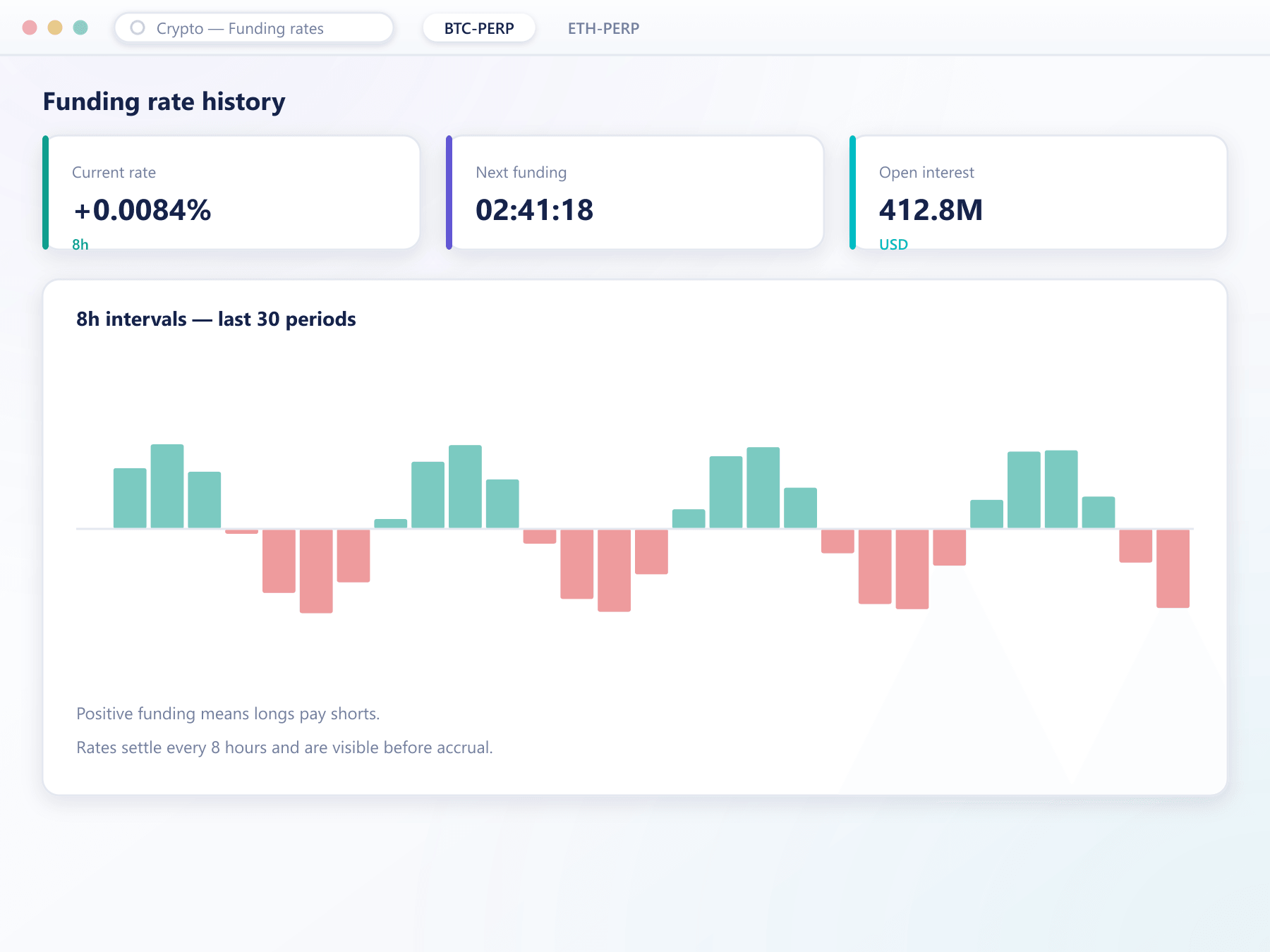
Funding history a trader can price into a strategy
KPI tiles and a cumulative chart show what funding has actually cost or paid over time, the same figures your revenue reporting draws on separately.
Computing and applying a rate
The sequence that runs at every funding interval
- Inputs
Components are sampled
The configured components are sampled across the interval rather than at a single moment, which stops a brief spike from setting the rate.
- Computation
Combined and clamped
Components are combined by the configured formula and the result is clamped to the bounds set on the contract.
- Publication
Shown before it applies
The running estimate is published throughout the interval so traders can act on it, and the final rate is published when the interval closes.
- Settlement
Transferred between sides
The payment moves between long and short holders in proportion to position size, with a ledger entry on each account.
What a predictable rate produces
Funding is a mechanism first and a revenue line second, and treating it the other way round breaks the market.
Markets that hold their anchor
A rate that responds proportionally keeps the contract tracking its underlying without heavy-handed intervention.
Professional participation
Basis traders and market makers need predictable funding to operate, and they are the participants that create depth.
Fewer disputes
A published estimate and a retained history mean a funding charge is rarely a surprise.
Visible economics
Separate reporting shows what funding actually contributes, which informs whether a contract is worth maintaining.
FAQ
Funding rates: common questions
5 short answers to what teams ask before a demo.
From the components you configure — typically the premium of the contract to its index, optionally with an interest component — combined by the configured formula and clamped to the bounds set on the contract.
Yes. A running estimate for the current interval is published in the terminal throughout, and the final rate is published when the interval closes, so the cost of holding is known in advance.
Without them, an unusual moment in the market can produce a charge severe enough to drive participants away. Clamping keeps the mechanism corrective rather than punitive.
No. Components are sampled across the interval, which prevents a brief price spike near the settlement time from determining the rate for everyone.
Funding transfers between long and short position holders. Where your commercial model takes a share, that is configured explicitly and reported separately so it is never hidden inside the rate.
Still have a question?
A specialist will answer it directly, with your set-up in mind.
Ask a specialistModel your funding mechanism
We will configure inputs, bounds and interval on a demo contract and run a settlement during the call.