For FX & CFD Brokers
Leverage that responds to size, not just to who is asking
Rather than one figure per account, leverage follows a schedule. As a position crosses configured notional bands the effective leverage steps down, and the margin requirement is computed before the order is accepted.
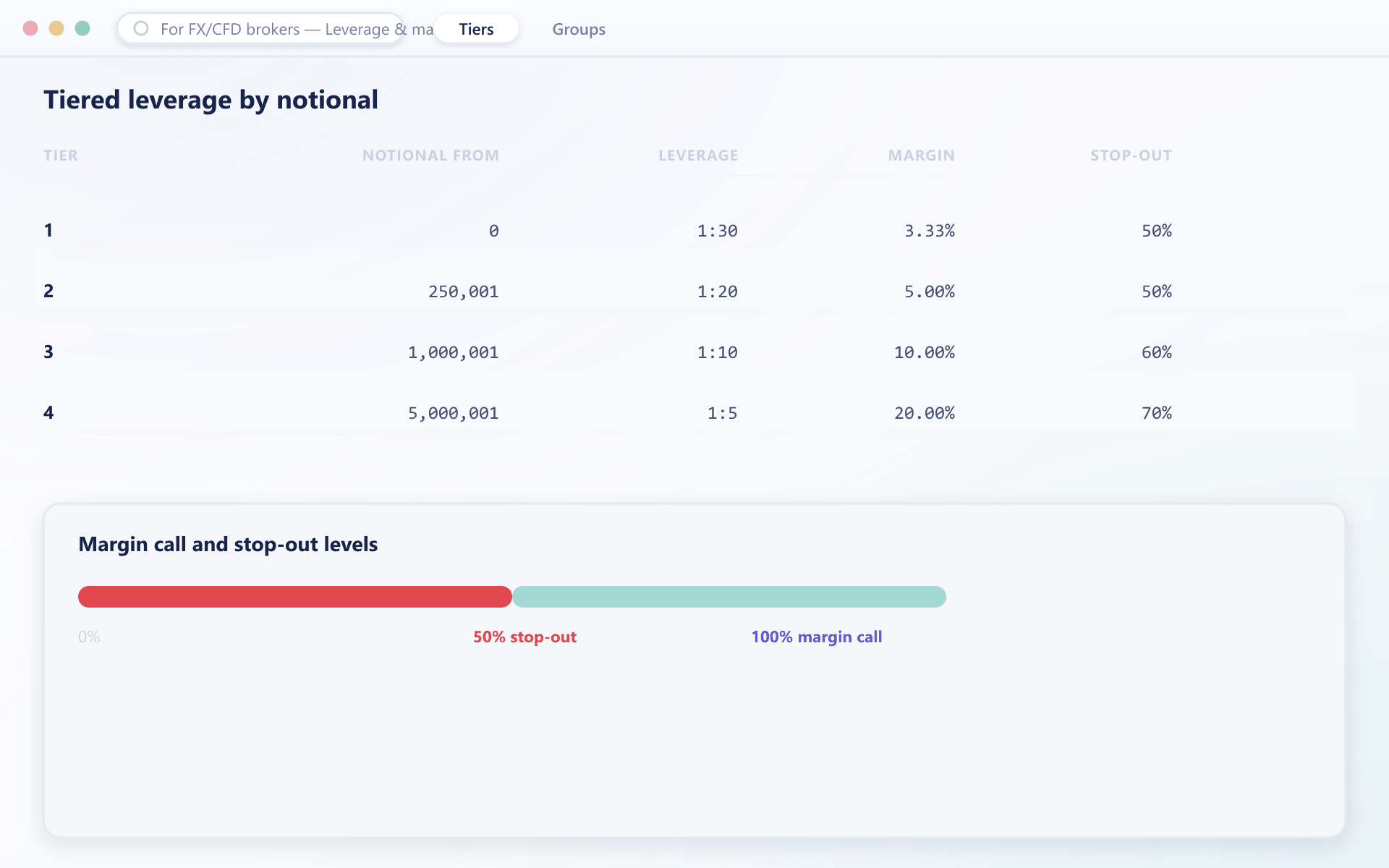
As the position grows, the leverage steps down
Illustrative bands. Thresholds and figures are configured per instrument, then capped per client group.
How leverage is actually decided
The interesting part is not the maximum figure but how it behaves as a position grows
Notional bands
Each instrument carries bands of position size, with a leverage figure per band. Crossing a band applies the lower figure to the portion above it.
Group caps
A client group can cap leverage below the instrument schedule, which is how jurisdiction limits are enforced structurally.
Cross or isolated
Choose whether margin is shared across the account or ring-fenced per position, configured per client group.
Computed at submission
The requirement for the resulting position is calculated before acceptance, so an order that would open an immediately unhealthy position never opens.
Shown to the trader
The ticket displays the effective leverage and the margin the order will consume for the size being entered.
See it live
Leverage tiers, set once per client group
The notional bands and group caps described here are configured from one screen, with swap and rollover settings for the same group sitting right beside them.
Working out one order’s margin
Four inputs, narrowing to a single answer
- Schedule
Start from the instrument bands
The instrument's notional bands give a base leverage figure for the resulting position size, applied progressively rather than as a single cliff.
- Group
Apply the group cap
If the client's group caps leverage below the schedule, the cap wins. The effective figure is always the stricter of the two.
- Mode
Cross or isolated changes the base
In cross mode the whole account's eligible collateral supports the requirement. In isolated mode only the margin allocated to that position does.
- Decision
Accept, or reject with a reason
If available collateral covers the requirement the order proceeds. If not, it is rejected naming the shortfall rather than failing generically.
What band-based leverage prevents
Flat leverage is the reason most desks discover concentration risk after the fact.
Stricter of two always winsConcentration contained
Large positions consume proportionally more margin, which slows the accumulation that causes real losses.
Competitive small sizes
Attractive leverage at typical trade sizes without exposing the book to the tail.
Regulatory compliance
Group caps enforce jurisdiction limits in the engine rather than through a policy document.
Fewer surprises
Because the ticket shows the effective figure, clients stop being surprised by their margin requirement.
FAQ
Leverage and margin: common questions
5 short answers to what teams ask before a demo.
Each instrument defines bands of position size with a leverage figure for each. As a position grows into a higher band, the lower leverage applies to the portion in that band, so the effective leverage declines progressively rather than dropping at a single cliff.
Yes, and this is how jurisdiction caps are enforced. Where the group and the instrument schedule disagree, the stricter figure always applies.
In cross mode the whole account's eligible collateral supports every position, so a profitable position can sustain a losing one. In isolated mode margin is ring-fenced per position, capping the loss on that position at the margin allocated to it.
At order submission, for the position that would result. This prevents an order from opening a position that is already inside the liquidation zone.
Yes. The ticket displays the effective leverage and the margin the order will consume for the size being entered, updating as the size changes.
Still have a question?
A specialist will answer it directly, with your set-up in mind.
Ask a specialistConfigure your leverage schedule with us
Bring your current leverage tiers and jurisdiction limits and we will model them as bands and caps.